Why Your Ledger Lies (And What to Trust Instead)
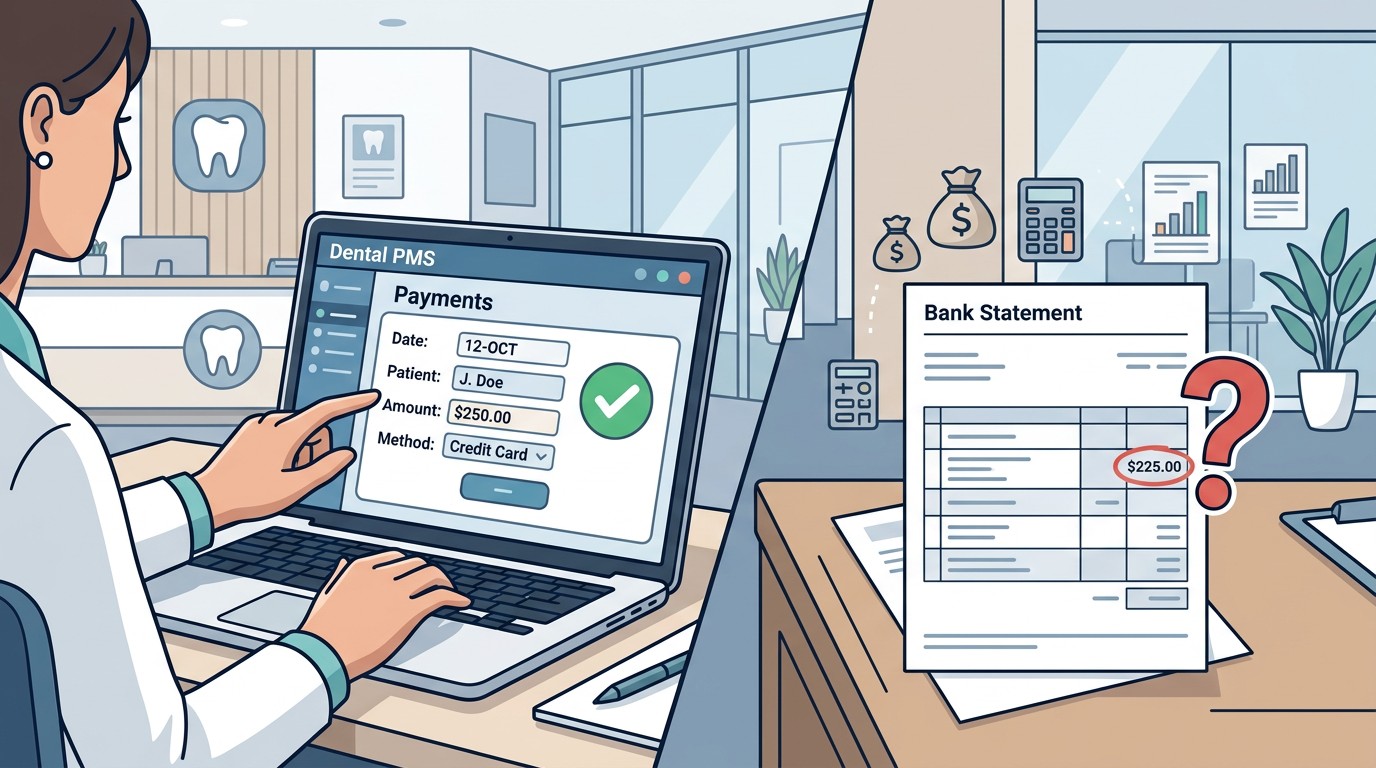
You can type anything into your practice management system. It will believe you every time.
📚 Part of our reconciliation series: This article is part of The Complete Guide to Dental Practice Reconciliation, our comprehensive resource on closing your books accurately and preventing revenue leakage.
The Fundamental Problem
There is an old saying in accounting: paper does not refuse ink. You can write anything on a ledger, and the ledger will accept it. The paper does not verify. It does not question. It simply records whatever you put there.
Your practice management system works exactly the same way. Enter a $500 payment, and the system records a $500 payment. Enter $5,000, and it records $5,000. Enter $50, and it records $50. The software has no way to know whether any of these entries reflect reality. It trusts the human completely.
This design makes sense from a software perspective. A PMS needs to be flexible. Unusual transactions happen. Corrections need to be made. You cannot build a system that rejects entries just because they seem unusual.
But this flexibility creates a fundamental problem for practice owners who rely on their PMS as the source of truth for their finances. The system will tell you exactly what it was told. It cannot tell you whether what it was told is accurate.
What Your System Actually Knows
When you pull a collections report from your PMS, you are not seeing what your practice collected. You are seeing what someone entered as collections. These two things should be the same, but they often are not.
Your PMS knows that on Tuesday at 2:47 PM, someone logged in and entered a $350 payment for patient Smith, coded as a credit card payment for account number 12345. That is the extent of its knowledge. It does not know whether a credit card was actually charged. It does not know whether $350 actually settled to your merchant account. It does not know whether the payment should have been $350 or $335 or $380.
The entry might be perfectly accurate. The entry might be completely wrong. The entry might be intentionally falsified. Your PMS cannot distinguish between these scenarios. It records the input and moves on.
This is not a flaw in your software. It is the nature of any data entry system. Inputs determine outputs. If the inputs are wrong, the outputs are wrong. Garbage in, garbage out.
How Errors Enter the System
Errors enter your ledger through multiple pathways, most of them mundane rather than malicious.
Typos happen constantly. A staff member means to enter $125 and enters $152. They mean to enter $1,200 and enter $120. A decimal point lands in the wrong place. A digit gets doubled or dropped. In a busy front office processing dozens of transactions daily, some percentage will contain entry errors.
Wrong patient attribution happens when payments get posted to incorrect accounts. The insurance payment for John Smith goes to Jon Smith. The copay for Mary Johnson goes to Mary Johnston. These errors create false balances for patients who paid and false credits for patients who did not.
Incorrect payment types cause reconciliation problems downstream. A check gets entered as cash. A credit card gets entered as a check. These miscategorizations make it impossible to match payments to deposits accurately.
Duplicate entries occur when someone posts a payment, gets interrupted, forgets they posted it, and posts it again. The patient now shows a credit they do not actually have. Eventually someone might issue a refund for money that was never collected twice.
Missing entries are perhaps the most common problem. A payment happens but never gets entered. The patient shows a balance they do not owe. The practice shows lower collections than it actually achieved. The money is in the bank, but the ledger does not reflect it.
None of these errors require bad intent. They happen because humans make mistakes, systems get busy, and paper — digital or otherwise — does not refuse ink.
When Errors Become Invisible
The danger of a ledger that accepts anything is that errors become invisible once entered. They look exactly like accurate entries. There is no flag that says "this one might be wrong."
Consider a payment entered as $280 when the actual amount was $380. That entry sits in your system looking perfectly normal. The patient account shows $280 received. Your daily report shows $280 collected. Your monthly totals include that $280. Everything balances internally because the system believes itself.
The $100 difference is simply gone. Not stolen exactly — it probably reached your bank account. But unaccounted for. A credit that exists in reality but not in your records. It might surface eventually as an unexplained variance, or it might never surface at all.
Multiply this by hundreds or thousands of transactions over months and years. Each small error compounds into significant discrepancies. But because each individual entry looks valid, and because the system accepts whatever it is told, no alarm bells ring.
The practice owner reviewing reports sees numbers that add up. The columns balance. The totals look reasonable. Everything appears fine. The report does not show how many of those balanced numbers are based on incorrect inputs.
The Trust Problem
When you run your practice based on PMS reports, you are placing enormous trust in the accuracy of every data entry. You trust that every payment was entered. You trust that every payment was entered correctly. You trust that every payment was attributed to the right patient. You trust that every payment was categorized properly.
That is a lot of trust. And it is trust placed in a process with no verification mechanism.
Consider how this would work in other contexts. Would you trust a bank that never verified deposits against actual cash received? Would you trust an accountant who recorded whatever clients told them without checking documentation? Would you trust an auditor who accepted records at face value without testing them?
In every other financial context, verification is standard practice. Records get checked against external sources. Entries get confirmed against documentation. Trust exists, but it gets verified.
Yet in most dental practices, the ledger operates on pure trust. Staff enter payments. The system records them. Reports get generated. Decisions get made. At no point does anyone systematically verify that the ledger matches reality.
The Verification Imperative
Paper may not refuse ink, but that does not mean you have to accept ink at face value. The solution is external verification — comparing your ledger entries against sources that actually know what happened.
Your credit card processor knows exactly what charges were made, what amounts were authorized, and what funds were deposited. That knowledge exists independently of your PMS. Comparing processor records to ledger entries reveals discrepancies: payments charged but not entered, amounts that do not match, transactions that show in one system but not the other.
Your bank knows exactly what deposits hit your account and for what amounts. That knowledge exists independently of your PMS. Comparing bank deposits to daily collection totals reveals discrepancies: posted collections that never deposited, deposits that exceed posted payments, timing gaps that need explanation.
Your insurance payers know exactly what they paid and for which patients. ERAs and EOBs document every payment in detail. Comparing these documents to ledger postings reveals discrepancies: payments received but not posted, amounts that do not match, patients attributed incorrectly.
These external sources are the verification your ledger lacks. They are the reality check that pure data entry cannot provide. When your ledger agrees with external sources, you can trust it. When it disagrees, you have found a problem.
Why Practices Skip Verification
If verification is so important, why do most practices skip it?
Time is the most common excuse. Comparing ledger entries to merchant statements, bank deposits, and EOBs takes hours weekly if done manually. Practices are busy. Staff have other responsibilities. Reconciliation gets pushed to "when we have time," and that time never comes.
Complexity is another factor. Matching hundreds of transactions across multiple systems requires organization and attention to detail. It is not difficult conceptually, but it is tedious and easy to do poorly. Staff assigned to reconciliation often lack training in what to look for and how to investigate discrepancies.
Trust substitutes for verification in many practices. The owner trusts the staff. The staff have been there for years. Nothing obvious has gone wrong. So verification seems unnecessary — a waste of time confirming what everyone already knows.
Denial plays a role too. Some owners do not want to know if problems exist. Verification might surface uncomfortable findings. Not verifying lets everyone assume things are fine.
None of these reasons are good enough. The risk of unverified records exceeds the cost of verification. The question is not whether to verify, but how to verify efficiently.
Building Verification Into Operations
Systematic verification does not have to consume your week. It needs to be built into operations as a standard process rather than an occasional effort.
Daily verification catches problems while they are fresh. Comparing yesterday's deposits to yesterday's posted payments takes minutes when done consistently. Discrepancies surface immediately when details are still available and memories are clear.
Automated matching eliminates most manual comparison. Software that connects to merchant processors, banks, and clearinghouses can compare thousands of transactions without human effort. Staff attention focuses only on the exceptions — the transactions that do not match automatically.
Exception-based workflows mean you are not reviewing everything, just the problems. When 95% of transactions match automatically, staff spend their time on the 5% that need investigation. This is dramatically more efficient than reviewing every transaction manually.
Clear accountability ensures verification actually happens. Someone owns the process. They are responsible for completing it on schedule and escalating unresolved discrepancies. Reconciliation does not fall through cracks because nobody is watching.
The investment in systematic verification pays for itself through errors caught, money recovered, and problems prevented. Paper may not refuse ink, but you can refuse to trust ink without verification.
The Bottom Line
Your PMS is an essential tool, but it is not a verification system. It records what it is told and trusts that input completely. This design is appropriate for flexible data entry but inappropriate for financial controls.
Running your practice based solely on unverified ledger data is running blind. You see numbers that might be accurate or might be fiction. You make decisions based on reports that might reflect reality or might reflect accumulated errors. You trust a system that lacks any mechanism for confirming its own accuracy.
The alternative is verification: systematic comparison of ledger entries against the external sources that actually know what happened. This verification transforms your ledger from accepted-on-faith to confirmed-accurate. It is the difference between hoping your numbers are right and knowing they are right.
Paper does not refuse ink. But you can refuse to accept ink until it is verified.
Zeldent connects to your merchant processor, bank, and insurance clearinghouse to verify every transaction against your PMS records. We catch the discrepancies that unverified ledgers hide. Schedule a demo to see what verification reveals.