Unbilled Encounters: The Revenue Leak Nobody Tracks
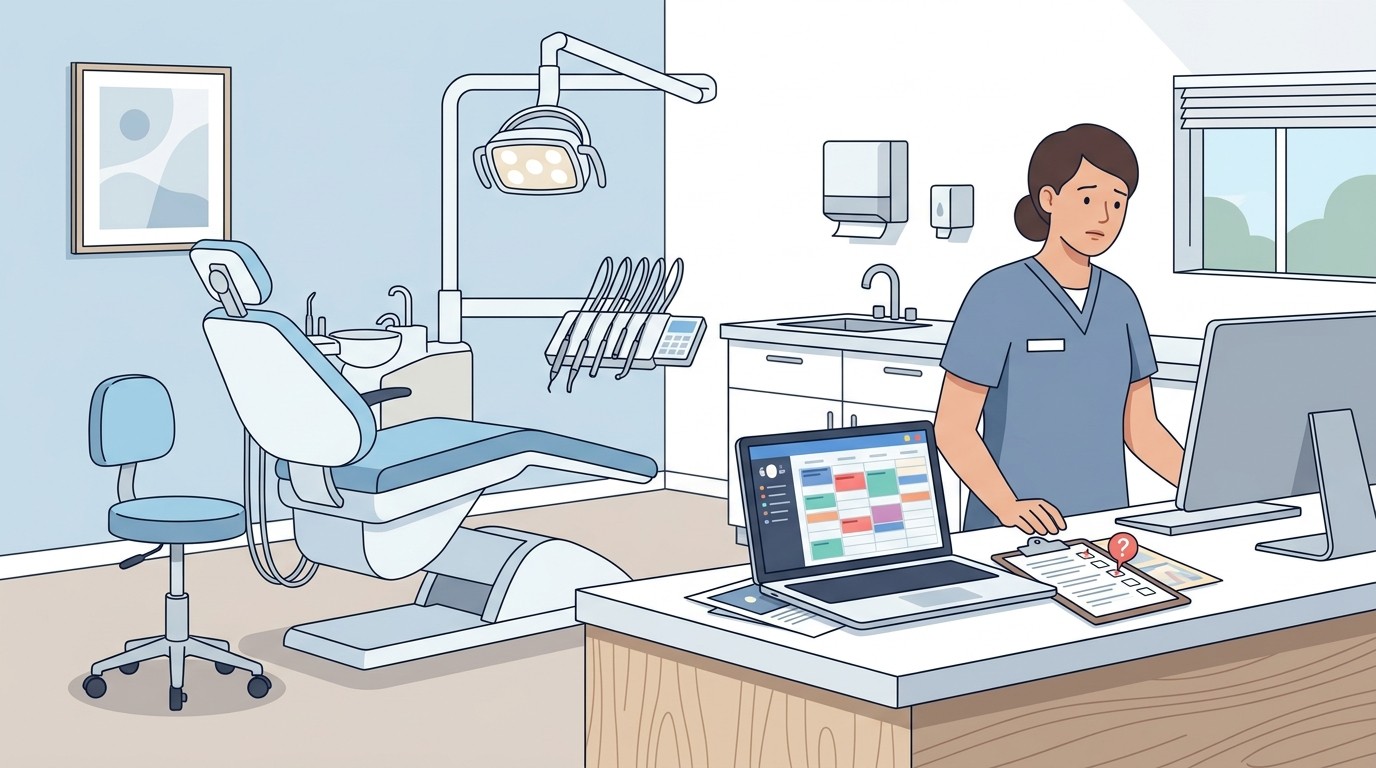
The patient was seen. The appointment shows completed. But no charges were entered. This happens more often than you would expect.
Revenue leakage has many forms. Insurance underpayments. Credit card batches that settle short. Payments posted but never deposited. These problems get attention because they involve money that was supposed to arrive and did not.
Unbilled encounters are different. The money never enters the system at all. A patient receives treatment, leaves satisfied, and no claim is generated. No charge appears on their ledger. The practice performed work and collected nothing for it.
This is the revenue leak nobody tracks because there is no record to review. The absence of a charge does not trigger an alert. It just looks like a day with slightly lower production than expected.
📚 Part of our reconciliation series: This article is part of The Complete Guide to Dental Practice Reconciliation, our comprehensive resource on closing your books accurately and preventing revenue leakage.
This article explains how unbilled encounters happen, why they go undetected, and what practices can do to catch them.
How Unbilled Encounters Occur
Unbilled encounters happen through workflow gaps, not malicious intent. Understanding the mechanisms helps identify where your practice might be vulnerable.
The most common cause is interrupted workflows. A patient checks in, gets taken back for treatment, and the front desk intends to complete the billing after the appointment. Then the phone rings. Another patient arrives early. A question requires immediate attention. The billing step gets skipped, and no one remembers to return to it.
Hand-off failures create similar gaps. The clinical team completes treatment and expects the front desk to handle billing. The front desk assumes clinical staff entered the charges. Neither side confirms. The patient checks out, perhaps paying a copay that was estimated in advance, and the actual services rendered are never documented.
Same-day additions cause problems. A patient comes in for a scheduled cleaning and the dentist discovers a cavity that can be filled immediately. The cleaning was pre-scheduled and billed in advance. The additional filling requires a separate charge entry. That additional step gets missed.
No-charge visits that should have charges slip through. A patient comes in for a quick adjustment or recement. The team treats it as a courtesy visit. But the procedure performed actually warranted a billable code. The informal decision to not charge is never questioned.
Staff training gaps contribute. New employees may not fully understand the billing workflow. They complete the clinical documentation but miss the charge entry step because no one explicitly trained them on it. By the time someone notices the pattern, weeks of unbilled encounters may have accumulated.
Why These Go Undetected
Traditional practice metrics do not catch unbilled encounters directly.
Production reports show what was billed. If an encounter was never billed, it does not appear on the production report. The report looks normal because the missing revenue was never counted.
Collection reports compare what was billed to what was collected. An unbilled encounter has no billing to compare against. Collections might be 98% of production, which looks healthy, while actual services rendered exceeded production by 5%.
Accounts receivable tracking watches for unpaid charges. An unbilled encounter has no receivable. There is nothing to age, nothing to follow up on, nothing to collect.
The patient is satisfied and unlikely to complain. They received care. They may have paid a copay or been told insurance would cover it. They have no reason to call and ask why they were not charged for a service.
The clinical team knows they provided care but has no visibility into billing. They assume the front desk handled it. The front desk has no visibility into exactly which procedures were performed. They assume clinical staff documented everything correctly.
No single person has the complete picture. The gap falls between responsibilities, invisible to everyone.
The Scale of the Problem
How many encounters go unbilled at a typical practice?
The honest answer is that no one knows precisely, because the nature of the problem is that it goes untracked. But indicators suggest it is more common than practice owners assume.
Practices that implement systematic encounter auditing typically find a discrepancy rate of 1 to 3 percent between appointments marked complete and charges actually entered. For a practice seeing 30 patients per day, that might be one unbilled encounter every day or two.
The dollar impact depends on what services are missed. A missed prophy is $150. A missed filling is $200 to $400. A missed crown is $1,000 or more. If a practice misses one $250 service per day, that is $5,500 per month or $66,000 per year in unrecovered revenue.
And because these are services already rendered, the cost has already been incurred. The provider's time, the materials, the operatory usage. The expense happened. Only the revenue did not.
Where the Gaps Hide
Certain situations create higher risk for unbilled encounters.
Multi-provider practices have more hand-offs and more opportunities for gaps. An associate provides treatment that the practice owner would normally bill. The associate assumes the system handled it. The practice owner never sees the patient and never thinks to verify.
New patient visits involve more moving parts. Insurance verification, treatment planning, case presentation, same-day treatment. Each step is an opportunity for the billing step to be dropped.
Emergency and add-on appointments disrupt normal workflows. The patient was not on the schedule. The clinical team fits them in between other patients. The front desk may not realize they were seen at all.
End-of-day rushes create pressure to move quickly. The last patient of the day gets treated as everyone is trying to leave. Charge entry gets deferred until tomorrow. Tomorrow, no one remembers.
Staff transitions increase risk. When the usual billing person is out, coverage staff may not know the complete workflow. When new staff are onboarding, they may miss steps that were not explicitly documented.
How to Find Unbilled Encounters
Detecting unbilled encounters requires comparing what happened clinically to what was billed financially.
The simplest approach is manual audit. Each day, compare the day's appointment list to the day's charge entries. Every appointment marked as completed should have a corresponding charge. Discrepancies indicate potential unbilled encounters.
This manual audit is tedious and rarely sustained. Staff start with good intentions, audit diligently for a week, then gradually stop as other priorities take over.
Automated comparison is more reliable. Software can match appointments to charges systematically. When an appointment is marked complete but no charge exists, an alert fires. The comparison happens automatically without requiring manual review.
Time-based detection catches delayed billing. An appointment completed today should have charges by the end of today or first thing tomorrow. An appointment from three days ago with no charge is almost certainly unbilled rather than pending.
Provider-level tracking identifies patterns. If one provider consistently has more unbilled encounters than others, the issue may be a workflow gap specific to how that provider operates.
Recovering Unbilled Revenue
When you identify an unbilled encounter, recovery depends on timing.
Same-day identification is ideal. The patient was just seen. Staff memory is fresh. The charge can be entered and billed immediately with full accuracy.
Next-day identification is still straightforward. Review clinical notes from yesterday, enter the missing charges, and bill normally.
Week-old encounters become harder. Insurance may question the delay between service date and billing date. Clinical notes must be consulted because staff no longer remember details.
Month-old encounters are difficult. Documentation may be incomplete. Timely filing limits may apply. The recovery rate drops significantly.
This is why detection speed matters. A systematic daily check catches nearly everything while recovery is still easy. Sporadic auditing catches only a fraction, and much of what is found may be unrecoverable.
Building a Detection System
An effective detection system has several components.
Appointment-to-charge matching should happen automatically. At end of day, every completed appointment should have a corresponding charge. Mismatches should generate a review task, not a silent log entry.
Clear ownership prevents hand-off failures. Someone specific should be responsible for confirming that every patient seen today was billed today. That responsibility should be documented and monitored.
Provider verification adds a check. Before providers leave for the day, they should confirm their patients were billed. A quick review of the day's charge entries takes two minutes and catches most gaps.
New staff training should explicitly cover billing workflows. Do not assume new team members understand the process. Document it. Train it. Verify it.
Exception tracking builds accountability. When an unbilled encounter is found, document it. Track patterns over time. Identify whether the problem is systemic or isolated.
The Larger Lesson
Unbilled encounters illustrate a broader truth about dental practice revenue: you cannot manage what you do not measure.
Most practices measure production, collections, and accounts receivable. These metrics assume that services rendered equal services billed. When that assumption is wrong, the metrics provide false confidence.
True revenue integrity requires measuring the gap between what happens clinically and what appears financially. Unbilled encounters are one form of that gap. Insurance underpayments are another. Posting errors are another. Each gap requires its own detection mechanism.
The practices that capture all their revenue are not necessarily the ones with the best teams or the best systems. They are the ones who verify systematically rather than trust implicitly.
Ready to catch unbilled encounters automatically? See how Zeldent matches appointments to charges and alerts you when something was missed.