De Novo vs Acquisition: Financial Systems Differences for DSOs
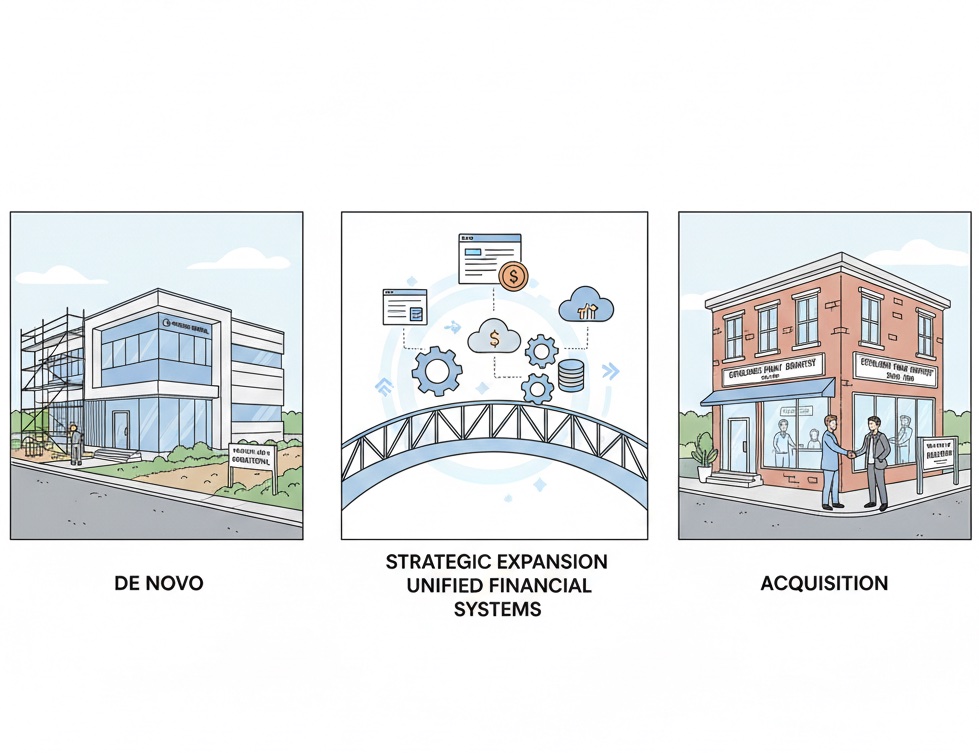
Building a new practice from scratch gives you a blank slate. Acquiring an existing practice gives you immediate production. The financial systems approach for each is fundamentally different.
📚 Part of our DSO series: This article is part of The DSO Financial Operations Playbook, our comprehensive guide to building scalable financial operations across multiple dental practice locations.
Two Fundamentally Different Growth Paths
DSOs grow through two primary paths, and each has distinct implications for financial systems that are often underestimated during planning.
De novo growth means opening a new practice location from scratch with no patients, no staff, no history, and no legacy systems. You start with nothing and build everything according to your standards.
Acquisition means purchasing an existing practice that comes with patients, staff, history, and whatever systems were already in place. You get immediate production but inherit whatever mess existed before.
Each path creates fundamentally different financial system challenges. Understanding these differences helps DSOs plan appropriately and avoid costly surprises that derail growth timelines.
The De Novo Approach to Financial Systems
The blank slate that comes with de novo development offers significant advantages for financial systems. You can choose your preferred practice management system without compromise. You can implement standard processes from day one rather than fighting legacy habits. You can train staff on your procedures without having to unteach old approaches. There is no legacy data requiring migration and no bad habits that need to be unlearned.
The challenges are equally real. Everything must be built from zero, which requires time and resources. There is no cash flow during the ramp-up period, meaning corporate must fund operations until the location becomes self-sustaining. New staff face a learning curve that affects initial performance. The timeline to profitability is longer than acquisition, which affects overall investment returns.
The implementation timeline for de novo financial systems typically spans eight to twelve weeks before opening. In the early weeks, the focus should be on selecting and contracting with the PMS vendor, ordering necessary hardware and equipment, beginning clearinghouse enrollment for insurance claims, and setting up bank accounts with appropriate configurations.
During the middle phase of preparation, install and configure the practice management system, configure payment processing including credit card terminals and integration with the PMS, set up insurance enrollments and payer connections, and implement accounting system integration so financial data flows properly.
In the final weeks before opening, test all systems thoroughly to identify problems before patients arrive, train staff comprehensively on every aspect of operations, verify bank connections are working correctly for deposits and EFTs, and conduct soft launch operations to work through any remaining issues.
On opening day, all systems should be operational and verified, staff should be trained and comfortable, processes should be documented for reference, and the location should be genuinely ready for patients rather than scrambling to figure things out while patients wait.
For de novo locations, PMS selection should default to your standard DSO platform to ensure compatibility with corporate systems, simplify support and training, and enable portfolio-wide reporting without translation between systems. Banking should be added to your existing banking relationship with EFT enrollment configured from the start, remote deposit capability if appropriate, and integration with treasury management systems.
Reconciliation should be implemented from day one using automated processes. With no legacy issues to clean up, you can establish standard processes immediately and give corporate immediate visibility into the new location's financial activity.
The chart of accounts should follow your standard DSO structure to ensure comparability across locations and simplify consolidation for financial reporting. Reporting should use standard formats from opening day so the new location is immediately included in portfolio reporting with consistent metrics definitions.
Controls should implement your standard framework from the beginning. With no legacy control weaknesses to address and staff trained on expectations from day one, the location should be audit-ready from the start.
De novo locations face specific challenges that require attention. Cash flow management is critical because the location will have negative cash flow during ramp-up and requires corporate funding. Careful budget management and monitoring against projections helps ensure the location reaches profitability on the expected timeline.
Staffing finance functions may be challenging if you cannot hire an experienced office manager immediately. Training investment is required, and more corporate support is typically needed during the initial period.
Limited data for analysis means you have no historical trends to reference for the new location. Benchmarking against other locations in the portfolio provides context, but patience is required during the ramp-up period before meaningful trends emerge.
The Acquisition Approach to Financial Systems
Acquisitions come with baggage that must be addressed regardless of how attractive the deal appears.
What you inherit includes the existing PMS which may not be your standard platform, existing processes which may not match your standards, existing staff who may resist change, historical data of unknown quality, and legacy issues that were often not fully disclosed during due diligence.
What you must accomplish includes assessing the current state accurately, maintaining operations during the transition period, migrating to standard systems if necessary, cleaning up legacy issues, and integrating the location into your portfolio.
Pre-acquisition assessment should evaluate the practice thoroughly before you commit to purchase. Systems assessment should determine what PMS is in use, how clean the data is, what integrations exist, and what transition will require. Financial assessment should examine reconciliation status, unidentified deposits, accounts receivable quality, and credit balance situation. Process assessment should document end-of-day procedures, reconciliation practices, documentation quality, and staff capabilities.
The integration timeline for acquisitions spans several phases. Before closing, document current systems thoroughly, identify integration requirements, plan the transition timeline realistically, and budget appropriately for migration costs.
During the first four weeks after closing, immediate actions should include securing access to all systems, implementing critical controls that cannot wait, beginning daily reporting to corporate, and establishing clear communication with the staff. Stabilization during this period means verifying banking information is correct and secure, implementing deposit verification, beginning cleanup of obvious issues, and training staff on highest-priority procedures.
During weeks five through twelve, transition activities include migrating to the standard PMS if you are changing systems, implementing standard processes, completing staff training, and cleaning up legacy issues. Integration activities during this period should achieve full integration into portfolio reporting, implement standard reconciliation, complete historical cleanup, and reach steady-state operations.
The decision whether to migrate PMS platforms is one of the most consequential in acquisition integration. Factors favoring migration include a current system incompatible with corporate reporting, poor data quality that is not worth preserving, an outdated system requiring replacement anyway, and a small or flexible staff who can adapt to change.
Factors against migration include a current system that works well for operations, clean and extensive data that is valuable to preserve, significant migration cost and operational disruption, and staff who strongly prefer the current system and might leave if forced to change.
A hybrid approach is sometimes appropriate where you maintain the current PMS for operations while extracting data to corporate systems for reporting, implementing standard reconciliation as an overlay, and deferring migration until timing improves.
Legacy issues in acquisitions fall into several categories. Data quality issues include unidentified deposits that cannot be matched to patients, unreconciled accounts with unexplained variances, accounts receivable that should have been written off long ago, and credit balances that need refunds or corrections.
Process issues include absent reconciliation procedures, poor documentation practices, weak controls, and inconsistent operations that vary by who happens to be working.
People issues include staff resistance to change, knowledge concentrated in one person creating key-person risk, training gaps that affect quality, and culture differences between the acquired practice and the DSO.
Cleanup priorities should be phased appropriately. During the first thirty days, identify all bank accounts, verify EFT enrollment is correct and secure, establish daily deposit verification, and implement basic controls. During days thirty through ninety, reconcile all accounts to current, research and resolve large unidentified deposits, review and clean credit balances, and implement standard end-of-day procedures. During ninety days through six months, complete historical cleanup, achieve full process standardization, ensure staff is fully trained, and complete integration.
Comparing the Two Paths
The timeline comparison shows fundamental differences. De novo requires eight to twelve weeks of build-out before operations begin, while acquisitions have a due diligence period before closing. De novo locations have systems ready on day one, while acquisitions require a transition period. De novo focuses on ramp-up during stabilization, while acquisitions focus on integration. Full integration takes four to eight weeks for de novo versus twelve to twenty-four weeks for acquisitions.
The cost comparison also differs significantly. De novo financial systems have known PMS setup costs, training included in the ramp-up budget, minimal integration work, and no cleanup required. Acquisition financial systems have pre-acquisition due diligence costs, significant integration effort, potential PMS migration costs, and often substantial cleanup requirements.
The risk comparison highlights different concerns for each path. De novo risks include longer time to positive cash flow, market uncertainty about whether patients will come, patient acquisition challenges, and building a staff from scratch. Acquisition risks include unknown legacy issues that emerge after closing, staff transition challenges, patient retention concerns, and systems integration complexity.
Best Practices for Each Path
De novo best practices start with thorough planning. Complete a comprehensive systems checklist before opening, test everything before seeing patients, and have backup plans for critical functions in case something fails.
Implement your standards from the start without allowing deviations that will create problems later. Train staff on the right way immediately and build good habits from day one before bad habits develop.
Monitor closely during the ramp-up period with daily attention, quick correction of any issues that emerge, and regular corporate check-ins to ensure the location is on track.
Acquisition best practices start with accurate assessment. Conduct thorough pre-acquisition due diligence, develop a realistic integration budget, and maintain a clear-eyed view of the challenges ahead.
Stabilize operations first before attempting changes. Maintain existing operations until you understand them, achieve quick wins on critical controls to demonstrate value and build trust, and earn staff trust before making major changes.
Plan the transition carefully with a clear timeline including milestones, communicate the plan to staff so they know what to expect, allocate sufficient resources to execute properly, and build contingency for problems that will inevitably arise.
Execute systematically by phasing changes appropriately rather than changing everything at once, training staff before requiring compliance with new procedures, monitoring results and adjusting as needed, and documenting everything for future reference.
Corporate Readiness for Both Paths
For de novo development, corporate needs specific capabilities. Systems requirements include a replicable PMS configuration that can be deployed quickly, a standard integration playbook that covers all necessary steps, and enrollment process templates for payers and processors.
Resource requirements include an implementation team or established process for opening new locations, training materials and capability to bring staff up to speed quickly, and go-live support availability when the location opens.
Process requirements include an opening checklist that covers all necessary steps, a timeline template that provides realistic scheduling, and quality verification procedures that ensure everything works before patients arrive.
For acquisitions, corporate needs different capabilities. Due diligence requirements include financial assessment capability, a systems evaluation framework, and the ability to estimate integration costs accurately.
Integration requirements include dedicated integration resources that focus on newly acquired locations, a standard integration playbook that guides the process, and experienced project management to keep integration on track.
Cleanup requirements include historical reconciliation capability to address legacy issues, accounts receivable cleanup processes, and documentation remediation procedures.
Whether building new or integrating acquired practices, financial systems success starts with reconciliation. Zeldent provides automated matching that works across PMS platforms, giving you immediate visibility into new locations and helping clean up legacy issues in acquisitions. Schedule a demo to see reconciliation that supports growth.