Which Dental Payers Send Virtual Credit Cards: Data From 38,599 Payments
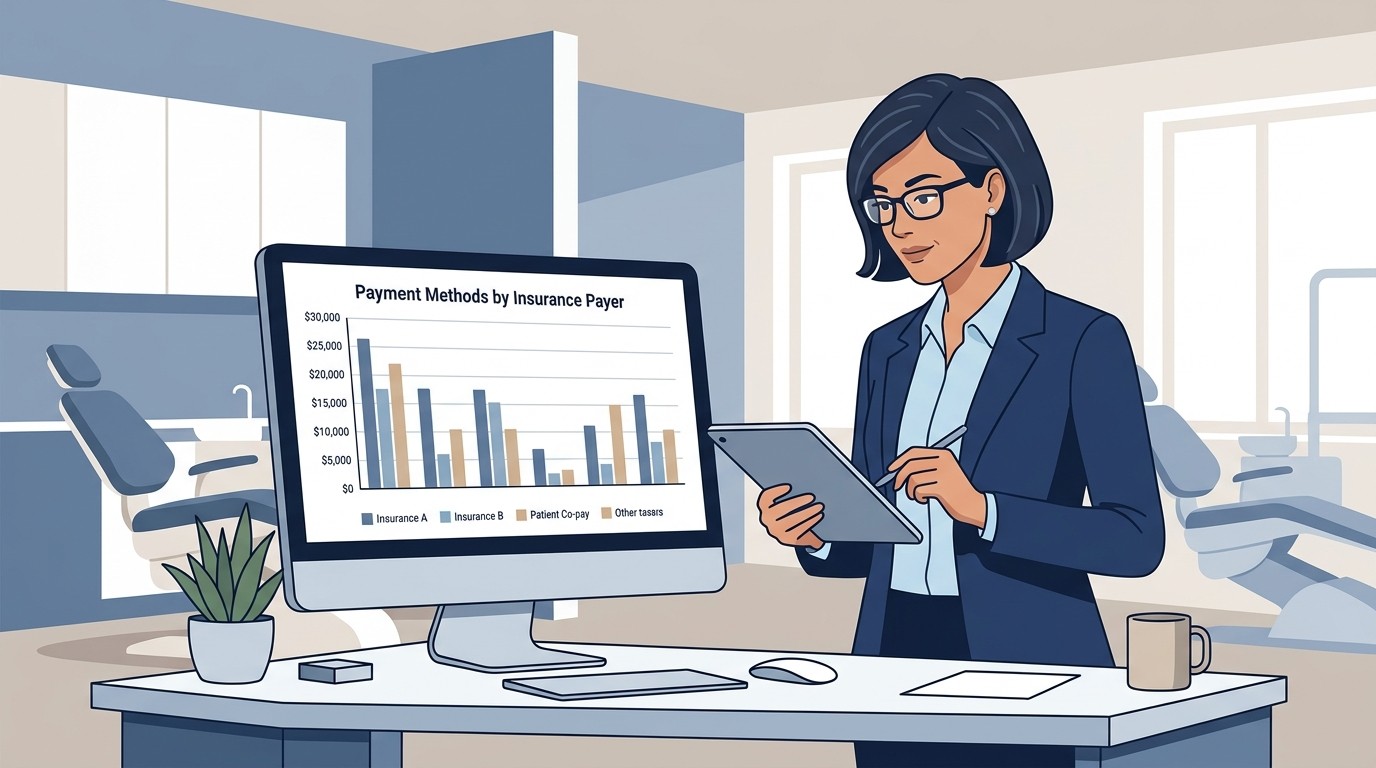
Two payers in this dataset almost never send a virtual credit card. Four send one more than three quarters of the time. Nobody has published the difference before, so we did.
Why this matters
When a dental payer reimburses you, the money can arrive several ways. An electronic funds transfer moves the money directly into your account. A paper check does the same thing more slowly. A virtual credit card, usually called a VCC, works differently: the payer sends a single-use card number that your team keys into a terminal, and the payment processes as a card transaction.
The practical difference is that card transactions carry processing fees. Commonly cited merchant rates fall somewhere in the low single digits as a percentage of the transaction, which means a practice receiving a meaningful share of its insurance revenue by VCC is paying a percentage of that revenue to accept money it has already earned. On an EFT, that cost does not exist.
Practices generally know this. What has not existed until now is any measurement of which payers actually do it, and how often. Payers do not publish it. Practice management systems do not aggregate it. So the conversation has run on anecdote.
We had the data sitting in our reconciliation records, so we measured it.
What we found
Across 38,599 payment events over four quarters, the spread between payers is far wider than we expected. This is the percentage of payments from each payer that arrived as a virtual credit card.
| Payer | Payments | 2025 Q3 | 2025 Q4 | 2026 Q1 | 2026 Q2 |
|---|---|---|---|---|---|
| Liberty Dental | 958 | 0% | 10% | 87% | 91% |
| Principal | 134 | 72% | 69% | 80% | 80% |
| Guardian | 470 | 66% | 79% | 79% | 77% |
| United Concordia | 238 | 56% | 69% | 67% | 73% |
| MetLife | 851 | 59% | 66% | 68% | 66% |
| UnitedHealthcare | 683 | 50% | 45% | 61% | 62% |
| Anthem / BCBS | 849 | 41% | 45% | 64% | 61% |
| Cigna | 542 | 49% | 47% | 54% | 51% |
| Ameritas | 113 | 31% | 26% | 22% | 37% |
| Humana | 209 | 38% | 11% | 13% | 19% |
| DentaQuest | 240 | 0% | 2% | 0% | 4% |
| Aetna | 586 | 1% | 0% | 0% | 0% |
| Delta Dental | 1,951 | 2% | 2% | 2% | 1% |
| Medicaid | 343 | 1% | 0% | 1% | 1% |
Three things stand out.
The range is nearly total. Delta Dental and Aetna, two of the largest payers in the dataset, essentially never send a virtual credit card. Guardian, Principal, United Concordia and MetLife send one most of the time. These are not small differences in degree. They are opposite operating policies, and a practice's payer mix therefore determines a real and largely invisible cost.
Liberty Dental changed policy mid-year. In the third quarter of 2025, zero percent of Liberty Dental payments in this dataset arrived as a virtual credit card. By the first quarter of 2026 it was 87 percent, and by the second quarter, 91 percent. A practice with meaningful Liberty Dental volume experienced a shift in how it gets paid without anything changing on its own end.
The overall direction is upward. Most payers that used virtual credit cards at all used them more by the end of the period than the beginning. Anthem and BCBS moved from 41 to 61 percent. UnitedHealthcare moved from 50 to 62 percent. The exception is Humana, which moved the other way, from 38 percent down to 19.
What this does not tell you
We want to be precise about the limits of this data, because the number that would complete the picture is one we could not measure.
We can report how often each payer issued a virtual credit card. We cannot yet report what those transactions cost, because processing fees are deducted by the merchant processor rather than recorded in the practice management ledger, and our current extract does not capture them. Anyone quantifying the dollar impact would need to pull it from merchant statements, which is a reasonable exercise for a practice to run on itself.
We also are not making a claim about payer intent. There are administrative arguments for virtual card payments, and payers who use them will point to them. What the data supports is a factual statement about frequency, and the observation that the practice, not the payer, absorbs the processing cost.
What a practice can do about it
Most payers that issue virtual credit cards are required to offer an alternative, and in many cases practices can request electronic funds transfer instead. The process varies by payer and is often more buried than it should be, but it usually exists.
The practical steps look like this. Identify which of your payers are sending virtual cards, which most practices have never actually tallied. Contact those payers to request EFT enrollment. Confirm the change actually took effect, because enrollment requests do not always process cleanly. And check your merchant statements afterward to verify the fees stopped.
That last step matters more than it sounds. Whether a payment arrived as EFT or as a card is recorded in your ledger, but whether the deposited amount matches what was posted is a separate question entirely, and processing fees are one of the ways those two numbers quietly separate.
Methodology
This analysis covers 38,599 payment events recorded between July 2025 and July 2026 across ten dental practices using Open Dental and Oryx practice management systems. Payment method is captured at the point of reconciliation for every payment in the dataset, which is why coverage on this particular measure is complete.
To avoid reporting a single practice's experience as an industry pattern, a payer appears in the table only if it had at least 100 payment events in the period and at least five distinct practices contributing. Fourteen payers met both thresholds. Payer names are consolidated to the parent brand, so state-level entities roll up to their national organization.
The third quarter of 2026 is excluded from the table because it was incomplete at the time of analysis.
Two limitations are worth stating plainly. Ten practices is a modest sample, and while it is large enough at the transaction level to be meaningful, it is not a national census. And all practices in this dataset use one of two practice management systems, so a systematic difference in how other systems record payment method would not be visible here.
We intend to refresh this quarterly as the underlying dataset grows.
Frequently Asked Questions
What is a virtual credit card payment in dentistry?
A virtual credit card, or VCC, is a single-use card number issued by an insurance payer in place of an electronic funds transfer or check. The practice keys the number into its card terminal to receive payment, which means the transaction carries standard merchant processing fees.
Which dental payers use virtual credit cards most?
In this dataset, Liberty Dental, Principal, Guardian, United Concordia and MetLife issued virtual credit cards for the majority of payments, several of them for more than three quarters of payments by the second quarter of 2026.
Which dental payers do not use virtual credit cards?
Delta Dental, Aetna, Medicaid and DentaQuest issued virtual credit cards on 4 percent or fewer of payments throughout the period measured, with Delta Dental and Aetna at roughly 1 to 2 percent.
Can a dental practice refuse virtual credit card payments?
In most cases a practice can request electronic funds transfer instead, though the process varies by payer and is not always well publicized. Confirming the change took effect, and checking merchant statements afterward, matters as much as making the request.
How much do virtual credit card fees cost a dental practice?
That depends on the practice's merchant rate and the share of revenue arriving by card, and it is not something this dataset measures. Commonly cited merchant processing rates run in the low single digits as a percentage of each transaction. The reliable way to find your own number is to audit your merchant statements against your payer mix.
This analysis comes from Zeldent's reconciliation data. Zeldent is an independent audit layer that compares a practice's ledger against its actual bank deposits every day, which is also how discrepancies like unexpected processing fees surface. Book a demo to see what your own payment data shows.