Dental Payment Posting Best Practices

Every reconciliation problem started as a posting problem. Get posting right and reconciliation becomes simple.
Reconciliation is downstream from posting. When payments are posted accurately, consistently, and promptly, reconciliation is routine verification. When posting is sloppy, late, or inconsistent, reconciliation becomes detective work — hunting for errors that should never have happened.
📚 Part of our reconciliation series: This article is part of The Complete Guide to Dental Practice Reconciliation, our comprehensive resource on closing your books accurately and preventing revenue leakage.
The best practices in this guide apply to patient payments, insurance payments, and every other transaction that flows through your practice management system. Master these fundamentals and your financial operations become dramatically cleaner.
Post Payments Same-Day
The single most important posting practice is timeliness. Payments should be posted the same day they are received. Not tomorrow. Not when you have time. Same day.
Same-day posting prevents backlog. When payments accumulate, posting becomes a project rather than a routine task. Projects get delayed. Delays create errors.
Same-day posting improves accuracy. The person who collected the payment remembers the details. The context is fresh. Questions can be resolved immediately rather than researched later.
Same-day posting enables same-day reconciliation. You cannot reconcile today's deposits if yesterday's payments are still sitting unposted.
If your practice struggles with same-day posting, examine why. Is staff too busy? Are there too few people with posting access? Is the PMS slow or difficult to use? Address the root cause rather than accepting delayed posting as normal.
Post Exact Amounts
Round numbers are suspicious. When a payment posts as exactly $500.00, it might be accurate — or it might be a rounded estimate that someone planned to fix later and forgot.
Post the exact amount shown on the payment. If the check says $487.52, post $487.52. If the credit card receipt says $1,234.18, post $1,234.18. Do not round, estimate, or adjust.
Exact amounts make reconciliation possible. When your bank deposit shows $487.52 and your PMS shows $487.52, they match. When your bank shows $487.52 and your PMS shows $490.00, you have a discrepancy to research.
Train staff that exact amounts are non-negotiable. If they cannot read the amount clearly, they should ask rather than estimate.
Use Correct Payment Types
Your PMS has payment type codes for a reason. Cash, check, credit card, insurance EFT, patient financing — each should post with the correct type.
Correct payment types enable accurate reporting. You cannot analyze credit card processing fees if credit card payments are mixed with cash. You cannot track insurance collections if insurance payments post as patient payments.
Correct payment types simplify reconciliation. Credit card batches should match credit card payments. Insurance EFTs should match insurance postings. When types are wrong, matching becomes impossible.
Create a reference guide for payment types if staff are uncertain. Which code for CareCredit? Which code for Sunbit? Which code for insurance virtual credit cards? Remove ambiguity.
Apply Payments to Correct Accounts
Posting a payment to the wrong patient is worse than not posting at all. The wrong patient shows a credit. The right patient shows a balance. Neither makes sense.
Before posting, verify the patient. Check the name on the payment against the name in the system. For insurance payments, verify the subscriber matches the patient on the claim.
Common errors include patients with similar names, family members posting to the wrong family member, and insurance payments posting to the wrong patient when multiple patients appear on one ERA.
When you discover a misposted payment, correct it immediately. Move the payment to the correct account with documentation. Do not leave credits sitting on wrong accounts.
Post Insurance Payments from the ERA
Insurance payments should post from the ERA, not from the bank deposit. The ERA tells you exactly which patients and procedures are being paid. The bank deposit only tells you a total.
When posting insurance payments, open the ERA first. Post each claim line as specified — payment amount, contractual adjustment, patient responsibility. The sum of your postings should equal the deposit total.
Posting from the deposit backward — starting with a number and trying to allocate it — leads to errors. You might post to wrong procedures, miss claims, or miscalculate adjustments.
If your ERA and deposit totals do not match, investigate before posting. Do not force a balance by adjusting numbers. Find the real reason for the discrepancy.
Post All Components of Insurance Payments
An insurance payment is not just the payment. It is payment plus contractual adjustment plus patient responsibility. All three must post correctly.
The payment is what the insurance company sent. Post this to reduce the insurance portion of the balance.
The contractual adjustment is the difference between your fee and the allowed amount. Post this as a provider adjustment, not patient responsibility.
The patient responsibility is what the patient owes — deductible, coinsurance, copay, non-covered amounts. Transfer this to the patient balance.
When staff post only the payment and skip adjustments, accounts become incorrect. The insurance portion shows paid but the total balance is wrong. Patient statements become inaccurate.
Handle Denials Immediately
When a claim is denied, do not ignore it. Post the denial with the reason code. Create a follow-up task if the denial can be appealed or corrected.
Unposted denials create phantom receivables. Your aging report shows insurance balances that will never be collected. Your true receivables are overstated.
Some denials are final — the service is simply not covered. Post these as adjustments and move on. Other denials are correctable — wrong code, missing information, eligibility issue. These need follow-up before you write them off.
Create a denial workflow. Who reviews denials? What qualifies for appeal? How quickly must appeals be filed? Without a workflow, denials languish.
Document Payment References
Every payment should include a reference that ties it to external documentation. Check number. Credit card transaction ID. Insurance trace number. ERA reference.
References create an audit trail. When reconciliation finds a discrepancy, references let you trace back to source documents.
Without references, posted payments are unsupported assertions. Yes, you posted $500 from Delta Dental. Can you prove it? Can you find the ERA? Can you match it to the deposit?
Configure your PMS to require reference numbers for certain payment types. If the field is optional, staff will skip it. If it is required, they will enter it.
Separate Collection from Posting
The person who collects money should not be the same person who posts it. This is basic segregation of duties — a fundamental financial control.
When one person handles both, errors and fraud become easier. Money can be collected and not posted. Payments can be posted without money changing hands. Discrepancies have no independent check.
In small practices, complete segregation may be impossible. At minimum, have someone independent verify deposits against postings daily. The person who did not post should confirm that postings match collections.
Batch Similar Transactions
Process similar payments together rather than mixing types randomly. Post all credit card payments, then all checks, then all insurance payments.
Batching reduces errors. When you are in credit card mode, you are less likely to accidentally code something as a check. When you are posting insurance, you are focused on ERA details.
Batching also speeds reconciliation. Credit card batch totals should match credit card postings. Check deposits should match check postings. Clear batches create clear audit trails.
Close Batches Daily
At end of day, close your credit card batch and your PMS batch. Do not leave batches open across multiple days.
Closed batches have defined totals that can be reconciled. Open batches have moving targets that create confusion.
When credit card batches close, they settle to your bank account. The settlement amount should match the closed batch total. If batches span multiple days, matching settlements to batches becomes difficult.
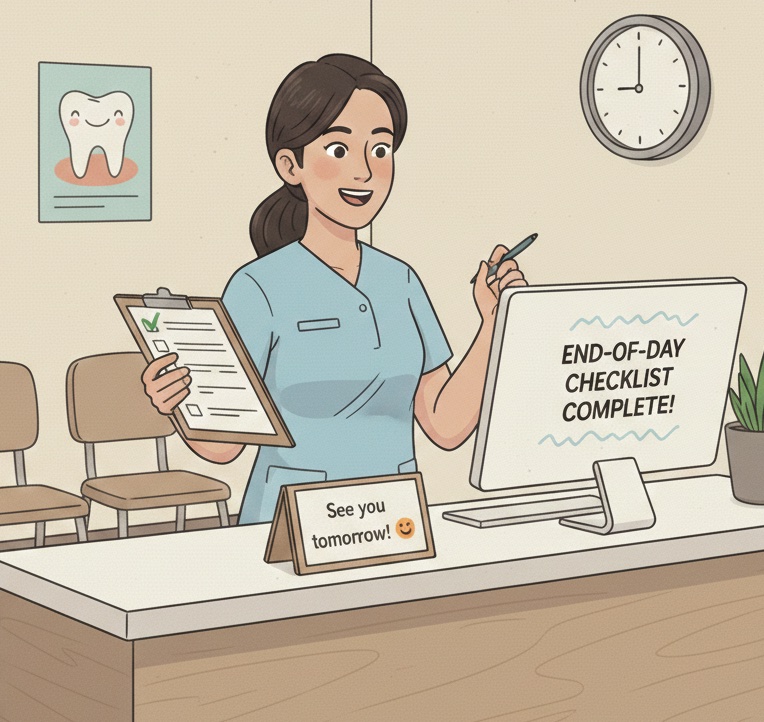
Create an end-of-day checklist that includes batch closing. This should happen every day, not just when someone remembers.
Handle Exceptions Immediately
When something does not fit — an unusual payment, an unexpected amount, an unclear instruction — resolve it immediately. Do not post it incorrectly and plan to fix it later.
Later rarely comes. Exceptions that are set aside become forgotten problems. Weeks later, you discover a misposted payment with no memory of what happened.
If you cannot resolve an exception immediately, document it clearly. Write a note. Flag the account. Create a task. Do something that ensures follow-up.
Train and Retrain
Posting accuracy depends on trained staff. Initial training gets people started. Ongoing training keeps skills sharp and addresses emerging issues.
When you find patterns of errors, address them with training. If multiple staff misunderstand a payment type, the training was unclear. If insurance posting is consistently wrong, reinforce ERA interpretation.
Create written procedures for posting. Document every payment type, every code, every exception scenario. Written procedures ensure consistency even when staff turnover occurs.
Audit Your Posting
Periodically audit posting accuracy. Pull a sample of payments and verify they were posted correctly — right amount, right account, right type, right reference.
Audits find problems before they become crises. A pattern of errors caught early can be corrected with training. The same pattern caught during year-end close creates a mess.
Consider peer review as ongoing auditing. Have one staff member spot-check another's posting daily. Small consistent checks prevent large accumulated errors.
The Connection to Reconciliation
Every best practice here makes reconciliation easier. Same-day posting means today's deposits can be reconciled today. Exact amounts mean totals match. Correct references mean discrepancies can be traced.
When posting is excellent, reconciliation is verification. When posting is poor, reconciliation is remediation.
Invest in posting quality and reconciliation quality follows automatically.
Want to verify that your posting matches your deposits automatically? See how Zeldent reconciles payments and catches discrepancies before they become lost revenue.