Dental Practice Production vs Collections: What the Gap Tells You
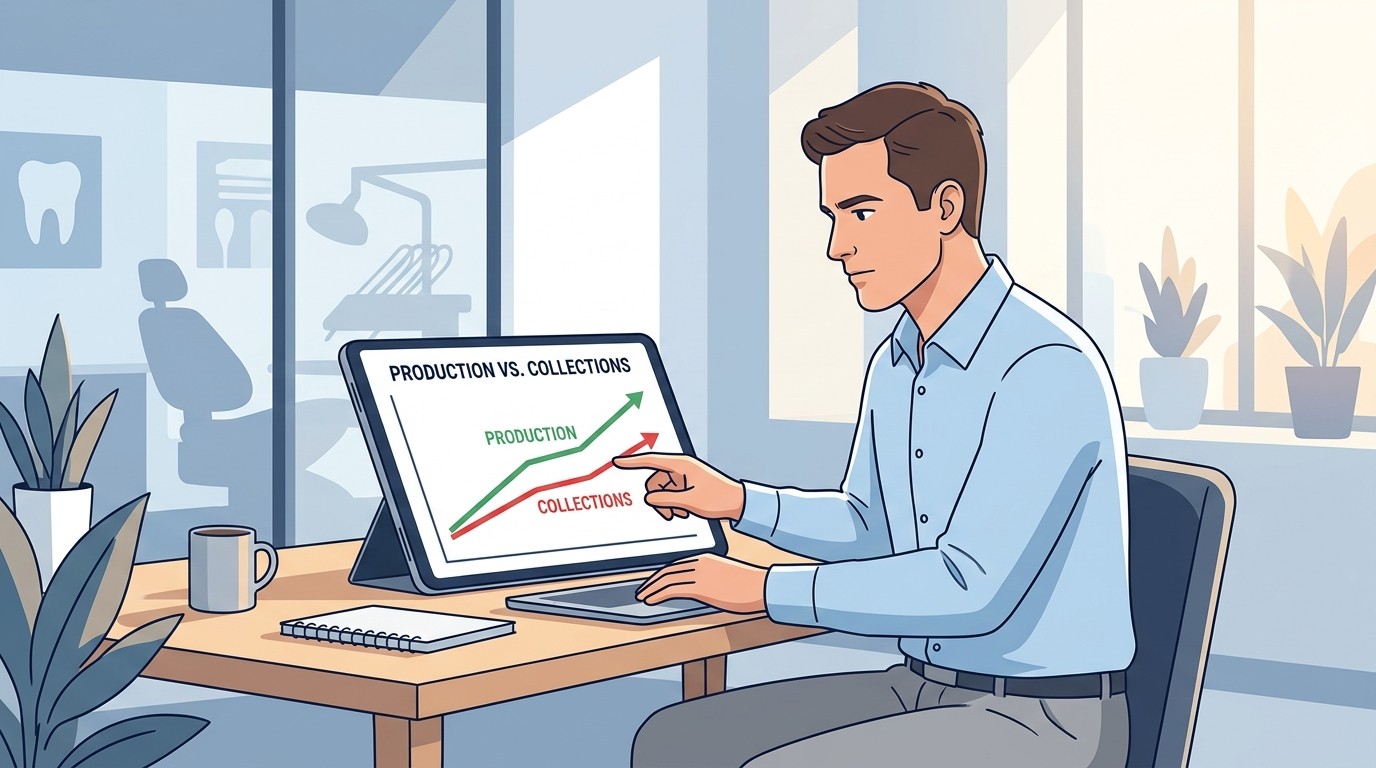
Production and collections are not the same number, but they should not be wildly different. When the gap is persistent, the size and shape of the gap tells the practice exactly which revenue layer is leaking. Most owners never read it.
The Two Numbers and Why They Diverge
Production is the dollar value of the dentistry performed in a given period, measured at the practice's full fee. Every crown, filling, exam, and cleaning adds up to the production number.
Collections is the dollar amount the practice actually received in payment for that work, including insurance payments, patient payments, and adjustments. After contractual write-offs (the difference between the practice's full fee and what insurance contracts pay), the collections number should approach the production number adjusted for the payer mix.
In a healthy practice, production and collections track closely month over month, with collections lagging production by a predictable amount based on the billing cycle. A typical practice might collect 92 to 96 percent of adjusted production within 60 to 90 days. Variance happens, but the long-term relationship is stable. The portion that never gets collected adds up fast, and it is a large part of how much revenue the average dental practice loses each year.
When production and collections diverge meaningfully over a sustained period, something is wrong. The shape of the divergence narrows down what the something is.
Reading the Gap
There are a few patterns of divergence, each pointing to a different category of problem.
Production Grows, Collections Stays Flat
The practice is producing more dentistry, more crowns and operative procedures, more comprehensive treatment plans, but the revenue is not following. This is the most common divergence and the most expensive to ignore.
Possible causes include billing falling behind on the increased volume, denial rates rising on a procedure mix that has shifted toward more denial-prone categories, insurance verifications failing on the larger volume, and the front desk losing track of patient balances as the practice gets busier. The growth in production has exceeded the capacity of the billing and reconciliation systems to capture it.
The fix is operational, not clinical. The billing process needs to catch up to the production pace. This is often a matter of adding billing capacity, fixing specific denial categories, or implementing automated reconciliation that can keep up with higher volume.
Production Stays Flat, Collections Declines
The clinical work is constant, but the revenue is shrinking. This is a more concerning pattern because it usually means the underlying problems have been there a while and are now compounding.
Possible causes include payer underpayments accumulating, write-offs and adjustments increasing without clear cause, AR aging into uncollectible territory, refunds increasing as a percentage of collections, and patient balances drifting into write-offs. The practice is doing the same work but keeping less of the money.
The diagnostic work is the same as for any reconciliation discipline. Compare what the practice management system reports against what is actually reaching the bank, and look at the categories of adjustment and write-off that are growing. The cause is usually concentrated in two or three specific patterns rather than uniformly distributed.
Production and Collections Both Decline
Both numbers are moving down together. This is the most diagnosable scenario from a reading-the-gap perspective because the patterns generally trace clearly to volume reduction. New patient acquisition has slowed, recall is leaking, treatment plan acceptance has dropped, or the practice is losing patients to competitors or attrition.
The fix lives upstream of billing entirely. The recall system, the treatment plan presentation process, the case acceptance rate, and the new patient flow are the targets. Reconciliation will not solve a top-of-funnel problem.
Production Rises, Collections Rises More Than Expected
A less common but worth-noting pattern. Collections is exceeding what production growth alone would predict. Two interpretations are common. The practice has been working through aged AR and is now collecting on prior period production, which is healthy and resolves over time. Or, less benignly, the practice has tightened collection on aged patient balances or pursued formerly written-off accounts, which is also healthy but is a one-time effect rather than a sustainable trend.
The pattern to watch is whether the divergence persists. A short period of collections outpacing production usually reflects catching up on backlog. A sustained pattern suggests the prior production numbers may have been undercollected.
How to Look at the Numbers Properly
The relationship between production and collections is most useful when measured over a meaningful period rather than month to month, because month-to-month variance is noisy.
Look at a rolling 90-day comparison. Total production over the trailing 90 days, total collections over the trailing 90 days, with collections lagged by 30 to 45 days to align with typical billing cycles. The rolling view smooths the noise.
Track the ratio over time. Collections divided by adjusted production, plotted across the last 12 to 24 months. A declining ratio is information. A stable ratio with both numbers growing or both shrinking is also information.
Break it down by provider. The composite practice number can hide provider-level variation. A practice where one provider's collections track tightly to production and another's does not is a practice with a provider-specific issue.
Break it down by procedure type. Hygiene, operative, prosthetic, and surgical procedures have different billing characteristics and different denial profiles. Production and collections divergence concentrated in one category points more directly to the cause than the aggregate divergence does.
What the Gap Should Drive
The production-versus-collections relationship is a diagnostic, not an action item by itself. The action depends on what the gap reveals.
For a growing practice where production has outpaced collections, the action is usually scaling the billing capacity, fixing specific denial patterns, and tightening reconciliation. The clinical engine is working; the financial engine needs to catch up.
For a stable practice where collections is shrinking against flat production, the action is the reconciliation work. Compare practice management to bank to payer remittances, identify the categories where money is disappearing, and fix the specific cause.
For a declining practice where both numbers are falling, the action is upstream of billing. Recall, acceptance, new patient flow, retention. Reconciliation will not solve it.
For an unusual pattern where collections is outpacing production, the action is figuring out whether the practice is catching up on backlog or whether prior production was undercollected. The interpretation determines whether the trend is sustainable or temporary.
The Revenue Integrity Connection
Production and collections divergence is the high-level indicator that drives most other Revenue Integrity work. It is the visible symptom that something needs investigation. The reconciliation, payer matching, denial analysis, adjustment review, and AR aging work all stem from the question "why are these two numbers diverging."
For practice owners who want one number to watch as a leading indicator of financial health, the ratio of collections to adjusted production over a rolling 90 days is the right one. It is computable from data the practice already has. It moves predictably in healthy practices. And when it moves unexpectedly, the size and direction of the move points at the specific category of problem that needs attention.
Frequently Asked Questions
What is the difference between production and collections in a dental practice?
Production is the dollar value of the dentistry performed in a period, measured at the practice's full fee. Collections is what the practice actually received in payment for that work, after contractual write-offs and including insurance payments, patient payments, and adjustments. The two numbers should track closely in a healthy practice, with collections lagging production by a predictable amount.
What should the relationship between production and collections look like?
In a healthy practice, collections runs 92 to 96 percent of adjusted production within 60 to 90 days. The ratio should be stable month over month, with normal variance. A sustained divergence indicates a problem in the billing, collection, or reconciliation systems.
Why would collections be lower than expected relative to production?
Common causes include billing falling behind on increased volume, rising denial rates, failing insurance verifications, accumulating payer underpayments, increasing write-offs without clear cause, AR aging into uncollectible territory, and patient balances drifting into write-offs. The specific cause is identified by reconciling practice management records against bank deposits and payer remittances.
Why would collections be higher than expected relative to production?
Two common explanations. The practice has been working through aged AR and is now collecting on prior production, which is healthy and resolves over time. Or the practice has tightened collection on aged patient balances or pursued previously written-off accounts. A short-term divergence is normal. A sustained pattern suggests prior production was undercollected.
How often should a dental practice compare production to collections?
The most useful view is a rolling 90-day comparison updated monthly, with collections lagged 30 to 45 days to align with typical billing cycles. Month-to-month variance is noisy and often misleading. The rolling view shows the underlying trend.
What does it mean if both production and collections are declining?
Both numbers declining together usually indicates a top-of-funnel problem rather than a billing problem. Recall is leaking, treatment plan acceptance has dropped, new patient acquisition has slowed, or the practice is losing patients to attrition. Reconciliation does not solve a top-of-funnel problem. The work has to be upstream of billing.
Zeldent tracks the production-to-collections relationship continuously and surfaces the divergence patterns that point to specific causes, whether the problem is in billing, payer behavior, AR management, or upstream patient flow. Schedule a demo to see how Revenue Integrity reads the gap between what your practice produces and what it collects.