Dental Practice Valuation: How Reconciliation Gaps Affect Sale Price

Your practice produces $1.1 million. But when the buyer's accountant digs in, they find $67,000 that cannot be verified. Your valuation just dropped by $57,000.
Valuation Depends on Verifiable Revenue
When you sell your dental practice, the buyer is purchasing your future cash flows. The price they pay is based on your historical financial performance, typically collections and profitability.
But here is what many sellers miss: buyers do not just accept your reported numbers. They verify them. And when verification reveals gaps, the valuation adjusts.
Reconciliation problems directly impact sale price because they create uncertainty about what the practice actually earns. Buyers discount for that uncertainty, or they walk away entirely.
If you are planning to sell your practice in the next few years, your reconciliation health matters as much as your clinical production.
How Buyers Calculate Value
Understanding how buyers value practices helps you understand why reconciliation matters.
The Basic Formula
Most dental practice valuations start with a multiple applied to collections or cash flow:
Asset Sale: Typically 65-85% of annual collections, depending on profitability, growth, and other factors.
Stock/Equity Sale: Often based on EBITDA multiples, ranging from 4x to 8x or higher for DSO acquisitions.
In either case, the base number, whether collections or EBITDA, must be verified. Unverified revenue reduces the base or reduces the multiple.
What Buyers Verify
Sophisticated buyers do not trust seller reports at face value. They verify:
- Bank deposits match reported collections
- Insurance payments were actually received and properly posted
- Patient payments were collected and deposited
- Adjustments are appropriate and documented
- AR is collectible, not just recorded
Each verification step can reveal gaps that affect the final number.
Reconciliation Issues That Reduce Value
Unidentified Deposits
Deposits sitting in your bank account that cannot be matched to specific revenue are a red flag.
Why it matters for valuation:
If you report $950,000 in collections but have $45,000 in unidentified deposits, a buyer sees two possibilities:
- Your collections are actually higher than reported (you are missing revenue in your PMS)
- The deposits are not really revenue (prepayments, loans, or other non-revenue items counted as collections)
Either way, the buyer cannot trust your reported collections. They will either:
- Reduce the collectible revenue figure by the unidentified amount
- Apply a lower multiple due to financial uncertainty
- Require a significant holdback until deposits are identified
Impact example:
$45,000 unidentified deposits at a 0.75x multiple = $33,750 reduction in practice value.
Unposted Insurance Payments
Insurance EFTs that hit your bank but were never posted to patient accounts create multiple problems.
Why it matters for valuation:
Unposted payments mean:
- Patient accounts show incorrect balances
- Your AR is overstated
- Revenue recognition may be inaccurate
- Your collection rate calculation is wrong
Buyers recalculate your true collection rate after adjusting for unposted payments. If your reported 98% collection rate drops to 92% after adjustments, your practice looks less efficient than advertised.
Impact example:
A practice with a 6% lower actual collection rate than reported will be valued as less operationally sound. The multiple applied may drop from 0.80x to 0.72x, costing the seller $88,000 on a $1.1 million collections practice.
Excessive Credit Balances
Patient credit balances are liabilities. They represent money you may need to refund.
Why it matters for valuation:
Buyers assess credit balances carefully:
- Total credit balance gets subtracted from practice value or treated as a liability
- Old, unresolved credits suggest operational problems
- Large credit balances relative to collections indicate posting errors or collection issues
A practice with $35,000 in patient credit balances needs to either refund that money or explain why it is there. Either way, it affects the deal.
Impact example:
$35,000 in credit balances might be treated as a dollar-for-dollar reduction in value, or as a sign of operational issues that reduces the overall multiple.
Unexplained Adjustments
Write-offs, discounts, and adjustments without documentation make buyers nervous.
Why it matters for valuation:
Adjustments can hide problems:
- Fraud or embezzlement covered by write-offs
- Collections issues masked by adjustments
- Fee schedule problems adjusted away
Buyers review adjustment patterns. If adjustments spike in certain periods, involve certain staff, or lack explanation, they dig deeper. Sometimes they find fraud. Sometimes they find operational problems. Either discovery affects value.
Impact example:
Discovering $28,000 in unexplained adjustments over two years may prompt a buyer to request a full forensic accounting review, delaying the sale and potentially revealing larger issues.
Aged Accounts Receivable
AR that looks healthy on the surface may be uncollectible in reality.
Why it matters for valuation:
Buyers evaluate AR quality:
- AR over 90 days is often worthless
- Insurance AR that has not been worked is unlikely to pay
- Patient AR without collection activity may be abandoned
If your $180,000 AR is 40% over 90 days, a buyer values it at far less than face value. They may attribute zero value to aged balances.
Impact example:
$72,000 in AR over 90 days valued at $0 instead of face value directly reduces the assets being purchased.
The Multiplier Effect on Valuation
Reconciliation problems do not just reduce your numbers directly. They also reduce the multiple buyers are willing to pay.
Why Multiples Drop
Buyers pay premium multiples for:
- Clean, verifiable financials
- Strong internal controls
- Predictable, sustainable cash flows
- Low-risk operations
Reconciliation problems signal the opposite:
- Financial uncertainty
- Weak controls
- Unpredictable reality behind the numbers
- Higher risk
A practice that might command a 0.82x multiple with clean books might only get 0.70x with reconciliation issues. On $1 million in collections, that is a $120,000 difference.
The Trust Factor
Beyond the math, reconciliation problems erode buyer trust. Buyers who find one issue look harder for others. The relationship becomes adversarial instead of collaborative.
Deals that start contentious often:
- Take longer to close
- Include more contingencies and holdbacks
- Fall apart entirely
The cost of lost trust is hard to quantify but very real.
What Buyers Look for in Due Diligence
Understanding buyer due diligence helps you prepare.
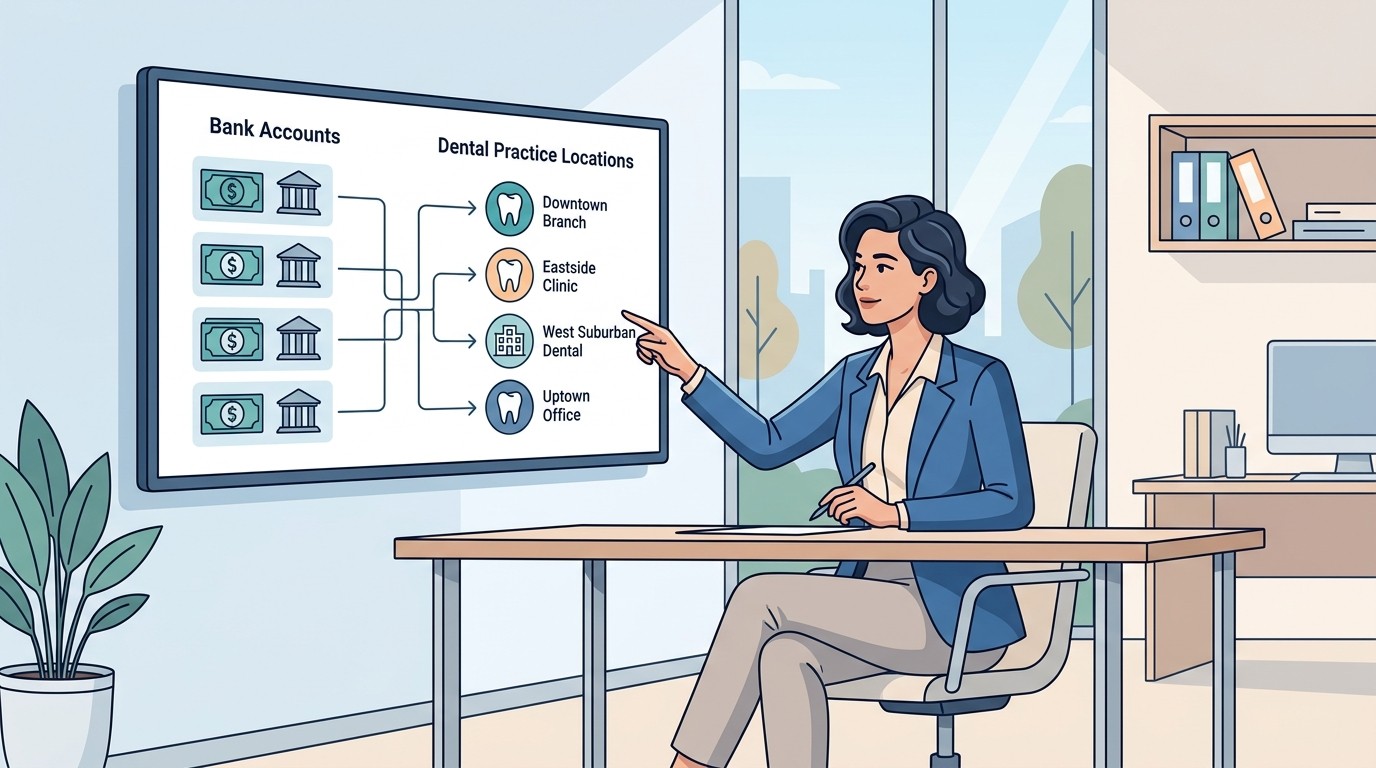
Bank-to-PMS Reconciliation
Buyers match your bank deposits to your PMS payment reports. They expect:
- Total deposits to equal total posted payments (with timing adjustments)
- Each deposit to trace to specific posted items
- Variances to be small and explainable
AR Quality Assessment
Buyers age your AR and assess collectability. They expect:
- AR over 90 days to be less than 15% of total
- Active collection efforts on aged balances
- Reasonable write-off rates
Credit Balance Review
Buyers examine credit balances for:
- Total balance relative to practice size
- Age distribution
- Resolution activity
- Refund documentation
Adjustment Analysis
Buyers review adjustments for:
- Consistent patterns and policies
- Appropriate documentation
- Reasonable totals relative to production
- No suspicious concentrations
Preparing Your Practice for Sale
If you plan to sell within the next one to three years, start improving reconciliation now.
Year Three Before Sale: Assess Current State
- Run a full reconciliation of bank to PMS for the past 12 months
- Identify all unresolved items
- Quantify the size of the problem
Year Two Before Sale: Clean Up
- Resolve all unidentified deposits (or document them as unsolvable)
- Process all pending refunds
- Work aged AR aggressively
- Write off truly uncollectible balances with documentation
Year One Before Sale: Maintain and Document
- Reconcile monthly without exception
- Keep credit balances near zero
- Document all adjustments
- Build a track record of clean books
Three Months Before Sale: Pre-Due Diligence
- Conduct your own due diligence review
- Identify anything a buyer might question
- Prepare explanations and documentation
- Fix anything that can still be fixed
The ROI of Clean Reconciliation
Consider the investment versus the return.
Cost to Fix:
- Staff time for cleanup: 40-80 hours
- Possible consultant fees: $5,000-$15,000
- Process improvements: minimal ongoing cost
Value Protected or Gained:
- Avoid 5-15% valuation reduction
- On a $1 million collection practice, that is $50,000-$150,000
- Plus faster closing, fewer contingencies, and better terms
The return on reconciliation cleanup is often 10x or more.
What to Do If You Find Problems
If you discover significant reconciliation issues while preparing to sell:
Disclose Proactively
Buyers find problems anyway. Disclosing proactively:
- Builds trust
- Gives you control of the narrative
- Avoids last-minute deal disruption
Quantify the Impact
Rather than letting the buyer estimate, do the work yourself:
- Calculate the adjustment to collections
- Estimate credit balance liability
- Project AR collectability
Your calculation may be more favorable than the buyer's worst-case assumption.
Offer Solutions
Structure the deal to address concerns:
- Holdback escrow for reconciliation items
- Seller note tied to collections verification
- Earnout based on verified performance
Buyers appreciate sellers who acknowledge issues and offer fair solutions.
Clean Books Command Premium Prices
The practices that sell quickly at premium multiples share common traits:
- Every deposit matches posted payments
- Credit balances are minimal and current
- AR is aged appropriately with active management
- Adjustments are documented and reasonable
- Financial reports are accurate and trusted
These practices attract multiple buyers. Competition drives up price. Deals close smoothly.
Reconciliation is not just operational hygiene. It is a direct driver of what your years of work are ultimately worth.
Planning to sell your practice? Zeldent provides a reconciliation health report showing exactly where your books stand, so you can fix issues before buyers find them. Schedule a demo to see how clean reconciliation protects your practice value.