Back to Practice Pulse

    How DSOs Standardize Financial Controls Across Locations
    9 min read
    Practice Management
    Revenue Management
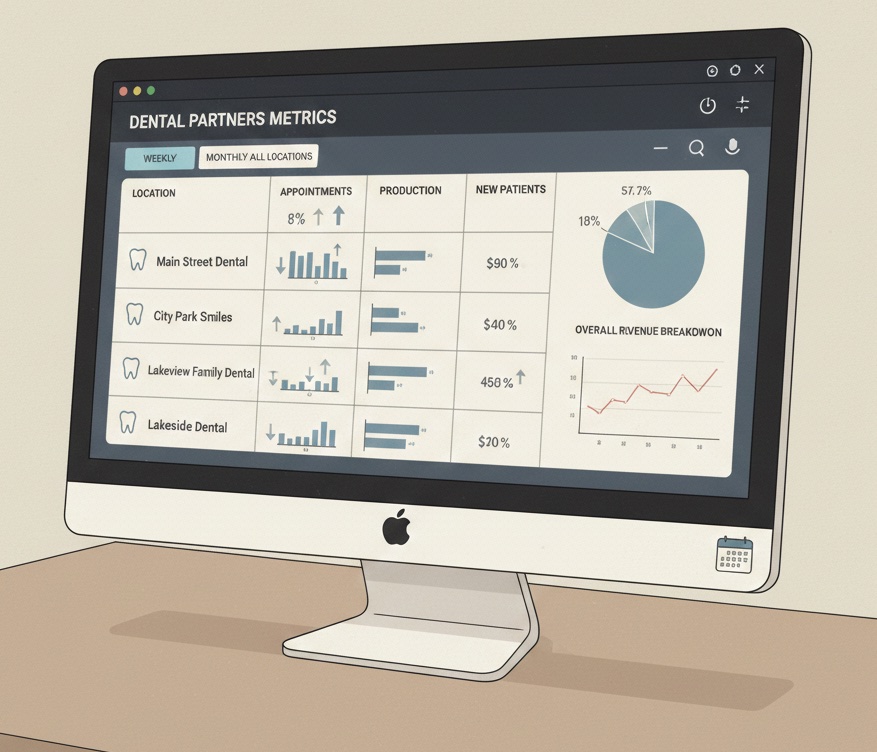
    DSO finance dashboard showing multiple location metrics
    Share this article:

    You have 15 locations. Each one does end-of-day differently. Some reconcile daily, some weekly, some never. How do you know which ones are leaking revenue?

    The Standardization Imperative

    When a DSO grows from one location to five to fifty, financial complexity multiplies. Each acquired practice brings its own processes, habits, and control gaps. Each de novo location starts fresh but can drift over time.

    Without standardization, DSO finance leaders face impossible challenges:

    • Comparing performance across locations when data is inconsistent
    • Identifying revenue leakage when each location tracks differently
    • Scaling oversight when every practice requires custom attention
    • Maintaining control as the organization grows faster than the finance team

    Standardized financial controls solve these problems. They create consistency that enables comparison, oversight, and scalability. They turn a collection of independent practices into a unified organization with predictable financial operations.

    This guide outlines a framework for implementing standardized financial controls across a multi-location dental organization.

    The Core Control Framework

    Effective DSO financial controls address four areas.

    Revenue Recognition Controls

    How revenue is recorded, when it is recognized, and how it flows through systems.

    Key elements:

    • Consistent production posting procedures
    • Standardized adjustment categories and approval requirements
    • Uniform payment posting workflows
    • Common insurance claim filing and tracking processes

    Cash Controls

    How money is handled, deposited, and safeguarded.

    Key elements:

    • Standard deposit procedures
    • Cash drawer management
    • Credit card batch settlement
    • Bank account structures and access

    Reconciliation Controls

    How financial data is verified and discrepancies identified.

    Key elements:

    • Daily reconciliation requirements
    • Unidentified deposit resolution processes
    • Credit balance management
    • Month-end close procedures

    Oversight and Reporting Controls

    How the central office monitors location performance and compliance.

    Key elements:

    • Standard reporting packages
    • Exception alerts and escalation
    • Audit procedures
    • Performance benchmarking

    Implementing Standardized End-of-Day Procedures

    End-of-day is where most revenue control happens or fails. Standardize it first.

    Define the EOD Checklist

    Create a single EOD checklist that every location follows. Include:

    Payment verification:

    • All patients seen today either paid or have documented reason why not
    • Credit card batch settled and total recorded
    • Cash drawer counted and reconciled
    • All payments posted to correct patient accounts

    Deposit preparation:

    • Cash and checks prepared for deposit
    • Deposit slip matches PMS payment totals
    • Deposit logged for next-day bank verification

    Insurance tasks:

    • Insurance EFT deposits identified and matched to ERAs
    • Claims filed for completed treatment
    • Claim rejections reviewed and addressed

    Reconciliation:

    • Day sheet run and reviewed
    • Payment totals match expected amounts
    • Any discrepancies documented and flagged for follow-up

    Sign-off:

    • EOD checklist completed and signed
    • Discrepancy log updated
    • Handoff notes for morning team if needed

    Train Every Location Identically

    Create training materials that explain not just what to do but why. Staff who understand the purpose of controls follow them more consistently.

    Training should cover:

    • The EOD checklist step by step
    • Common mistakes and how to avoid them
    • How to handle exceptions
    • Escalation procedures when problems arise

    Document training completion. Retrain when processes change or performance slips.

    Monitor Completion

    Require EOD sign-off from each location daily. The sign-off should be visible to the central office, either through a shared system or daily submission.

    Missing sign-offs indicate process failures. Follow up immediately when locations skip EOD procedures.

    Audit Periodically

    Even with sign-offs, verify that procedures are actually being followed. Conduct periodic audits at each location:

    • Observe EOD procedures in person
    • Test reconciliation accuracy
    • Interview staff about their understanding of procedures
    • Review exception handling

    Audits catch drift before it becomes systemic.

    Standardizing Reconciliation Requirements

    Reconciliation catches problems. Standardize it to catch problems consistently.

    Daily Reconciliation Standards

    Every location should complete daily:

    • Match bank deposits to PMS payment totals
    • Identify and log unmatched deposits
    • Verify credit card batches deposited correctly
    • Flag any discrepancies for investigation

    Daily reconciliation keeps problems small and fresh. Monthly reconciliation lets problems compound and trails go cold.

    Unidentified Deposit Protocol

    Create a uniform process for handling deposits that cannot be immediately identified:

    Day 1-3: Location investigates using available resources. Check ERAs, patient accounts, credit card batches.

    Day 4-7: Escalate to regional manager or central finance team. Additional resources applied to investigation.

    Day 8-14: Final determination. Either identify the deposit or document it as unresolvable with reason.

    Day 15+: Unresolved deposits escalate to finance leadership. Decision on write-off or continued investigation.

    This protocol ensures deposits do not age into permanent mysteries.

    Credit Balance Management

    Credit balances accumulate without attention. Standardize how they are managed:

    Monthly review: Every location reviews credit balances over 60 days old.

    Resolution requirements: Credit balances must be resolved (refunded, applied, or documented as uncollectible) within 90 days.

    Threshold escalation: Credit balances over a dollar threshold (e.g., $500) require central office notification.

    Refund procedures: Standardized refund process with approval requirements and documentation.

    Month-End Close Procedure

    Create a standard month-end close that every location follows:

    Close date: Set a specific day (e.g., business day three of new month) when prior month is closed.

    Required reconciliations:

    • Bank statement reconciled to PMS
    • Credit card deposits matched to batches
    • Insurance EFTs matched to posted payments
    • Credit balance report reviewed
    • Adjustment report reviewed

    Reporting submission: Locations submit required reports to central office by close date.

    Sign-off: Location manager certifies month-end completeness.

    Building a Central Oversight System

    Standardized controls only work with central oversight. Build systems to monitor compliance and performance.

    Exception-Based Monitoring

    You cannot review every transaction at every location. Instead, monitor for exceptions:

    Unidentified deposit alerts: Any deposit unidentified for more than seven days triggers alert.

    Reconciliation gap alerts: Daily PMS-to-bank variance exceeding threshold (e.g., $500) triggers alert.

    Credit balance alerts: Credit balance total exceeding threshold percentage of monthly collections triggers alert.

    Adjustment alerts: Adjustment volume exceeding normal patterns triggers alert.

    EOD completion alerts: Missing EOD sign-off triggers alert.

    Exception monitoring focuses attention where problems exist rather than reviewing everything.

    Standardized Reporting Package

    Require consistent reports from every location, delivered on the same schedule:

    Daily:

    • EOD sign-off confirmation
    • Deposit summary
    • Unidentified deposit status

    Weekly:

    • Reconciliation status
    • Credit balance summary
    • Exception items and resolution status

    Monthly:

    • Complete bank reconciliation
    • Production and collection summary
    • Adjustment report
    • Credit balance aging
    • KPI dashboard

    Standardized reports enable comparison across locations and trend analysis over time.

    Performance Benchmarking

    With standardized data, benchmark locations against each other:

    • Collection rates by location
    • Days in AR by location
    • Credit balance percentage by location
    • Adjustment rates by location
    • EOD completion rates by location

    Benchmarking identifies outliers. A location collecting 92% when peers collect 97% warrants investigation. A location with growing credit balances when others are flat needs attention.

    Audit Rotation

    Implement a rotating audit schedule that touches every location periodically:

    Quarterly: Desk audit reviewing reports and exceptions
    Annual: On-site audit observing procedures and testing controls
    Triggered: Additional audits when exceptions or performance issues arise

    Audits verify that reported compliance reflects reality.

    Technology Requirements for Standardization

    Standardization requires supporting technology.

    Unified Practice Management System

    Ideally, all locations use the same PMS. This enables:

    • Consistent reporting
    • Centralized access
    • Standard workflows
    • Easier training

    If multiple PMS platforms exist, consider long-term migration strategy. In the interim, create bridges that normalize data for central reporting.

    Centralized Banking Visibility

    Central office needs visibility into all location bank accounts. Options include:

    • Multi-location banking with centralized access
    • Treasury management systems that aggregate accounts
    • Bank feed integrations that pull data automatically

    Real-time bank visibility enables daily reconciliation monitoring from central office.

    Reconciliation and Reporting Tools

    Spreadsheets do not scale. Implement tools that:

    • Automate bank-to-PMS matching
    • Generate exception alerts
    • Produce standardized reports
    • Track resolution workflows

    The investment in tooling pays off quickly as location count grows.

    Secure Document Management

    Store financial documentation securely and accessibly:

    • EOD sign-offs
    • Reconciliation workpapers
    • Exception investigation notes
    • Audit reports

    Documentation protects the organization and enables knowledge transfer when staff changes.

    Change Management Considerations

    Implementing standardized controls in an existing DSO requires change management.

    Expect Resistance

    Locations with established processes will resist change. Office managers who have done things their way for years do not welcome new procedures.

    Address resistance by:

    • Explaining the why behind changes
    • Involving location leadership in process design
    • Providing adequate training and support
    • Recognizing compliance and improvement

    Phase Implementation

    Do not roll out everything at once. Phase implementation:

    Phase 1: Core EOD procedures and daily reconciliation
    Phase 2: Month-end close and reporting requirements
    Phase 3: Exception monitoring and benchmarking
    Phase 4: Advanced controls and audit procedures

    Phasing allows locations to absorb changes and allows central office to refine processes based on initial experience.

    Support Heavily at First

    New controls require extra support during implementation:

    • Dedicated training sessions
    • Help desk for questions
    • Frequent check-ins with location managers
    • Quick response to issues

    Support intensity can decrease once processes become routine.

    Measure and Communicate Progress

    Track implementation progress and share results:

    • Percentage of locations completing EOD daily
    • Average unidentified deposit resolution time
    • Credit balance trends
    • Reconciliation accuracy rates

    Sharing progress creates accountability and celebrates improvement.

    The Payoff of Standardized Controls

    DSOs that successfully standardize financial controls gain significant advantages.

    Visibility: You actually know what is happening financially at every location.

    Comparability: You can benchmark and identify outliers.

    Scalability: Adding locations does not proportionally increase finance team workload.

    Risk reduction: Fraud and error are caught faster and prevented more often.

    Acquisition readiness: Clean, standardized financials support future fundraising or exit.

    Operational improvement: Data-driven insights enable targeted performance improvement.

    The investment in standardization compounds as the organization grows. DSOs that delay pay an increasing price in complexity, risk, and missed opportunity.

    Building financial oversight across multiple locations? Zeldent provides a unified reconciliation dashboard that monitors every practice, flags exceptions automatically, and ensures standardized controls are actually working. Schedule a demo to see DSO-scale financial visibility.

    Share this article:

    Ready to protect your practice revenue?

    Missed collections and revenue leaks add up quickly. With Zeldent, you can automatically safeguard your income, prevent revenue loss, and simplify dental billing in one streamlined platform.