Dental Bookkeeping Checklist: The Monthly Close for Dental Practices
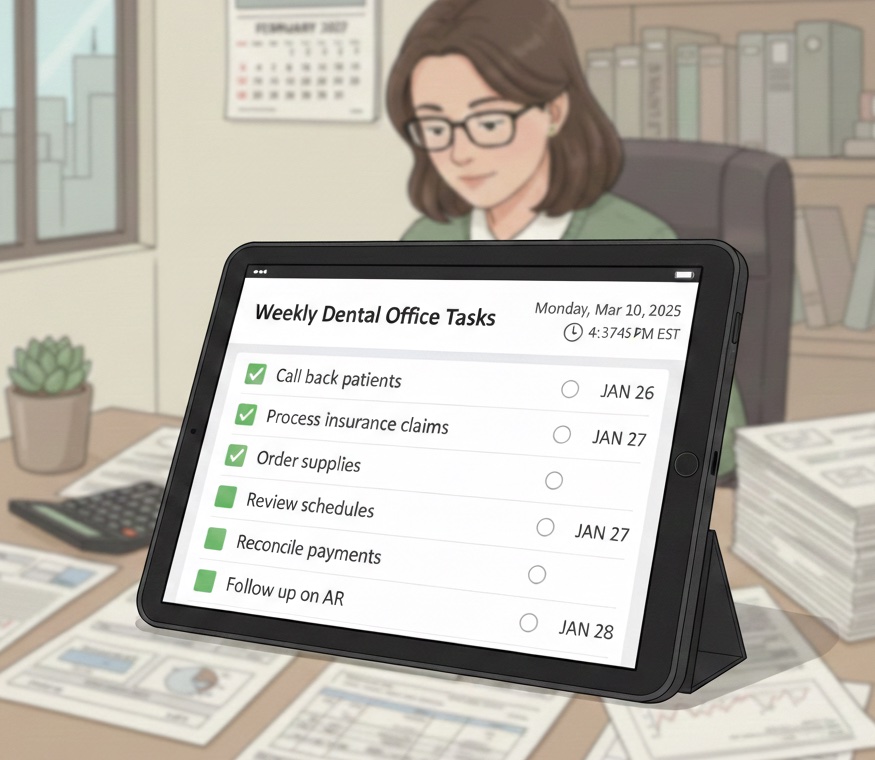
It is the fifth of the month. Your dental client expects financials by the tenth. Do you have a systematic process, or are you scrambling?
📚 Part of our reconciliation series: This article is part of The Complete Guide to Dental Practice Reconciliation, our comprehensive resource on closing your books accurately and preventing revenue leakage.
Why Dental Monthly Close Requires Specialized Knowledge
Closing the books for a dental practice differs fundamentally from closing for a retail store or professional services firm. Dental practices have unique revenue cycle characteristics that complicate every aspect of month-end accounting.
Multiple payment sources flow into the same accounts simultaneously. Patient payments in cash, check, and credit card arrive alongside insurance payments via EFT and paper check. Financing companies like CareCredit and Sunbit add another layer. Some practices also receive payments from government programs. Each source has its own timing, documentation, and reconciliation requirements.
Payment timing disconnects create matching challenges that do not exist in simpler businesses. Production happens in one month, but insurance may not pay for weeks. The cash arrives in the bank on a different day than the remittance advice is generated. Credit card batches settle on different schedules than the transactions are recorded in the practice management system. Matching all of this requires careful attention and systematic processes.
The practice management system operates as a parallel universe to the accounting software. The PMS tracks clinical activity, billing, and collections from the practice perspective, while the accounting system tracks the same activity from a financial perspective. These systems must reconcile, but they organize information differently and use different terminology, creating endless opportunities for discrepancy.
High transaction volume makes manual review impractical. A busy practice processes hundreds of payments monthly, and errors hide easily in that volume. Without systematic processes, problems go undetected until they compound into larger issues.
Accountants serving dental clients need a monthly close process specifically designed for these complexities. What follows is that framework.
Pre-Close Preparation During the First Three Days
Before diving into reconciliation work, gather everything you will need so the actual close process can proceed efficiently.
Secure complete bank statements for all practice accounts including the main operating account, any separate payroll account, savings or reserve accounts, and merchant account statements showing credit card activity. Verify that statements cover the full month with no missing days or pages.
Request key reports from the practice management system. You will need the production report showing total production by provider, by date, and by procedure category. The collection report should show total payments received broken down by type including patient payments, insurance payments, cash, and credit card. The adjustment report should show all adjustments, write-offs, and discounts with reason codes that explain why each adjustment was made. The accounts receivable aging report should show current AR by age bucket and by payer type. The credit balance report should show all patient accounts carrying credit balances. The deposit report should show daily deposits as recorded in the PMS.
Request additional supporting documentation as needed including credit card batch settlement reports from the merchant processor, insurance ERA summaries, patient financing statements from CareCredit, Sunbit, or similar services, payroll reports, and loan statements.
Pull forward any items from last month's close that require attention this month. This includes unresolved reconciliation items that could not be explained or corrected, pending adjustments that were identified but not yet posted, and items flagged for follow-up. These need resolution during the current close.
Bank Reconciliation During Days Three Through Five
Operating account reconciliation forms the foundation of monthly close. Start by comparing totals between the bank statement and the PMS deposit report, documenting any variance between total deposits per the bank and total deposits per the PMS.
Categorize deposits by type to enable meaningful analysis. Patient payments include cash, checks, and credit cards collected from patients directly. Insurance payments include EFTs and checks from payers. Other deposits include loans, owner contributions, refunds received, and any other non-operating items.
Match deposits individually by identifying the corresponding PMS entry for each bank deposit. Flag any deposits that cannot be matched for investigation. This individual matching is time-consuming but essential for catching posting errors and unrecorded transactions.
Investigate variances systematically. Common causes include timing differences where a deposit was made at month-end but cleared the bank in the following month, unposted insurance EFTs that arrived but were never recorded in the PMS, credit card batch timing differences, and misclassified deposits that appear in unexpected categories.
Document resolution for each variance including the cause, how it was resolved, and any adjusting entries required. This documentation supports the close and serves as reference if questions arise later.
Credit card deposits require separate attention because of their complexity. Match PMS credit card payments to merchant deposits by running a PMS report of credit card payments by date and comparing to merchant account deposits. Account for processing fee deductions which reduce the deposited amount below the charged amount. Identify timing differences between when transactions are batched and when funds actually deposit.
Calculate the effective processing rate by dividing total fees by total volume. Flag any significant difference from prior months as this could indicate a rate change or an error in classification. Reconcile any chargebacks or refunds to verify they are properly recorded in both the PMS and the accounting system.
Reconcile any additional accounts including separate payroll accounts, savings accounts, and any HSA or FSA accounts managed by the practice.
Insurance Revenue Reconciliation During Days Four Through Six
Insurance payments represent the most complex reconciliation area for dental practices, requiring careful attention to match bank activity to posted payments.
For each insurance EFT deposit in the bank, locate the corresponding ERA, verify that the ERA total equals the deposit amount, and confirm that payments were actually posted to patient accounts in the PMS. Flag any deposits without matching ERAs for investigation, as these represent money received but potentially not credited to patients.
Sample-check insurance payment postings to verify accuracy. Select ten to fifteen insurance payments from the month at random and verify they were posted to correct patients and correct dates of service, that adjustments were posted correctly according to the ERA, and that patient balances are accurate after posting. This sampling catches systematic posting errors that affect many transactions.
Identify unposted insurance payments by comparing total insurance deposits received at the bank to total insurance payments posted in the PMS. The difference indicates payments that arrived but were never recorded. If significant unposted payments exist, work with the practice to resolve before finalizing the monthly close.
Review take-backs and recoupments where insurance companies recovered prior payments. Verify that take-backs were properly recorded, that original payments were adjusted appropriately, and that patient balances are correct after accounting for the recoupment.
Production and Collection Analysis During Days Five Through Seven
Verify production accuracy by reviewing the production total for reasonableness. Compare to prior months and to the same month in the prior year. Look for unusual spikes or drops that might indicate posting errors. Verify that production by provider makes sense given provider schedules and typical activity levels. Production anomalies may indicate posting errors, procedure code issues, or fee schedule problems that need correction.
Calculate key collection metrics to assess practice performance. Gross collection rate equals collections divided by production. Net collection rate equals collections divided by production minus contractual adjustments. Break down collection rate by payer to see insurance versus patient collection performance. Compare these metrics to prior periods and industry benchmarks. Significant changes warrant investigation to understand the cause.
Analyze adjustments by reviewing the adjustment report for the month. Verify that adjustment categories are being used consistently, that adjustment totals are reasonable relative to production, and that there are no unusual patterns. Red flags include round-number adjustments that suggest estimation rather than proper calculation, spikes in certain adjustment types, and adjustments posted without proper reason codes.
Review AR aging to assess receivable health. Calculate what percentage of AR is over ninety days, how aging has changed from the prior month, and whether specific payers have growing AR balances. AR over ninety days is often uncollectible and should be discussed with the practice owner regarding write-off strategy.
Credit Balance Review on Day Six
Analyze credit balances by pulling the credit balance report and examining total credit balance amount, number of accounts carrying credits, age distribution of credit balances, and largest individual credit balances. Credit balances represent practice liability and should not accumulate indefinitely.
Categorize significant credit balances by determining the cause. Patient overpayments need refunds to patients. Insurance overpayments need refunds to payers. Posting errors need correction. Unapplied payments need application to services rendered.
Provide the practice with a credit balance action list specifying refunds to process, errors to correct, and items needing further investigation. This accountability ensures credit balances are resolved rather than ignored month after month.
Adjusting Entries on Days Six and Seven
Prepare standard monthly entries including depreciation on fixed assets, amortization of prepaid expenses, accrual of expenses like rent or loan payments, and accrual of loan interest.
Consider whether accruals are needed for production completed but not yet billed, insurance payments received but not yet posted to patient accounts, or expenses incurred but not yet invoiced. The need for accruals depends on the practice's accounting method and materiality thresholds.
Post any adjustments needed for reconciliation including bank reconciliation adjustments, credit card fee accruals, and write-offs that have been approved by management. Document the support for each adjustment so the basis is clear.
Financial Statement Preparation During Days Seven Through Nine
Generate a trial balance and verify that all accounts have reasonable balances, that balance sheet accounts reconcile to supporting schedules, and that revenue and expense accounts align with expectations based on practice activity.
Prepare standard financial statements including the income statement showing both current month and year-to-date results, the balance sheet, and the cash flow statement if required by the client.
Prepare management reports that provide dental-specific insights beyond standard financials. These should include production by provider, collection rate trends over time, AR aging summary, payer mix analysis showing where revenue comes from, and a key performance indicator dashboard tracking the metrics most important to the practice owner.
Compare results to budget if available and to the same month in the prior year. Document significant variances and prepare explanations that the client will understand.
Review and Finalization on Days Eight Through Ten
Before finalizing, verify that all reconciliations are complete including bank accounts, credit cards, and insurance payments, with any unidentified deposits either resolved or documented for follow-up. Confirm that all analysis is complete including production review, collection analysis, AR aging review, and credit balance review. Verify that all entries are complete including adjusting entries, reconciliation adjustments, and resolution of prior period items. Confirm that all deliverables are ready including financial statements, management reports, and variance explanations.
Prepare client deliverables including financial statements with a cover memo highlighting key points, the key metrics and trends that matter most, items requiring client attention or decision, and questions that need follow-up. Schedule a brief call to review results if the client prefers that level of engagement.
Maintain workpapers documenting reconciliation support, adjustment calculations, variance explanations, and open items carried forward to the next month. Good documentation protects you and serves as reference for future periods.
Ongoing Process Improvement
Track how long monthly close takes and identify bottlenecks. Which items consume the most time? What information is consistently late from the practice? Use this data to improve processes and set realistic expectations with clients.
Note issues that repeat each month including specific reconciliation problems, data quality issues, and communication gaps. Address root causes rather than fixing the same symptoms repeatedly.
Based on your observations, recommend process improvements to the client. Daily reconciliation reduces month-end burden. Better documentation practices at the practice level reduce your investigation time. System or workflow changes may eliminate recurring problems. Proactive recommendations demonstrate value and reduce your future workload while helping the practice operate more efficiently.
A Practical Close Calendar
The first two days focus on receiving bank statements and requesting PMS reports. Day three begins bank reconciliation. Day four completes bank reconciliation and starts insurance reconciliation. Day five completes insurance reconciliation and begins analysis. Day six completes analysis, reviews credit balances, and prepares adjustments. Day seven posts adjusting entries and begins financial statement preparation. Day eight completes financial statements and management reports. Day nine reviews and finalizes all deliverables. Day ten delivers to the client and documents the close for future reference.
Adjust this timing based on client deadlines and the complexity of each specific practice.
Want to streamline monthly close for your dental clients? Zeldent provides continuous reconciliation that eliminates the month-end scramble. Whether you manage one practice or twenty, our multi-client dashboard gives accountants and bookkeepers clean data from day one, not day ten. Schedule a demo to see how Zeldent supports efficient dental accounting.