Financial Oversight for Multi-Location Dental Practices

A single-location practice owner can walk the front desk, glance at the deposit, and know their practice. The second location breaks that. By the fifth, the owner who relied on personal attention has no idea what is actually happening to the money.
The Oversight Problem Scales Faster Than the Group
When a dentist owns one practice, financial oversight is largely a function of personal attention. The owner is in the building. They know the staff, they see the schedule, they can glance at a deposit slip, and they have an intuitive feel for whether the numbers look right. This informal oversight is imperfect, but it is real, and it catches a lot.
The moment a practice owner operates a second location, that informal oversight breaks. The owner cannot be in two buildings at once. They cannot personally glance at two deposits. By the time a group reaches three, five, or ten locations, the owner who built their oversight habits around personal presence has effectively no direct visibility into most of the money most of the time.
The problem is that the oversight need does not shrink as the group grows, it multiplies. Every location has its own staff, its own front desk, its own billing activity, its own cash handling, and therefore its own surface area for revenue leakage and fraud. A ten-location group has ten times the exposure of a single practice and, unless oversight is rebuilt deliberately, a small fraction of the visibility.
This is the central financial challenge of multi-location dentistry. Growth multiplies the risk while breaking the oversight mechanism that managed the risk at single-practice scale.
Why Multi-Location Groups Are Especially Exposed
Several factors make multi-location groups and DSOs particularly vulnerable to undetected financial problems.
No single person can audit every location. The personal-attention model simply does not scale. A regional manager overseeing several locations cannot perform detailed financial verification at each one.
Location-level staff operate with less direct ownership oversight. Staff at a satellite location know the owner is rarely present. The informal accountability that comes from the owner's regular presence is weaker.
Patterns hide in aggregation. When a multi-location group looks at consolidated financials, a problem at one location can be masked by the performance of the others. A single underperforming or leaking location does not stand out in the group total.
Inconsistent processes across locations. Different locations, especially acquired ones, often have different practice management setups, different billing habits, and different cash handling. Inconsistency makes group-wide verification harder and creates gaps.
Acquired locations carry inherited patterns. A group that grows by acquisition inherits whatever billing patterns, accounting habits, and potential liabilities each acquired practice carried. Without a deliberate audit, those patterns continue under new ownership.
The result is that multi-location groups can have a leaking or even fraudulent location operating for a long time before anyone notices, because no one is looking at that specific location with the depth a single-practice owner would.
Building Oversight That Scales
Financial oversight for a multi-location group has to be rebuilt as a system, because the personal-attention model does not scale. Several principles matter.
Location-level visibility, not just consolidated. The group's financial reporting must allow leaders to see each location individually, not only the consolidated total. A problem hides in aggregation; it is visible at the location level. Every metric that matters, collection rate, days in AR, the production-to-collections relationship, adjustment patterns, should be viewable per location.
Standardized processes across locations. The more consistent the practice management setup, billing process, and cash handling across locations, the easier group-wide verification becomes. Standardization is worth the effort it takes to impose, especially on acquired locations.
Reconciliation at every location, independent of location staff. Each location needs its collections reconciled against its deposits and its payers, and that reconciliation must be performed independent of the staff at that location. A regional or central function, or an automated system, performs the verification so that no location is checking its own work.
Outlier detection across the group. With location-level data, the group can compare locations against each other and against benchmarks, and flag the outliers. A location whose adjustment rate, collection rate, or AR pattern diverges from its peers is a location to look at closely. This cross-location comparison is a powerful detection tool that single practices do not have.
Pre-acquisition diligence on every acquired location. A group growing by acquisition should perform a financial audit on each practice before closing, to verify the numbers and surface inherited liability. Continuing this discipline keeps the group from accumulating hidden problems with each deal.
Centralized, owner-level financial verification. Ultimately the group needs a verification function that reports to ownership or central leadership, independent of every location's staff and even of regional management. This is the structural equivalent of the single-practice owner glancing at the deposit, rebuilt to work at scale.
The Role of Continuous Reconciliation at Scale
For a multi-location group, continuous automated reconciliation is not a convenience, it is close to a necessity. Manual reconciliation at every location, performed independently of location staff, requires a central team large enough to keep up, and even then it tends to be periodic rather than continuous.
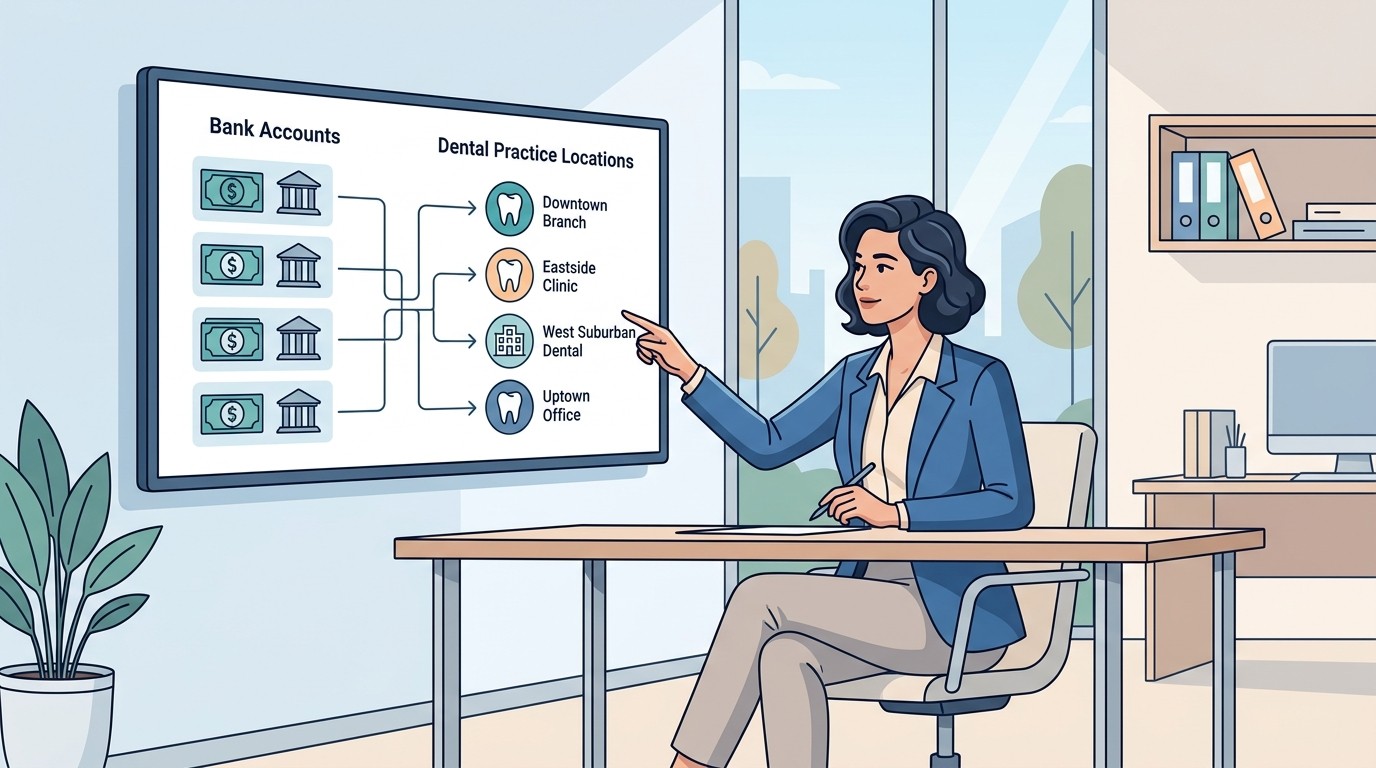
A Revenue Integrity platform that connects to every location's practice management system, bank accounts, clearinghouse, and merchant processor performs the verification continuously across the entire group and surfaces location-level outliers automatically. The group's leadership sees, in one place, which locations are performing, which are leaking, and which show patterns that warrant a closer look. This is the scaled equivalent of the oversight that personal presence provided at single-practice scale.
Bottom Line
Growth multiplies a dental group's financial risk while breaking the personal-attention oversight that managed that risk at single-practice scale. Every added location is added surface area for leakage and fraud, and problems hide in consolidated aggregation. Multi-location groups and DSOs need oversight rebuilt as a system: location-level visibility, standardized processes, reconciliation independent of location staff, cross-location outlier detection, and a verification function that reports to ownership. The groups that build this scale safely. The groups that rely on personal attention discover, eventually, that they stopped being able to see their own money several locations ago.
Zeldent provides multi-location dental groups and DSOs with continuous, location-level reconciliation across every practice, surfacing outliers and revenue leakage automatically and reporting to central leadership. Schedule a demo to see how Revenue Integrity scales financial oversight across your group.