Myrtle Beach Dental Practice Loses $612K to Cash Skimming Scheme
Dental Embezzlement Red Flags Checklist
The specific patterns that indicate billing fraud or embezzlement in a dental practice. Use this checklist to audit your own ledger for the patterns most often missed.
Cash skimming is the oldest form of embezzlement and remains one of the hardest to catch. The Myrtle Beach case shows how a relatively small role, the person who collects and deposits patient payments, can drain $612,000 in 18 months when no one independently verifies that what was collected matches what was deposited.
What Happened
In November 2025, a 39-year-old former employee at Affordable Dentures and Implants on 38th Avenue in Myrtle Beach, South Carolina was arrested by U.S. Marshals on charges of breach of trust with fraudulent intent. According to police, the employee was responsible for collecting and depositing patient payments at the practice. Between January 2024 and August 2025, an 18-month window, she allegedly marked patient accounts as paid while keeping the cash for herself, accumulating more than $612,000 in unaccounted funds.
The investigation, conducted with assistance from federal authorities, relied on bank statements, audit reports, and scheduling records to reconstruct what had been paid versus what had been deposited. The arrest occurred on November 18, 2025. The defendant was booked into the Horry County jail on a $20,000 bond and released the following day pending further proceedings.
Why Cash Skimming Is So Hard to Detect
Cash skimming has a specific structural advantage over other forms of embezzlement. The fraud happens at the very first moment money enters the practice, before it ever appears in the bank statement, before it appears in any reconciliation report, before it generates any kind of digital footprint. The patient pays cash. The employee accepts the cash. The patient leaves. From that moment forward, the only evidence that the payment ever existed is whatever the employee chooses to record.
If the employee records the payment in the practice management system but pockets the cash, the practice management system shows a fully paid account. The patient is satisfied because their account is marked paid. The bank simply receives less cash than it should have, and unless someone is comparing daily cash collections in the practice management system to actual deposits, the gap is invisible.
If the employee does not record the payment at all, the patient may eventually call to dispute a balance, but a small percentage of patients fail to follow up, and even those who do can be told the original record is missing and given a courtesy adjustment. The fraud becomes a small administrative tangle rather than a detectable scheme.
This is why cash-heavy roles, the front desk, the patient billing coordinator, anyone who collects and deposits, are the second-highest risk after the office manager. The role's daily activity sits at the boundary between paper money and the digital systems, which is exactly where independent verification has to happen if the fraud is going to be caught.
What an 18-Month Drain Looks Like in Practice
At $612,000 over 18 months, the average drain was approximately $34,000 per month. For a multi-doctor denture and implant practice, this is significant but absorbable. The practice continued operating, payroll continued running, the schedule presumably stayed full.
The structural lesson is the same as in longer-running cases. Embezzlement schemes that survive past the first few months do so because the practice can absorb the loss without operational disruption. The owner sees collections fluctuate but attributes the variation to seasonality, payer mix, or normal patient attrition. Over months, the cumulative gap is large, but no individual month is anomalous enough to force investigation.
A practice using continuous reconciliation catches this within the first 30 to 60 days. The signature of cash skimming on a reconciliation report is unmistakable. Practice management cash collections consistently exceed cash deposits by a similar amount each day or week. The pattern does not vary much because the perpetrator usually settles into a steady rate of skimming. Once the pattern is visible on a daily dashboard, the question becomes who and how, not whether.
A practice doing manual reconciliation may catch this at quarter end or year end if the CPA is thorough. Many practices do not catch it at all until something else goes wrong, the perpetrator quits, takes a vacation that exposes the gap, or makes a high-profile spending purchase that draws law enforcement attention.
Specific Defenses Against Cash Skimming
Cash skimming defenses are practical and operationally simple, but they require the discipline to enforce them every day.
Daily reconciliation of cash collections to cash deposits, performed by someone other than the person who collected the cash. This is the single highest-leverage defense. If the same person collects cash and reconciles deposits, the structural protection is absent. If a different person, even briefly each day, performs the cross-check, the pattern is caught quickly.
Two-person counting at end of day. Cash drawer counts at the close of each day involve two people, both of whom sign off on the count. The practice management system's cash receipts total for the day must equal the count, and any discrepancy is documented and resolved before the next morning.
Bank deposits performed by someone other than the cash collector. The person who took the cash from patients should not be the person who walks the cash to the bank. Separation of these two functions creates a checkpoint that is otherwise absent.
Drop-safe deposit until reconciliation is complete. Cash collected during the day is deposited into a one-way drop safe that the front desk staff cannot retrieve from. The cash is removed from the safe by the practice owner or a designated controller, counted against the practice management system's daily cash receipts, and only then prepared for bank deposit.
Bank deposit slips matched to practice management cash collection reports daily. Most banks will return scanned deposit slips through online banking. A manager or owner spends 10 minutes per day comparing the deposit slip total to the practice management cash collection report total. Any gap of more than a small variance is investigated immediately.
Patient receipts issued for every cash payment. The receipt is the patient's record of payment, and it creates a third-party record that the practice can later verify against. Patients who pay cash and receive a receipt are protected from disputed balances. Patients who pay cash and do not receive a receipt are vulnerable, and their unrecorded payments are also the easiest to skim.
Why the Audit Reports and Scheduling Records Mattered
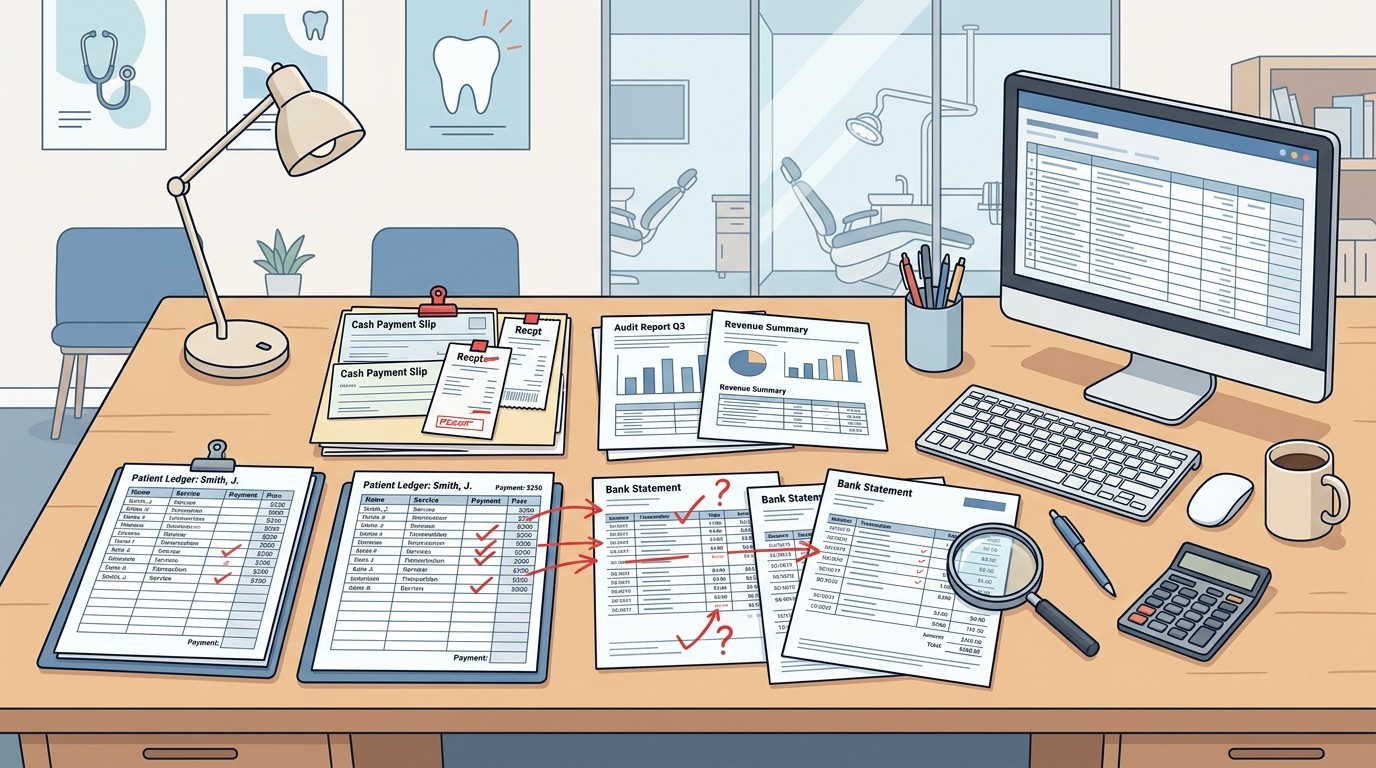
Notably, the Myrtle Beach investigation reportedly used audit reports and scheduling records alongside bank statements to reconstruct the loss. This combination is significant. Schedule records show which patients were seen on which days. Practice management reports show which patients were billed and what was collected. Bank deposits show what cash actually reached the bank. By cross-referencing all three, investigators were able to identify days where patients were seen and presumably paid but the cash did not reach the bank.
This is exactly the cross-reference that continuous reconciliation tools perform. The same data that ultimately built the criminal case could have been compared in real time, surfacing the pattern within 30 days of when it began rather than 18 months later. The forensic accounting that happens after the fact is essentially the same exercise as the reconciliation that should have been happening all along.
What Practice Owners Should Do This Week
If your practice accepts cash payments, three actions matter. Verify that the person who collects cash is not the same person who reconciles deposits to the practice management system. If the answer is no, restructure those two functions to be performed by different people, even if briefly each day.
Implement a daily cash reconciliation that the practice owner sees, even if just a one-line summary. If cash collections reported by the practice management system equal cash deposits reaching the bank, that single line is enough to detect cash skimming within days of when it begins.
Consider moving toward cashless or near-cashless payment options for patients. Card and ACH payments leave digital footprints that cash does not. Practices that have moved to predominantly card-based collection have dramatically less exposure to skimming, simply because there is less cash to skim.
The Myrtle Beach case shows what happens when these structural defenses are absent. The amount and the duration are not extraordinary. They reflect what tends to happen in any practice where one person controls the entire cash workflow.
For the full control framework behind these steps, see our complete guide to dental embezzlement prevention and our practical walkthrough on preventing employee theft.
Sources
The factual reporting in this article is drawn from public news coverage of the Myrtle Beach embezzlement case, including reporting from Dimensions of Dental Hygiene and local Myrtle Beach news outlets. All charges referenced are allegations, and the defendant is presumed innocent until proven guilty.
Zeldent reconciles practice management cash receipts against bank deposits daily and reports directly to the owner. Practices using continuous reconciliation typically detect cash-skimming patterns within the first 30 to 60 days of the activity, before significant losses accumulate. Schedule a demo to see how independent reconciliation closes the gap this case operated in for 18 months.
Dental Embezzlement Red Flags Checklist
The specific patterns that indicate billing fraud or embezzlement in a dental practice. Use this checklist to audit your own ledger for the patterns most often missed.