Real-Time Reconciliation: The Future of Dental Revenue Management
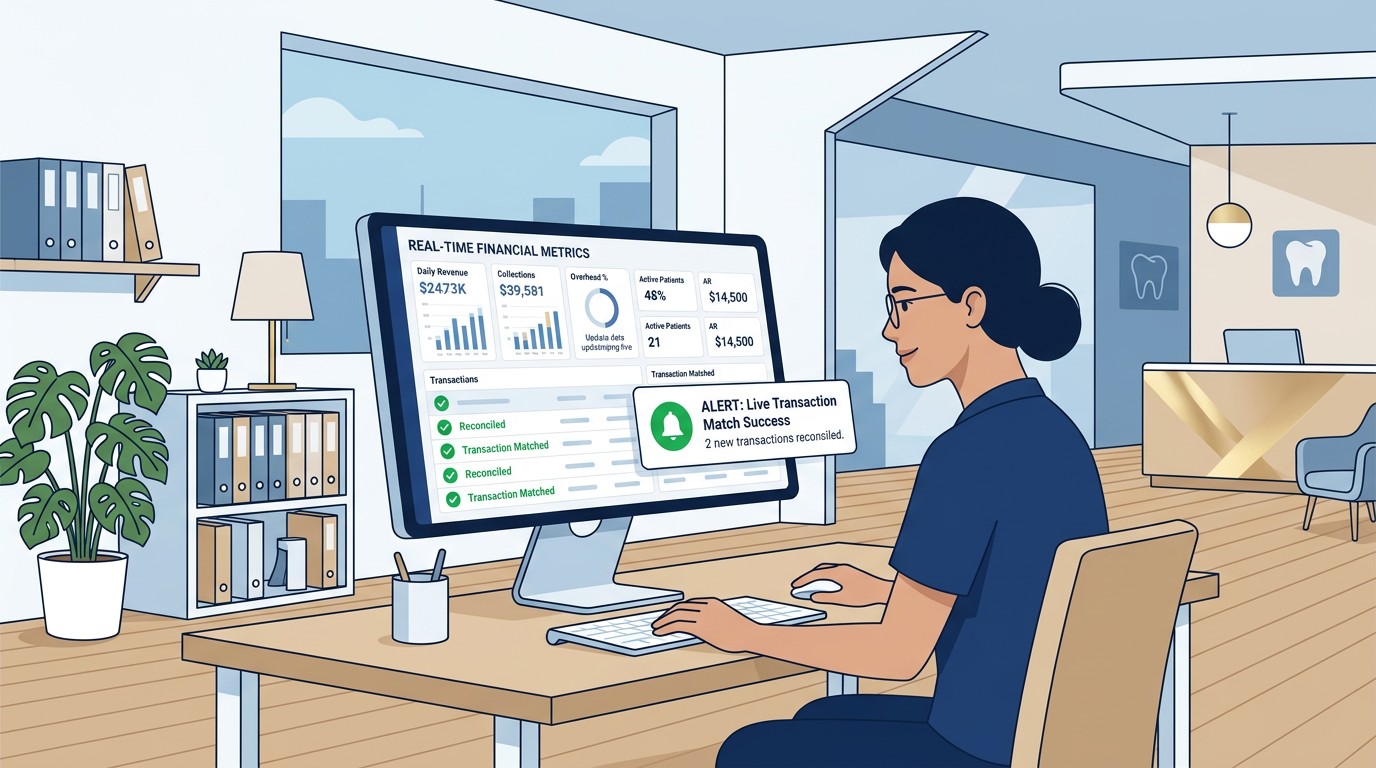
By the time your monthly reconciliation finds a problem, you have lost a month. What if you knew in minutes instead?
📚 Part of our reconciliation series: This article is part of The Complete Guide to Dental Practice Reconciliation, our comprehensive resource on closing your books accurately and preventing revenue leakage.
The Lag Problem
Traditional reconciliation happens after the fact. At the end of the day, someone compares deposit slips to PMS records. At the end of the month, someone reviews bank statements against posted payments. At the end of the quarter, an accountant digs through discrepancies that have aged beyond easy investigation.
This lag creates real costs. A payment posted incorrectly on Monday sits wrong all week until Friday's review. A deposit that fails to settle goes unnoticed for days until someone checks the processor dashboard. An insurance payment arrives and enters a posting queue where it waits for attention that might not come until next month.
Every day of lag is a day when errors compound, when money sits unrecognized, when problems become harder to solve. The longer you wait to reconcile, the more you lose in the gap between what happened and what you know happened.
What Real-Time Means
Real-time reconciliation compares transactions as they occur rather than in batches afterward.
When a credit card processes, real-time reconciliation immediately compares the authorization to the PMS entry. If they match, confirmation is instant. If they do not match, an alert surfaces immediately while the patient is still in the office and the transaction is fresh.
When a deposit hits the bank, real-time reconciliation compares it to expected deposits based on PMS records and processor batches. Matched deposits confirm instantly. Unmatched deposits trigger investigation while the trail is still warm.
When an insurance payment arrives via EFT, real-time reconciliation parses the ERA and compares to expected reimbursement. Payments that match expectations flow through. Underpayments and unexpected adjustments surface for review the same day they arrive.
This immediate comparison transforms reconciliation from a backward-looking audit into a forward-looking control. Instead of discovering problems, you prevent them or catch them before they propagate.
The Information Value
Knowing your revenue position in real-time changes how you operate.
You know what you actually collected today, not what you think you collected based on PMS entries that might be wrong. This is your true cash position, verified against bank records, not an estimate based on staff data entry.
You know what should arrive tomorrow. Insurance payments in process, credit card batches settling overnight, checks in transit to the bank. You can anticipate cash flow rather than reacting to it.
You know what went wrong while it is still fixable. A credit card decline that should have been retried. A posting error that created a false patient credit. An insurance payment that needs follow-up. Same-day alerts mean same-day resolution.
This information advantage compounds over time. Practices with real-time visibility make better decisions because they work from accurate data. Practices working from lagged data make decisions based on what they thought was true, which might differ from reality.
The Process Change
Implementing real-time reconciliation requires different processes than batch reconciliation.
Someone needs to monitor alerts and respond to them. Real-time information is only valuable if someone acts on it. This might mean dedicating time each day to reviewing and clearing alerts, or it might mean distributing responsibility across staff.
Workflows need to accommodate immediate corrections. When real-time reconciliation identifies a posting error, correcting it should be simple and immediate. If corrections require manager approval, escalation, or complex procedures, the speed advantage of real-time detection is lost.
Staff need to understand that discrepancies will be caught immediately. This awareness changes behavior. Errors that might have gone unnoticed for weeks now surface within hours. Staff naturally become more careful when they know their work will be verified immediately.
Training should emphasize why real-time matters, not just how to use the tools. Staff who understand the cost of delayed detection appreciate why immediate reconciliation is worth the effort.
Technology Requirements
Real-time reconciliation requires integration between systems that traditionally operate separately.
Your PMS holds records of what should have happened: treatments rendered, payments expected, adjustments posted. Real-time reconciliation needs programmatic access to this data, not just manual report exports.
Your payment processor holds records of what actually processed: authorizations, settlements, deposits. Real-time reconciliation needs API connections to pull this data as transactions occur, not batch files delivered daily.
Your bank holds records of what actually deposited. Real-time reconciliation ideally connects to bank feeds that report deposits within hours rather than waiting for monthly statements.
Insurance clearinghouses hold ERA data showing what payers actually remitted. Real-time reconciliation needs these files as they arrive, matched to expected payments from submitted claims.
Connecting these systems creates a unified view where transaction data from multiple sources can be compared automatically. Without integration, reconciliation requires manual data gathering that makes real-time impractical.
The Alert Philosophy
Real-time reconciliation generates alerts when discrepancies occur. Managing these alerts is crucial for effectiveness.
Alerts should be actionable. An alert that says "discrepancy detected" without context is not helpful. Alerts should identify what does not match, where to find the relevant records, and what action might resolve the issue.
Alerts should be appropriately sensitive. Too many alerts create noise that causes staff to ignore them. Too few alerts miss problems that should surface. Calibrating alert thresholds balances catching issues against creating alert fatigue.
Alerts should route to the right people. A posting discrepancy should go to billing staff. A settlement failure should go to the office manager. A suspected fraud pattern should go to the practice owner. Routing ensures the person who can act receives the alert.
Alerts should have resolution workflows. Once an alert is generated, what happens next? Who investigates? Who documents the resolution? Who closes the alert? Clear workflows prevent alerts from lingering indefinitely.
The Fraud Detection Advantage
Real-time reconciliation dramatically improves fraud detection.
Most dental practice embezzlement involves manipulating records over time. Small amounts disappear regularly, adding up to large totals over months or years. The embezzler relies on the gap between transactions and review to avoid detection.
Real-time reconciliation eliminates that gap. If someone pockets cash and posts a lower amount, the discrepancy between expected and actual deposits surfaces immediately. If someone processes a fraudulent refund, the mismatch between PMS records and processor records generates an alert the same day.
The deterrent effect is significant. Employees considering theft know that discrepancies will be caught within hours rather than hidden for months. This knowledge prevents some fraud that might otherwise occur.
When fraud does occur, real-time detection limits the damage. Catching a problem on day one means losses are limited to day one. Catching a problem after six months means losses accumulated for six months. Speed of detection directly affects magnitude of loss.
Beyond Reconciliation
Real-time reconciliation creates a foundation for broader real-time financial management.
Real-time revenue dashboards become possible when you know your actual collections as they happen. You can track daily performance against goals, seeing whether you are on pace without waiting for end-of-week reports.
Real-time cash flow projection improves when you know what collected today and what is in process. You can anticipate payroll funding, major purchases, and other cash needs with current information rather than lagged data.
Real-time performance comparison across locations becomes feasible for multi-practice groups. Headquarters can see which locations are reconciling clean and which are showing problems, enabling intervention before issues grow.
Real-time vendor management improves when you can track payer performance as payments arrive. Which insurance companies are paying slowly? Which are underpaying? Real-time data answers these questions continuously.
The Transition
Moving from batch reconciliation to real-time reconciliation is a transition, not a switch.
Start with one data source. Connect credit card processing first, or bank deposits, or insurance ERAs. Prove the concept with one integration before expanding.
Build comfort with alert management. Staff need to develop habits around reviewing and resolving alerts. Start with a manageable alert volume and expand as processes mature.
Maintain batch reconciliation as a backup during transition. Until you trust real-time processes fully, keep running your end-of-day or end-of-week checks. Confidence builds over time.
Measure the improvement. Track how quickly discrepancies are identified and resolved before and after real-time implementation. Quantifying the improvement justifies the investment and motivates continued adoption.
The practices that transition successfully are those that commit to the change rather than treating real-time as an experiment. Half-hearted implementation produces half-hearted results. Full commitment produces transformative improvement.
The Competitive Advantage
Practices with real-time reconciliation operate differently than those without.
They know their numbers. Not approximately, not after the fact, but accurately and currently. This knowledge informs every decision from staffing to expansion to compensation.
They catch problems immediately. What would have been a month of losses becomes a single incident. What would have been a complicated investigation becomes a simple correction.
They spend less time on reconciliation overall. Immediate matching is faster than investigating aged discrepancies. Staff time shifts from detective work to productive activities.
They have confidence in their financial data. Reports reflect reality because reality is continuously verified. Decisions based on these reports are decisions based on truth.
Real-time reconciliation is where revenue management is heading. The practices that adopt it now gain advantages that compound over time. Those that wait will eventually catch up, but they will have lost the years of benefits that early adopters captured.
Zeldent provides real-time reconciliation by connecting directly to your payment sources and comparing them to your PMS continuously. Discrepancies surface within hours, not weeks. Schedule a demo to see real-time reconciliation in action.