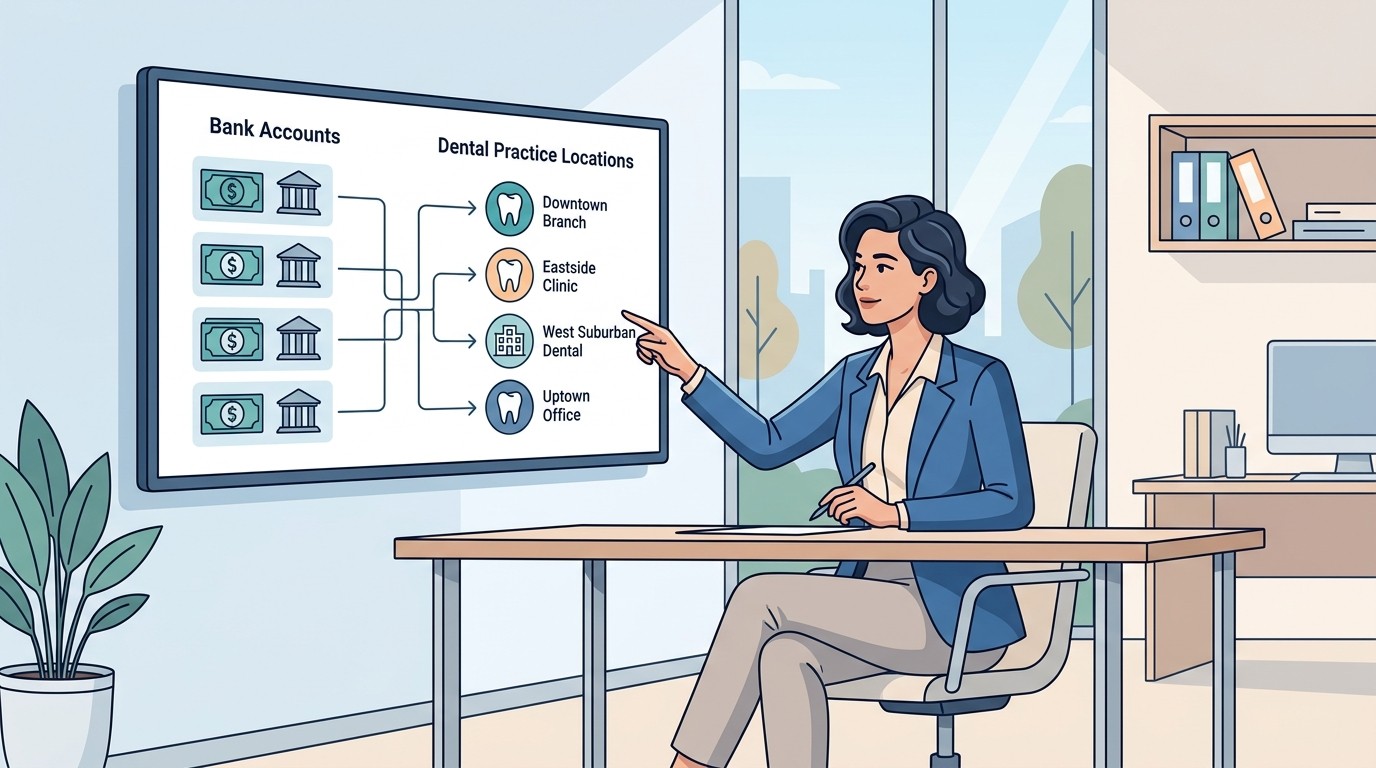
Red Flags Accountants Look for in Dental Practice Financials
After twenty years reviewing dental practice financials, you develop a sixth sense for trouble. The numbers tell stories, and some of those stories have unhappy endings.
📚 Part of our reconciliation series: This article is part of The Complete Guide to Dental Practice Reconciliation, our comprehensive resource on closing your books accurately and preventing revenue leakage.
The Accountant's Eye
When an experienced accountant sits down with a dental practice's financials, they are not just checking that debits equal credits. They are reading a narrative. They are looking for the parts of the story that do not quite fit, the chapters where something feels off even if they cannot immediately say why.
This pattern recognition comes from seeing hundreds of practices over the years. You learn what healthy looks like. More importantly, you learn what sick looks like before it becomes critical. The warning signs are often subtle, easy to dismiss individually, but together they paint a picture that demands attention.
This guide covers the red flags that make accountants pause, dig deeper, and sometimes have uncomfortable conversations with practice owners about what the numbers really mean.
Revenue Red Flags
The Declining Collection Rate
A healthy dental practice collects 96% to 98% of its adjusted production. When that number starts slipping, something is wrong. Maybe the front desk stopped following up on patient balances. Maybe insurance claims are getting denied and nobody is appealing them. Maybe the billing person left six months ago and the replacement never quite got up to speed.
Or maybe someone is stealing.
The concerning pattern is not a single bad month. It is the slow drift downward over time. The practice that was at 97% last year is at 94% now. Nobody noticed because the decline was gradual, maybe half a point per quarter. But compounded over two years, that is tens of thousands in collections that should have happened and did not.
When I see collection rates below 94%, I start asking questions. When I see a declining trend without an operational explanation, I keep asking until I get answers that make sense.
Growing Accounts Receivable
Accounts receivable should be relatively stable as a percentage of production. If production is flat but AR keeps growing, money that should be coming in is not arriving. That is either a collection problem or a posting problem, and neither is good.
The aging of AR matters as much as the total. Healthy practices have very little AR over 90 days because insurance either pays within 60 days or it becomes clear the claim needs work. When I see a practice with 20% or 30% of AR over 90 days, I know either nobody is working those claims or there is something fundamentally broken in the billing process.
Sometimes growing AR is more sinister. I have seen practices where AR was artificially inflated to make the books look better than reality, either to support a higher valuation or to hide the fact that collections were actually declining. The receivable looked like an asset on the balance sheet, but it was really an illusion.
Unidentified Deposits
Every dollar that hits the bank account should be traceable to a specific source. When I see deposits that cannot be explained, that nobody can match to an insurance ERA or a patient payment, it tells me the practice has lost control of its revenue cycle.
Sometimes unidentified deposits are innocent. An insurance payment came in and the ERA is sitting in a clearinghouse queue that nobody checked. A patient paid an old balance and the payment got posted to the wrong account. These things happen.
But unidentified deposits that persist month after month are a different story. That pattern suggests either profound operational dysfunction or something being deliberately hidden. I have seen both, and neither ends well for the practice owner.
Expense Red Flags
Payroll Creeping Upward
Staff costs typically run 25% to 30% of collections in a well-managed dental practice. When that percentage starts climbing without a corresponding increase in revenue or service capability, something is off.
Sometimes the explanation is simple. The practice gave raises but did not increase production. They hired ahead of growth that never materialized. The owner's spouse went on payroll at a salary that does not match any actual work performed.
The more concerning scenarios involve ghost employees or unauthorized overtime. I once found a practice where the office manager had put a family member on payroll for three years. The person never worked a day in the office. That family member received $120,000 before anyone noticed.
Payroll is where I see the most money walk out the door, both through fraud and through poor management. Any practice where staff costs exceed 32% of collections gets a hard look at exactly who is being paid and what they are doing.
Lab Cost Volatility
Lab costs should be predictable relative to the procedures being performed. A practice doing consistent crown and bridge work should have consistent lab expenses. When lab costs swing wildly from month to month without corresponding changes in procedure mix, something is wrong with either the coding, the vendor relationships, or the controls.
Unusual vendor concentration is also a warning sign. If 80% of lab costs go to one vendor and the practice cannot clearly explain why that vendor is the best choice, I wonder about the relationship. Kickback schemes between dental practice staff and lab vendors are not common, but they happen often enough that any unexplained vendor loyalty deserves scrutiny.
Supply Costs Out of Line
Dental supplies typically run 5% to 7% of collections. A practice running at 10% is either wasteful, getting robbed, or charging personal expenses to the practice.
The personal expense problem is more common than most owners realize. An office manager who handles purchasing discovers that nobody checks receipts carefully. First it is a personal item buried in a Costco order. Then it is regular personal shopping on the practice credit card. By the time someone notices, thousands of dollars have walked out the door.
I always want to see the actual invoices behind unusual supply expense patterns, not just the totals.
Balance Sheet Red Flags
Persistent Credit Balances
Patient credit balances represent money the practice owes back to patients. A few thousand in credit balances is normal. Tens of thousands, especially credit balances that have been sitting for months, is a problem.
Some of those credits are real. A patient prepaid for treatment they never completed. Insurance paid more than expected. These should be refunded.
Some of those credits are posting errors. Payments got applied to wrong accounts. Adjustments were entered backwards. These need to be corrected.
And some of those credits are covering fraud. I have seen schemes where an embezzler posted fake credits to patient accounts, then processed refund checks to themselves. The practice thought they were cleaning up credit balances. They were actually writing checks to a thief.
When credit balances exceed 1% of annual collections, I want to understand every dollar.
Cash Declining While Revenue Holds
If a practice reports stable revenue but cash keeps declining, money is going somewhere it should not. This disconnect between reported profitability and actual cash position is one of the clearest signals that something is wrong.
Legitimate explanations exist. The practice might be paying down debt aggressively. Owner distributions might exceed net income. Capital expenditures might be funded from operations.
Illegitimate explanations also exist. Revenue might be overstated. Expenses might be understated. Cash might be walking out the door in someone's pocket.
I reconcile reported income to actual cash flow on every engagement. The practices where these numbers diverge significantly always have stories worth hearing.
Debt Increasing Without Investment
When practice debt keeps growing but there are no new assets, no expansion, no equipment purchases to show for it, the money went somewhere. Maybe the owner is taking distributions the practice cannot afford. Maybe cash flow is weaker than reported. Maybe someone is stealing and the practice is borrowing to cover the shortfall.
I once worked with a practice that had doubled its line of credit over three years. Production was flat. There were no capital improvements. The owner could not explain where the money went. It took a forensic investigation to discover that the bookkeeper had been siphoning cash and the practice had been borrowing to stay afloat without understanding why cash was always tight.
Adjustment Red Flags
Adjustment Spikes
Adjustments should be predictable relative to production. A practice writing off 15% of production month after month might have a fee schedule problem, but at least it is consistent. A practice whose adjustments jump from 12% to 25% in a single month has something unusual happening.
Sometimes the explanation is an aggressive AR cleanup. The practice decided to write off old balances they were never going to collect. That is a legitimate, if painful, business decision.
Other times the explanation is that someone needed to make the books balance after stealing money. Adjustments are the easiest way to hide theft because they require nothing but a journal entry. No cash has to move. No outside party has to cooperate. Just enter the adjustment and the stolen payment disappears from the patient's balance.
Round Number Adjustments
Legitimate insurance adjustments come in odd amounts. The allowed amount was $847.23, you billed $1,100, so the adjustment is $252.77. When I see adjustments in round numbers, especially nice even figures like $500 or $1,000, my antenna goes up.
Round number adjustments often come from manual entries rather than systematic processing. Manual entries require human judgment, which means human error or human intent. A series of round-number adjustments from the same staff member is a pattern worth investigating.
One Person Making All Adjustments
Adjustments should require some level of oversight, at least a second set of eyes. When I see one person responsible for 100% of adjustment activity, I see a control weakness that invites exploitation.
The person making adjustments should not be the same person collecting payments, making deposits, or reconciling accounts. When one person controls the entire cycle from collection through posting through adjustment, that person can steal without leaving obvious traces.
I have seen too many embezzlement cases where the scheme would have been obvious if anyone else had been involved in the process. Separation of duties is not just accounting theory. It is theft prevention.
The Control Environment
No Regular Reconciliation
When I ask to see reconciliation records and get blank stares, I know I am dealing with a practice that has no idea whether their reported revenue matches their actual cash. This is not just a red flag. It is a flashing red alarm.
Reconciliation is how you know. Without it, you are trusting that everyone is honest, that no mistakes are being made, that nothing is falling through the cracks. That trust is misplaced. Every practice needs regular reconciliation, and every practice without it is flying blind.
One Person Controls Everything
The most vulnerable practices are those where a single trusted employee handles all financial functions. This person opens the mail, makes deposits, posts payments, makes adjustments, reconciles accounts, and handles the bank statements. The owner trusts them completely because they have been there for fifteen years and they are like family.
These are the practices that end up on the news. Complete trust without verification is not loyalty. It is negligence. The office manager who has been there forever has also had forever to figure out how to exploit the lack of oversight.
Resistance to Questions
When I ask questions about financial matters and get defensiveness rather than answers, I pay attention. Honest employees explain. They pull up records, walk through transactions, show their work. Employees with something to hide deflect, make excuses, get emotional, or answer questions that were not asked.
Resistance to outside accountants is particularly telling. A practice owner who says their staff does not like me asking questions is telling me something important. They are telling me their staff has something they do not want found.
What To Do With Red Flags
Finding red flags is only the first step. Knowing what to do with them matters more.
Document what you see with specificity. Vague concerns are easy to dismiss, but specific data commands attention. Note the amounts, the dates, the patterns. Build a picture that shows the trend, not just a single data point.
Present findings factually, not accusatorially. Practice owners are often defensive about their teams. They hired these people, they trust them, and hearing that something might be wrong feels like a personal criticism. Let the numbers speak. Ask questions rather than making accusations. Create space for explanations while maintaining your professional skepticism.
Recommend appropriate action based on what you found. Sometimes that means additional investigation. Sometimes it means bringing in forensic specialists. Sometimes it means implementing controls that should have existed all along. What you cannot do is ignore red flags and hope they resolve themselves. They do not. They compound.
The practices that survive financial problems are the ones that face them early. The ones that fail are usually the ones where someone saw the warning signs and decided not to make waves. Making waves is your job. The discomfort of hard conversations is nothing compared to the devastation of discovering fraud that has been running for years.
Reviewing dental practice financials and want automated red flag detection? Zeldent continuously monitors reconciliation patterns, identifies anomalies, and surfaces concerns before they become crises. For accountants managing multiple dental clients, our multi-practice dashboard lets you see warning signs across your entire portfolio at a glance. Schedule a demo to see how Zeldent supports proactive oversight.