Vendor Due Diligence: 7 Security Questions to Ask

You have thirty-seven locations running four different PMS platforms with dozens of third-party integrations. How confident are you that each of those connections meets your security standards?
📚 Part of our DSO series: This article is part of The DSO Financial Operations Playbook, our comprehensive guide to building scalable financial operations across multiple dental practice locations.
The Scale Challenge
Managing vendor relationships at a dental support organization is fundamentally different from managing them at a single practice. A solo practitioner might evaluate one new software tool per year and make a decision based on a demo and a few reference calls. A DSO with dozens or hundreds of locations faces an entirely different challenge.
Your portfolio likely runs multiple practice management systems. Acquisitions bring Dentrix practices, Eaglesoft practices, Open Dental practices, and others into your organization. Each platform has its own integration ecosystem, its own partnership programs, and its own technical architecture. Software that integrates beautifully with one PMS might use entirely different methods to connect to another.
Beyond PMS diversity, you have scale to consider. A security vulnerability at a single practice exposes that practice's data. A security vulnerability in a vendor that connects to every practice in your portfolio exposes your entire organization. The risk multiplies with your size.
And you have operational consistency concerns. If a vendor integration fails at one practice, that practice has a bad day. If the same vendor integration fails across your entire portfolio simultaneously, you have a crisis. Understanding how vendors connect, and whether those connections are robust, becomes a portfolio-level risk management question.
This document provides a framework for evaluating vendor integration security systematically across a multi-location dental organization.
Building an Integration Inventory
Before you can evaluate integration security, you need to know what integrations exist. This sounds obvious, but many DSOs discover they lack comprehensive visibility into the third-party software operating across their locations.
Start by cataloging every software tool that connects to your PMS platforms. This includes obvious categories like revenue cycle management, patient communication, and analytics, but also less obvious ones like marketing automation, reputation management, and specialty-specific clinical tools.
For each tool, document which locations use it, which PMS platforms it connects to, and what data it accesses. A tool used at three practices connecting only to Dentrix has different risk characteristics than a tool used at fifty practices connecting to four different PMS platforms.
Identify who authorized each integration. Was it approved at the corporate level, or did individual practice managers adopt it independently? Integrations that bypassed central IT review may not have received appropriate security scrutiny.
Document the credentials situation for each integration. Does the software use API tokens, or does it require staff login credentials? If credentials are involved, whose credentials are being used, and where are they stored?
This inventory becomes your foundation for systematic evaluation. Without it, you are working blind, unable to assess risks you cannot see.
The Evaluation Framework
With an inventory in hand, you can evaluate each integration against a consistent set of criteria. This framework focuses on integration method, vendor security practices, compliance alignment, and operational stability.
Integration method is the first and most fundamental criterion. For each software tool, determine how it actually connects to your PMS. Official API integration through documented partnerships is the gold standard. Screen scraping using stored credentials represents significantly higher risk. Direct database access outside official channels is concerning. Understanding the technical reality beneath the vendor's marketing language is essential.
Verify partnership claims independently. If a vendor claims to be a certified Dentrix partner, check Henry Schein's published partner directory. If they claim Eaglesoft certification, verify through Patterson's documentation. Claims that cannot be verified should be treated skeptically.
Vendor security practices matter regardless of integration method, but they matter more for vendors using riskier approaches. Request documentation of the vendor's security program. Ask about SOC 2 certification, penetration testing, security incident history, and data handling procedures. A vendor storing your PMS credentials on their servers should have robust security practices, and you should verify those practices rather than taking them on faith.
Compliance alignment includes both the vendor's own compliance status and how their integration affects your compliance. Ensure Business Associate Agreements are in place and current. Assess whether the integration method creates audit trail problems or other compliance complications. Consider how you would explain the vendor's data access to a regulator or auditor.
Operational stability refers to the integration's reliability over time. Ask about the vendor's track record during PMS updates. How often has the integration failed? How quickly were failures resolved? A vendor with a history of prolonged outages after PMS updates is showing you what your future experience will look like.
Risk Stratification
Not all integrations carry equal risk. A tool that accesses limited scheduling data at a few locations presents different exposure than a tool with comprehensive access to clinical and financial data across your entire portfolio. Your evaluation intensity should match the risk level.
High-risk integrations warrant the most thorough evaluation. These include integrations that access PHI or financial data, integrations deployed across many or all locations, integrations using credentials-based methods, and integrations from vendors with limited track record or unclear security practices.
For high-risk integrations, consider requesting formal security documentation, conducting security questionnaires, reviewing contracts carefully with legal counsel, and potentially engaging third-party security assessments.
Medium-risk integrations still deserve careful evaluation but may not require the same depth. These might include integrations with limited data access, integrations confined to a subset of locations, or integrations from well-established vendors with verified partnership status.
Lower-risk integrations include tools with minimal PMS access, tools used at only a few locations, and tools from vendors with strong security credentials and official partnership status. These still merit review, but the review can be proportionally less intensive.
Risk stratification helps you allocate evaluation resources effectively. You cannot conduct exhaustive due diligence on every integration, but you can ensure that your highest-risk vendors receive the scrutiny they deserve.
Standardizing Across Platforms
A DSO running multiple PMS platforms faces the additional challenge of evaluating integrations that behave differently on different platforms. A vendor might have official partnership with Dentrix but use screen scraping for Eaglesoft. The same software presents different risk profiles depending on which PMS it connects to.
For vendors operating across multiple platforms in your portfolio, evaluate each platform-specific integration separately. Do not assume that partnership on one platform means partnership on all platforms. Ask specifically about each PMS in your environment.
Consider platform-specific risks. Some PMS platforms have more robust API programs than others. Some have stricter partnership requirements. A vendor's integration quality may vary across platforms based on what each PMS makes available.
Document your findings by platform. Your risk assessment for a vendor should note that they are certified for Dentrix but use unofficial methods for Eaglesoft, if that is the case. This platform-specific view helps you make location-level decisions about which integrations to permit.
Vendor Assessment Questionnaire
A standardized questionnaire ensures consistent evaluation across vendors. Consider including the following areas:
Integration architecture questions should ask how the software connects to each PMS platform in your portfolio, what specific APIs, bridges, or interfaces are used, whether any staff credentials are required, how credentials are stored if required, what data the integration accesses, and whether access is read-only or read-write.
Partnership verification questions should ask for documentation of partnership or certification status with each relevant PMS vendor, how long the partnership has existed, what level of partnership has been achieved, and for references from the PMS vendor confirming partnership.
Security practice questions should ask about SOC 2 certification or equivalent, penetration testing frequency and results, security incident history, encryption practices for data in transit and at rest, access controls limiting who can access customer data, and employee security training.
Compliance questions should ask about willingness to execute a BAA, HIPAA training for staff with PHI access, breach notification procedures, and data retention and deletion policies.
Operational stability questions should ask about integration uptime over the past twelve months, average resolution time for integration failures, process for handling PMS updates, and advance notification provided before maintenance or changes.
A consistent questionnaire enables comparison across vendors and ensures you do not overlook important factors for any particular evaluation.
Remediation Strategies
Your evaluation will likely identify integrations that do not meet your security standards. Having a remediation playbook helps you address these systematically.
For integrations that pose unacceptable risk, replacement may be necessary. Identify alternative vendors that offer similar functionality through more secure integration methods. Plan migration timelines that minimize operational disruption.
For integrations with moderate concerns, improvement may be possible without replacement. Can the vendor migrate from credentials-based to API-based integration? Can they achieve partnership certification they currently lack? Are they willing to implement specific security improvements? Some vendors will make changes to retain a large DSO customer.
For newly identified shadow IT, determine whether the integration should be brought under central management or discontinued. Local software adoptions that bypassed IT review may lack appropriate security controls. Decide whether to formalize and secure these integrations or eliminate them.
Prioritize remediation based on risk level. Address the highest-risk integrations first. Create a timeline that your team can execute while maintaining operational continuity.
Ongoing Monitoring
Vendor security is not a one-time evaluation. The landscape changes continuously. Vendors release new versions, change their integration methods, experience security incidents, or modify their partnership status. Your monitoring must be ongoing.
Establish periodic re-evaluation cycles. Annual reviews of significant vendors, triggered reviews when vendors announce major changes, and continuous monitoring for security incidents all contribute to maintaining visibility.
Track PMS update impacts. After each major PMS update across your portfolio, verify that integrations continue functioning and note any vendors that experienced problems. Patterns of post-update failures suggest integration fragility.
Monitor vendor communications. Subscribe to vendor newsletters, security bulletins, and status pages. Awareness of vendor changes helps you anticipate issues rather than discovering them through operational failures.
Include integration security in your acquisition due diligence. When acquiring new practices, inventory their integrations and evaluate them against your standards before integration into your portfolio.
Building Organizational Capability
Effective vendor security evaluation requires organizational commitment. Someone needs to own this function, have authority to make decisions, and have resources to execute evaluations and remediation.
Consider establishing clear ownership for vendor security. This might sit within IT, within compliance, or as a shared responsibility with clear accountability. Whoever owns it needs mandate to require vendor participation in evaluations and to make binding decisions about which integrations are permitted.
Develop evaluation templates and procedures that can scale with your organization. A repeatable process ensures consistency as your portfolio grows and as team members change.
Build relationships with PMS vendors that enable you to verify partnership claims efficiently. Having a contact at Henry Schein or Patterson who can confirm a vendor's status accelerates your due diligence.
Train practice-level staff on integration security basics. Help them understand why central IT review matters, what to look for in software that wants PMS access, and how to escalate questions about unfamiliar integrations.
The Competitive Advantage
DSOs that manage vendor integration security effectively gain advantages over those that do not. Reduced security incidents protect your reputation and avoid costly breach responses. Operational stability across your portfolio improves practice performance. Compliance confidence simplifies audits and reduces regulatory risk.
These advantages compound as you grow. Each acquisition brings new integrations that your processes can evaluate and align with your standards. Your security posture improves rather than degrading as your portfolio expands.
Perhaps most importantly, systematic vendor evaluation builds institutional knowledge. You develop understanding of which vendors meet high standards, which have room for improvement, and which should be avoided. That knowledge accelerates future decisions and helps you guide acquired practices toward better solutions.
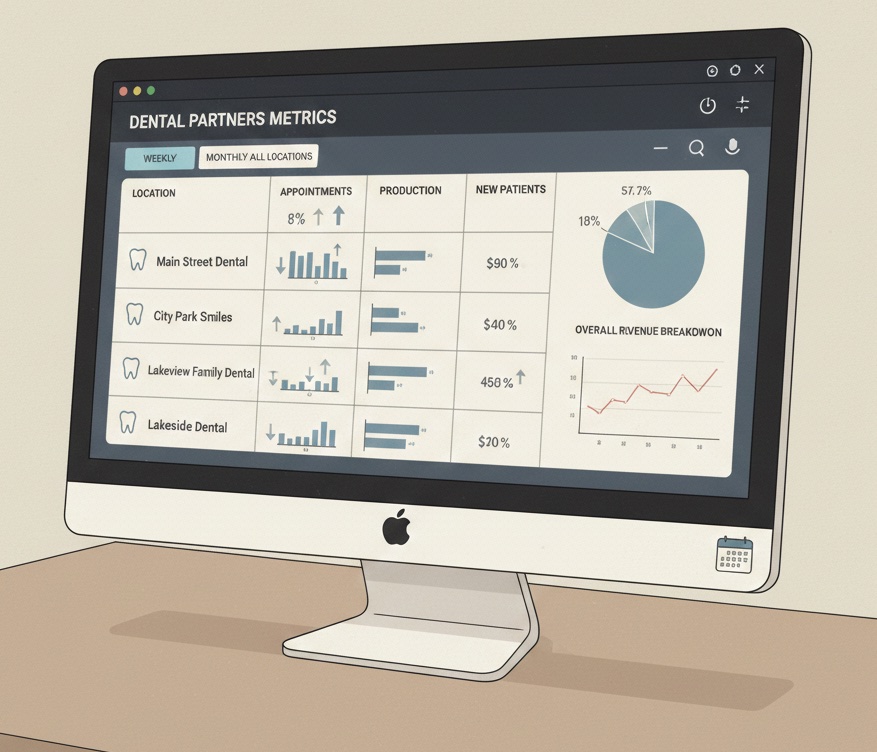
Zeldent maintains official integration partnerships with Dentrix, Eaglesoft, Open Dental, and Curve Dental, providing consistent security and stability across multi-platform DSO environments. Our multi-location dashboard gives finance leaders visibility across their entire portfolio. Schedule a demo to see how Zeldent supports DSO-scale operations.