Year-End Financial Close for Dental Practices: A Complete Guide
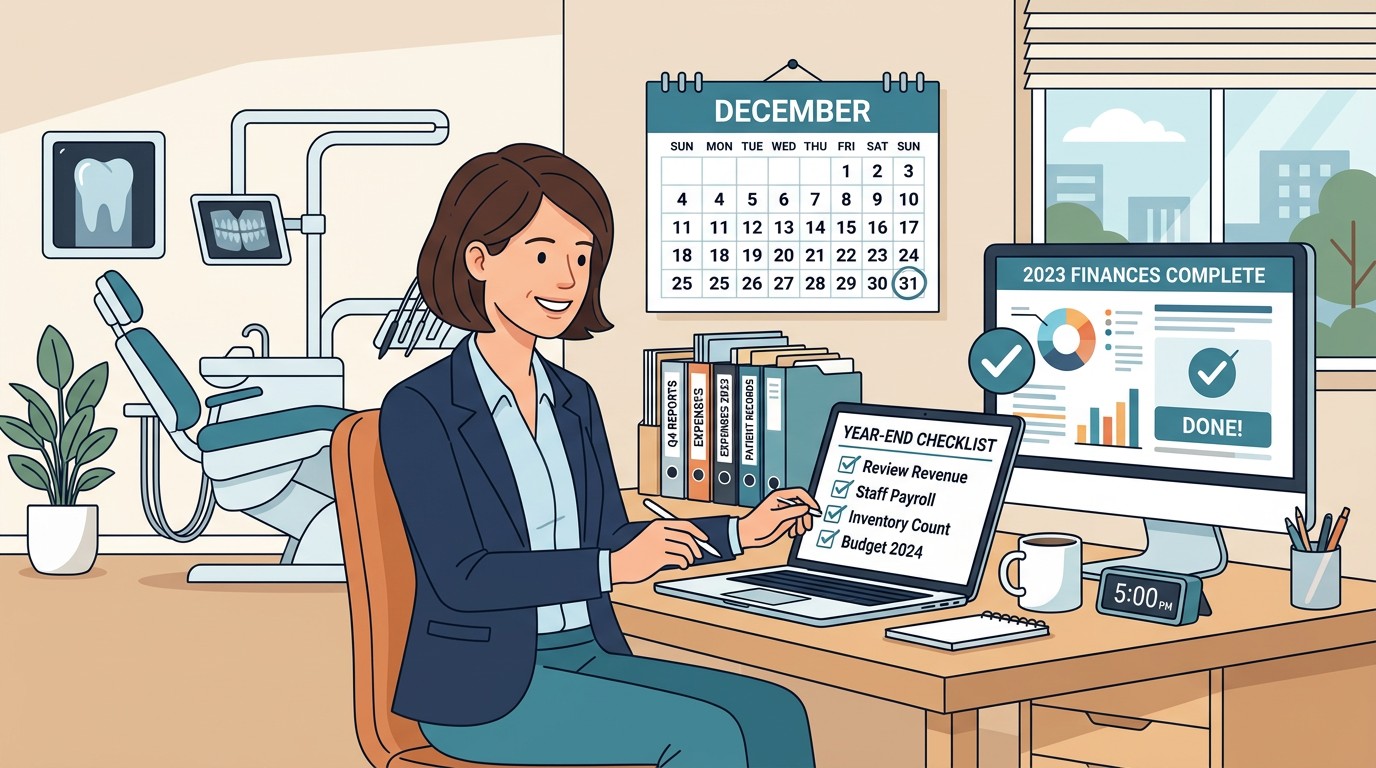
December 31st is not just the last day of the year. It is your deadline for ensuring every dollar is in its proper place.
📚 Part of our reconciliation series: This article is part of The Complete Guide to Dental Practice Reconciliation, our comprehensive resource on closing your books accurately and preventing revenue leakage.
Why Year-End Matters
The end of the fiscal year creates a line in the sand. Everything on one side belongs to this year. Everything on the other belongs to next year. Getting that line right affects your taxes, your financial statements, your planning, and your peace of mind.
Practices that close their books properly start the new year with clarity. They know exactly what they earned, what they collected, what they owe, and where they stand. Practices that scramble through year-end carry uncertainty into the new year, making decisions based on incomplete information.
Year-end close is also when accumulated problems surface. The posting backlog that seemed manageable in March looks different in December when you realize those entries need to be in the right year. The reconciliation you postponed becomes urgent when your accountant needs final numbers.
Treating year-end as a deadline rather than just another day forces the discipline that keeps records accurate. The pressure is actually helpful. It creates urgency for tasks that might otherwise drift indefinitely.
The Timing Challenge
Year-end close involves transactions that span the boundary between years.
Deposits made in late December might not post until January. Insurance payments mailed in December might arrive in January. Patient payments collected December 31st need to be deposited and recorded before the year closes, but the bank deposit might not show until the next business day.
This timing complexity means year-end close is not a single-day event. It extends from mid-December through mid-January as you ensure transactions land in the correct year.
The goal is matching economic reality to accounting records. If you earned revenue in December, it should show in December even if the cash arrives in January. If you incurred expenses in December, they should hit December even if you pay them in January. This matching principle drives accurate financial statements.
Your accountant can guide you on specific timing rules, especially if cash versus accrual accounting affects your situation. But the basic principle holds regardless: transactions belong in the year when the underlying economic event occurred.
Clearing the Posting Backlog
Nothing derails year-end close like a backlog of unposted payments. If December arrives and you have insurance payments from October still awaiting posting, you face an ugly choice between rushing through the backlog or closing the year with inaccurate records.
The weeks leading into year-end should include aggressive attention to posting queues. Every payment that arrived should be posted. Every ERA should be processed. The goal is reaching December with posting current rather than catching up under pressure.
If you do have a backlog, prioritize getting December transactions posted correctly. Older transactions still matter, but a misposted October payment has less impact on year-end accuracy than a misposted December payment. Focus first on current-year transactions landing in the current year.
Reconciliation helps identify what is missing. Compare your bank deposits to your posted payments. The difference reveals your backlog concretely. You know exactly how many dollars need to be posted and can work through them systematically.
Accounts Receivable Cleanup
Year-end is a natural time to review accounts receivable and address aged balances.
Patient balances over 90 days old are unlikely to collect without active intervention. Either pursue collection or write off balances that are genuinely uncollectable. Carrying ancient receivables on your books overstates your assets and creates clutter.
Insurance receivables need similar attention. Claims pending for months may have missed timely filing windows. Follow up aggressively on outstanding claims before year-end, both to collect what you can and to write off what is genuinely lost.
Review credits on accounts as well. Patient credits might represent overpayments that need refunding or posting errors that need correction. Clean up credits so your accounts receivable reflects actual amounts owed rather than net positions hiding problems.
The goal is an accounts receivable balance that you believe you can actually collect. Inflated receivables feel good on paper but mislead you about your financial position. Honest receivables, even if smaller, give you accurate information.
Deposit and Payment Verification
Before closing the year, verify that every dollar you collected actually made it to the bank and the ledger.
Pull your bank statements for December. Every deposit should trace to posted payments. If deposits and postings do not match, investigate before closing. Finding discrepancies in January is much harder than finding them while records are fresh.
Verify credit card settlements. Your processor should show December settlements matching your posted card payments. If batches failed to settle or settled with different amounts than expected, address these issues before year-end.
Check for deposits in transit. If you made a deposit on December 30th that will not post until January 2nd, ensure it is recorded in December's records. The cash belongs to the year when you deposited it, not when the bank processed it.
Reconcile your petty cash if you maintain one. Count what is there and compare to what should be there based on records. Adjust for any discrepancy and ensure the fund starts the new year correctly.
Expense and Payable Review
Revenue is only half the year-end equation. Expenses need similar attention.
Review unpaid bills. Expenses incurred in December should be recorded in December even if you pay them in January. Your accountant may handle this through accruals, but you need to provide the information about what you owe.
Check for prepaid expenses that span year boundaries. Insurance premiums, software subscriptions, and similar costs paid in advance may need allocation between years. Your accountant will handle the accounting, but you need to identify these items.
Verify payroll records. Paychecks issued in late December might clear the bank in January. Ensure wages are recorded in the period when employees earned them, not necessarily when checks cleared.
Review any deposits you have made that represent future obligations. If patients prepaid for treatment they will receive next year, that might be deferred revenue rather than current-year income. Flag these situations for your accountant's guidance.
Tax Preparation Foundation
Year-end close prepares the foundation for tax filing. What you close now directly affects what you report to the IRS.
Ensure income is complete. Every dollar of production and collection should be in your records. Missing income might seem like a benefit at tax time, but it creates discrepancies that surface during audits or when you need accurate financial history.
Document deductible expenses properly. Equipment purchases, continuing education, supplies, and other deductible costs should be recorded with appropriate documentation. Year-end is your last chance to capture expenses that might otherwise be forgotten.
Review retirement plan contributions. Contributions to SEP-IRAs, 401(k)s, and similar plans have specific timing requirements. Ensure contributions are made or scheduled according to plan rules.
Gather documentation your accountant will need. This typically includes bank statements, credit card statements, loan statements, equipment purchase records, and other financial documents. Having these ready speeds tax preparation and reduces back-and-forth.
The January Follow-Through
Year-end close extends into January as you handle boundary-crossing transactions.
Process any remaining December deposits that posted in January. Ensure they are recorded in December's records even though the bank shows them in January.
Complete any year-end adjustments your accountant recommends. These might include depreciation entries, accrual adjustments, or other items that affect your final numbers.
Run final reports for the closed year. Production, collection, adjustment summaries, and other key reports should be generated and saved. These become your historical record of the year's performance.
Archive relevant documents. Year-end records should be preserved according to your retention policies. Electronic copies are fine, but ensure they are backed up and accessible.
Communicate final numbers to stakeholders. If partners, lenders, or others need your year-end results, provide them promptly once numbers are finalized.
Common Year-End Mistakes
Certain errors recur across practices at year-end.
Closing too early leaves transactions in limbo. If you finalize numbers on December 20th, you lose ten days of activity that belongs in the current year. Wait until all December transactions are captured.
Closing too late creates different problems. If January is half over and you are still adjusting December, you cannot focus on the new year. Set a target date for finalizing prior-year numbers and stick to it.
Ignoring timing differences distorts results. A large insurance payment that arrives January 2nd but relates to December services might belong in December. Ignoring these timing issues makes one year look worse and the next look better than reality.
Forgetting about pending transactions creates surprises. Credit card chargebacks, returned checks, and similar reversals that hit in January might relate to December transactions. Account for pending items rather than assuming everything that reached the bank is final.
Rushing through reconciliation to meet deadlines introduces errors. Year-end reconciliation should be thorough even if it takes longer than routine reconciliation. Accuracy matters more than speed when closing the books.
Starting Clean
The reward for thorough year-end close is a clean start to the new year.
You know exactly what you earned last year. Not approximately, not probably, but exactly. Your financial reports reflect reality. Your tax filings will be accurate. Your planning for the new year is based on solid data.
You know where you stand with receivables. Old balances are resolved one way or another. What remains on your books is what you actually expect to collect. No hidden problems lurk in ancient receivables.
You start the new year current on posting. There is no backlog carried forward. Every payment is recorded. Every account is reconciled. You begin January with clean books rather than inherited problems.
This clean start has value throughout the year. When you pull a report in March, you know the data is accurate because you verified it at year-end. When you make a decision in June, you trust the numbers because they trace back to proper close processes.
Year-end close is annual maintenance for your financial operations. Practices that do it well operate more smoothly than practices that skip it or rush through it. The investment of time in December pays dividends all year long.
Zeldent makes year-end close easier by keeping reconciliation current throughout the year. When December arrives, you are not catching up on months of backlog. Your accounts are reconciled, your postings are current, and closing the year is straightforward. Schedule a demo to see how continuous reconciliation simplifies year-end.