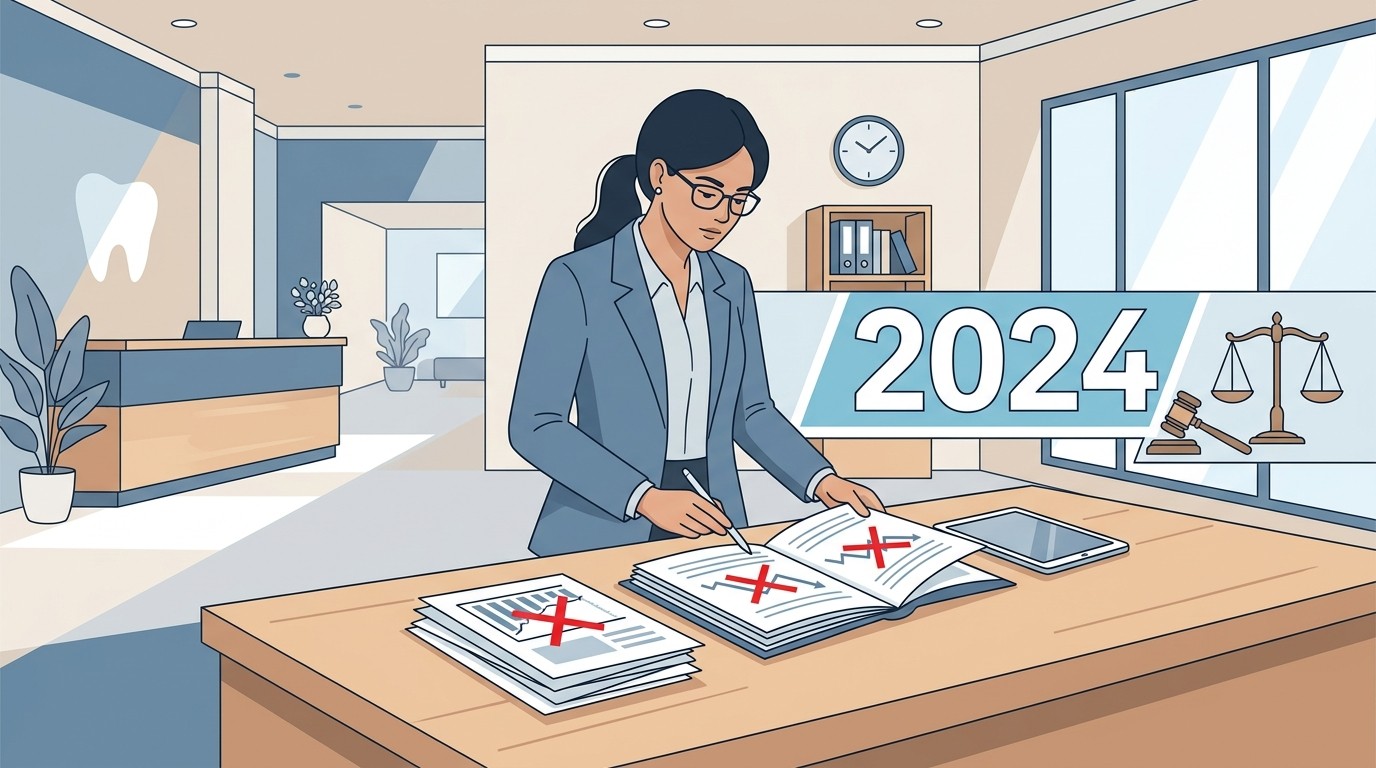
2026 Dental Embezzlement Cases: $1.4M in Recent Thefts

We are only four months into 2026, and dental practices have already lost over $1.4 million to employee theft in cases that have made national news. These are not isolated incidents. They are patterns that repeat across the industry.
Every year, new embezzlement cases emerge from dental practices across the country. The names change. The locations change. The amounts vary. But the underlying patterns remain remarkably consistent.
Here are the three major cases that have hit the news in 2026, what went wrong in each one, and what practice owners can learn from them.
Case 1: The Illinois Office Manager Who Stole $900,000
What Happened
In February 2026, Rebecca Gutierrez, a 49-year-old office manager at Hastings and Havlik Family Dentistry in Mattoon, Illinois, was indicted on five federal counts of wire fraud. She is accused of stealing approximately $900,000 from the practice over five years.
Gutierrez worked at the practice from June 2020 to August 2025. According to federal prosecutors, she transferred money directly from the practice's business checking account to pay off her personal credit card debt.
To conceal the theft, she allegedly altered notes in the practice's books, creating fake entries that hid the missing funds.
The federal charges stem from her use of an out-of-state payment processing service to wire the stolen funds to her credit card company. Once the theft was discovered, Gutierrez was terminated. State charges were dropped when federal wire fraud charges were filed.
How It Worked
This scheme relied on two things: unrestricted access to banking and control over the books.
Gutierrez had the ability to initiate transfers from the business account. She also maintained the financial records. That combination meant she could move money and then edit the records to hide the movement.
The altered book entries were the concealment mechanism. Without independent verification of bank activity against recorded transactions, the discrepancies went unnoticed for years.
What Should Have Caught It
- Monthly bank statement review by someone other than the person making entries
- Automated matching of recorded transactions to actual bank activity
- Separation between payment initiation authority and bookkeeping responsibility
- Periodic reconciliation by an outside accountant
The $900,000 did not disappear in one transaction. It leaked out over five years. Each individual transfer was small enough to avoid immediate detection. Cumulative oversight would have caught the pattern within months, not years.
Case 2: The West Virginia Employee Who Wrote 380 Checks to Herself
What Happened
In January 2026, Angela Hall, a former employee of Jarrell Family Dentistry in Surveyor, West Virginia, was accused of embezzling at least $463,351 from the practice.
The investigation began in October 2025 when a forensic accountant, hired to investigate suspicious checks, contacted authorities on behalf of Dr. Jeffery Jarrell.
Hall had served as office manager, giving her access to both the practice's finances and the dentist's personal accounts. According to investigators, she wrote 380 checks directly to herself without authorization. Another 42 checks were written to businesses and individuals in an attempt to conceal the theft.
The investigation also revealed that patients paid more than $140,000 in cash, but only $42,000 was deposited into the practice's accounts. The remaining cash allegedly went into Hall's personal bank account.
How It Worked
This scheme had two components: check fraud and cash skimming.
The check fraud was brazen. Writing 380 checks to yourself is not sophisticated. It relies entirely on the assumption that nobody is reviewing check registers against actual payees. That assumption held true for years.
The cash skimming was simpler. Collect cash from patients, pocket most of it, deposit a fraction. Without independent verification of cash collections against deposits, there was no way to detect the gap.
What Should Have Caught It
- Regular review of check registers by someone independent of check-writing authority
- Comparison of patient payment records to actual deposits
- Dual signature requirements on checks above a threshold
- Periodic audits of cash handling procedures
The 380 checks were spread across years. Even a quarterly review of check payees would have raised immediate questions. The cash discrepancy would have been visible in any reconciliation of daily collections to deposits.
Case 3: The Pennsylvania Practice That Lost $30 Million to Medicaid Fraud
What Happened
In March 2026, three individuals associated with the Savani Group, a multi-state network of dental practices based in Pennsylvania, were convicted in a racketeering conspiracy that defrauded Medicaid of more than $30 million.
Brothers Bhaskar Savani, D.M.D., and Arun Savani were convicted of charges including RICO conspiracy, visa fraud, obstruction of justice, health care fraud, money laundering, and tax fraud. Their employee Aleksandra Radomiak was convicted of RICO conspiracy and health care fraud.
The scheme involved filing false H-1B visa applications, billing Medicaid for services that were never provided, and billing for services that were required to be provided by a licensed dentist but were performed by unlicensed staff.
How It Worked
This was not employee embezzlement in the traditional sense. This was owner-directed fraud on a massive scale.
The Medicaid fraud involved systematic overbilling for services not rendered and services performed by unqualified personnel. The visa fraud brought in workers under false pretenses. The obstruction charges came from attempts to hide the scheme during investigation.
What It Means for Other Practices
This case is different from the others because the fraud was directed from ownership. But it illustrates an important point: revenue verification matters regardless of who might be committing fraud.
Practices that accept Medicaid should have systems verifying that billed services match actual treatment records. Compliance officers should periodically audit claims against patient charts. The systems that catch employee fraud also catch owner fraud when properly implemented.
The Pattern Across All Three Cases
Despite the differences in scale and method, these cases share common elements:
Excessive Trust Without Verification
In each case, someone had access to financial systems without adequate oversight. Trust without verification creates opportunity.
Lack of Independent Reconciliation
None of these practices had effective systems comparing what should have happened financially to what actually happened. That gap is where embezzlement lives.
Long Detection Periods
The Illinois case ran five years. The West Virginia case ran years. The Pennsylvania case involved schemes that spanned extended periods. Early detection would have limited losses dramatically.
Single Points of Control
One person or small group controlled enough of the financial process to both commit and conceal fraud. Separation of duties would have created natural checkpoints.
What Practice Owners Should Do
Implement Daily Reconciliation
Compare collections to deposits every day. Not weekly. Not monthly. Daily. The faster you catch a discrepancy, the smaller the loss.
Separate Duties
The person posting payments should not be the person making deposits. The person writing checks should not be the person reconciling the bank statement. Create independence in your financial processes.
Review Bank Statements Personally
Practice owners should personally review bank statements monthly. Look at check payees. Look at transfer recipients. Look at patterns. Fifteen minutes monthly can save years of loss.
Use Automated Verification
Manual reconciliation is error-prone and easy to manipulate. Automated systems that pull from bank feeds and practice management software create independent verification that is harder to fool.
Conduct Surprise Audits
Periodically have an outside accountant review your finances without warning. The element of surprise prevents manipulation of records before the audit.
The Cost of Inaction
These three cases represent over $31 million in losses in just the first quarter of 2026. The individual practice losses of $900,000 and $463,000 are devastating at the practice level, potentially threatening the viability of the businesses themselves.
But the real cost is broader. Every embezzlement case represents years of a dentist's career earnings disappearing. It represents retirement accounts that will not be funded. It represents practice sales that will not happen. It represents the emotional devastation of betrayal by trusted employees.
The controls that prevent embezzlement are not expensive. They are not complicated. They just require implementation.
The question is not whether you can afford to implement them. The question is whether you can afford not to.
Related Reading: