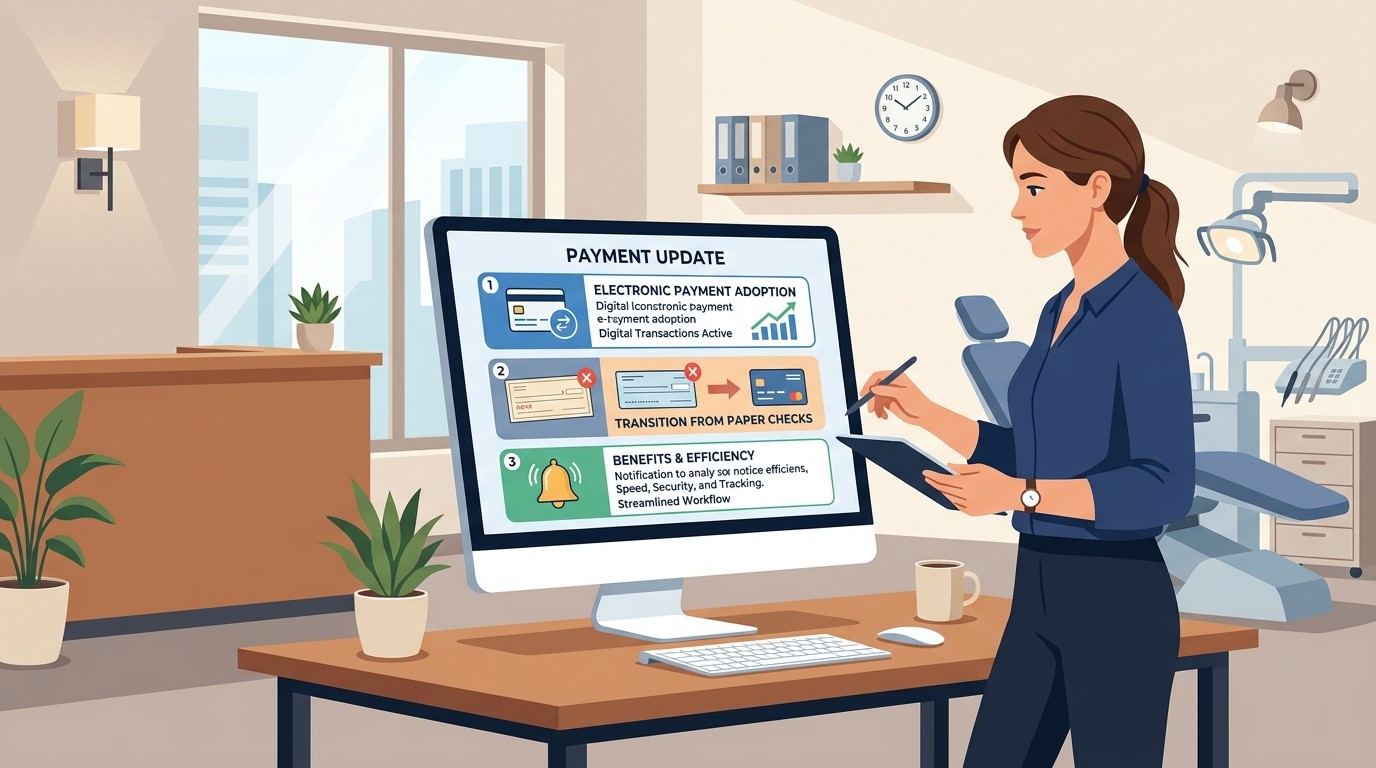
Delta Dental Is Eliminating Reimbursement Checks: What Your Practice Needs to Know

Delta Dental has announced it will eliminate insurance payments by check at the end of 2026. While this sounds like a simple administrative change, the downstream impact on dental practices could be significant.
Delta Dental, the largest dental benefits provider in the United States, is phasing out paper checks for insurance reimbursements. By the end of 2026, practices will no longer receive those familiar envelopes in the mail. Instead, payments will arrive electronically.
This shift affects every practice that accepts Delta Dental. And the way you prepare for it will determine whether it becomes an operational headache or a non-event.
What Is Actually Changing
Delta Dental will stop issuing paper checks for insurance reimbursements. Practices will need to receive payments through one of two electronic methods:
Virtual Credit Cards (VCCs): Delta Dental sends a one-time credit card number that practices process like any other card payment. The funds arrive quickly, but the practice pays merchant processing fees on every transaction.
Electronic Funds Transfer (EFT): Payments deposit directly into the practice's bank account. No processing fees, but less visibility into what arrived and when.
The specific options available to your practice may vary by state, depending on local legislation. In states without specific prohibitions, insurance companies often default to virtual credit cards.
Why This Matters More Than You Think
The Hidden Cost of Virtual Credit Cards
Virtual credit cards seem convenient. The money arrives quickly. The process is familiar. But the economics are brutal.
Credit card processing fees typically run 2.5% to 3.5% of the transaction. On a $1,000 insurance payment, you lose $25 to $35 before the money even hits your account. Scale that across hundreds of claims monthly, and you are looking at thousands of dollars in annual fees that did not exist when you received checks.
For a practice processing $50,000 monthly in Delta Dental claims, the math is stark:
- Paper checks: $0 in processing fees
- Virtual credit cards at 3%: $1,500 per month, $18,000 annually
That is real money disappearing to payment processing that used to be free.
The Visibility Problem with EFT
If you opt out of virtual credit cards, EFT becomes the alternative. No processing fees. Sounds better, right?
The problem is visibility. Unlike checks or credit card payments, EFT deposits are not something your team physically handles. The money appears in your bank account as a lump sum. Your staff posts payments based solely on the Explanation of Benefits provided by Delta Dental.
Here is where things get dangerous: there is no physical verification that the funds actually arrived.
Prosperident, the dental embezzlement investigation firm, has documented cases where EFT payments were sent to wrong accounts without anyone realizing it, sometimes for extended periods. Without a way to independently verify that funds were actually received, practices are exposed to risk they did not have before.
With paper checks, someone physically received the envelope, saw the check amount, and deposited it. That physical touchpoint created a verification step. With EFT, that verification step vanishes.
The Embezzlement Angle
This payment transition introduces new fraud vectors that did not exist before.
Virtual Credit Card Risks:
- Funds can be redirected or refunded more easily than checks
- Processing systems can be manipulated
- Less physical oversight means less natural verification
EFT Risks:
- No physical handling means no natural checkpoints
- Posting relies entirely on EOB data, which can be falsified
- Mismatch between posted payments and actual deposits harder to detect
Neither option is inherently dangerous. But both require different controls than paper checks did. Practices that do not update their reconciliation processes are creating vulnerabilities.
What You Should Do Now
Step 1: Opt Out of Virtual Credit Cards
Unless you have a specific reason to accept them, opt out of virtual credit card payments. The processing fees are not worth the convenience. Contact Delta Dental and request EFT payments instead.
Most states allow practices to choose their payment method. Some states have legislation specifically prohibiting mandatory VCC payments. Check your state's regulations, but default to opting out.
Step 2: Strengthen Your EFT Reconciliation
If you are receiving EFT payments, you need a process to verify that posted payments match actual bank deposits. This is not optional.
Daily reconciliation checklist:
- Compare EOB payment amounts to bank deposit amounts
- Verify that claim counts match between EOB and deposits
- Flag any discrepancies immediately for investigation
- Document the verification with timestamps and initials
Do not assume that because the EOB says $5,000 was paid, $5,000 actually landed in your account. Verify it.
Step 3: Separate Posting from Deposit Verification
The person posting insurance payments should not be the same person verifying deposits. This separation of duties is a fundamental fraud prevention control.
If you are a small practice where one person handles everything, you need an external verification step. The practice owner or an outside bookkeeper should independently confirm that deposit totals match posted payment totals weekly.
Step 4: Automate What You Can
Manual reconciliation is error-prone and easy to manipulate. Automated systems that pull data from multiple sources and flag discrepancies are harder to fool.
This is exactly what Zeldent does. We connect directly to your bank feeds and your practice management system. We match expected insurance payments to actual deposits automatically. When something does not match, you know immediately, not at the end of the month when the trail has gone cold.
The Bigger Picture
Delta Dental's check elimination is part of a broader industry shift toward electronic payments. Other major payers will follow. The days of physical checks arriving in the mail are ending across dental insurance.
This transition is not inherently bad. Electronic payments can be faster and more efficient. But efficiency without controls creates risk.
The practices that thrive through this transition will be the ones that update their reconciliation processes before problems emerge. The ones that assume their current processes will work unchanged are the ones that will discover gaps the hard way.
Key Takeaways
- Delta Dental stops issuing paper checks at end of 2026
- Virtual credit cards cost 2.5% to 3.5% in processing fees. Opt out.
- EFT payments require stronger reconciliation controls
- Verify that posted payments match actual bank deposits daily
- Separate posting duties from deposit verification
- Consider automated reconciliation tools to catch discrepancies
The payment method is changing. Your reconciliation process needs to change with it.
Related Reading: