What 1% of Collections Is Actually Worth, by Practice Size
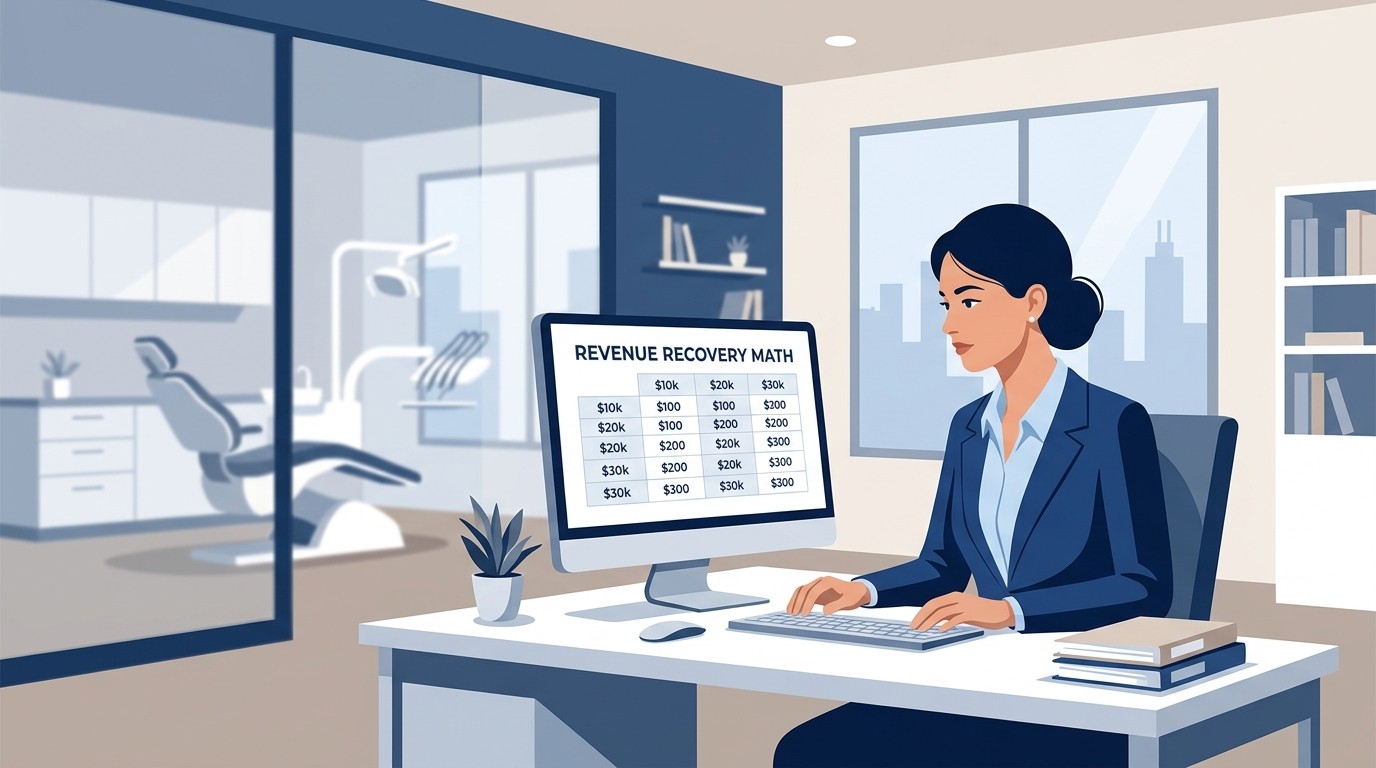
The question is never whether revenue recovery is expensive. It is whether it costs less than what you are currently losing. At most production levels, that math is not close.
The comparison that gets made, and why it is wrong
When a dental practice evaluates a tool that finds and recovers lost revenue, the instinct is to compare its price to other software. It sits in the same budget line as the practice management system, the imaging software, and the patient communication platform, so it gets measured against them.
That comparison is a category error. Those tools are costs you pay to run the practice. A revenue recovery tool is measured against the money you are currently not collecting. One is an expense. The other is a return on money you already earned but never received. Comparing them is like comparing the cost of a lock to the cost of a subscription, they are not the same kind of thing, and the lock is cheap relative to what is behind the door.
The right comparison is simple. What does the tool cost, and what is even a small recovery worth at your production level? Once those two numbers sit next to each other, the decision usually makes itself.
The math, by production level
Industry observation suggests practices commonly lose a few percent of collections to underpayments, posting errors, missed claims, and reconciliation gaps. You do not need to accept the high end of that range for the math to work. Look at what just 1 percent recovered is worth annually, against a representative software cost.
At $600,000 in annual production, 1 percent is $6,000 a year. At $1,000,000, it is $10,000. At $1,500,000, it is $15,000. At $2,000,000, it is $20,000. At $3,000,000, it is $30,000.
Now set those against a cost that, at most practice sizes, runs a few hundred dollars a month, call it somewhere in the low thousands per year. At a million dollars of production, recovering a single percent covers the cost several times over. At two million, it covers it many times over. And 1 percent is deliberately conservative. If the real number is two or three percent, which is closer to what practices commonly leave on the table, the return multiplies accordingly.
The point of running it at 1 percent is that the case does not depend on optimism. It works at the floor.
Why smaller practices get this wrong in both directions
There is a real nuance at the lower end of the range, and it is worth being honest about rather than glossing over.
Below roughly $600,000 in production, the absolute dollars recovered shrink, and the math tightens. A practice at $400,000 recovering 1 percent gets $4,000, and against a comparable annual cost the return is real but not overwhelming. This is where the "the math does not work for me" objection has some genuine basis, and where a practice is right to look closely.
But smaller practices also frequently guess their own gap low, and that is the more common error. The assumption "my gap is only a few thousand dollars" is usually just that, an assumption, made by the same person and the same system that would have to have caught the leakage for it to be small. If your reconciliation were tight enough to know your gap is small, you would not have a gap. The practices most confident that they are not losing money are often the ones with the least visibility into whether they are.
The uncertainty underneath the price objection
Underneath most price hesitation is not really price. It is uncertainty about whether the problem exists at all.
Nobody wants to pay to find out whether they have a problem, because that feels backwards, paying to discover bad news. It is a reasonable feeling and a poor guide, because the alternative to finding out is not the absence of the problem. It is the problem continuing, undetected, at whatever rate it is already running. The money that leaks while a practice waits to be certain the leak exists is the most expensive money in the whole equation, because it is invisible and therefore never recovered.
The honest framing is that you are not paying to find out whether you have a problem. You are paying to stop losing money you are almost certainly already losing, and to know the number instead of guessing it.
How to run the math on your own practice
You can do this yourself in about five minutes. Take your annual collections. Multiply by 1 percent for a conservative recovery estimate, and by 3 percent for a more realistic one. Compare both numbers to the annual cost of any recovery tool you are evaluating. Then ask the harder question: do you actually know your current gap, verified against your bank, or are you estimating it from the same system that would have to be wrong for the gap to exist?
If you cannot answer that last question with real numbers, that uncertainty is itself the finding. Our guide to the production versus collections gap covers how to start measuring it, and our revenue cycle management guide covers where the leaks tend to be.
Frequently Asked Questions
Is dental revenue recovery software worth the cost?
At most production levels, recovering even 1 percent of collections covers the cost several times over. At $1,000,000 in production, 1 percent is $10,000 against a cost typically in the low thousands per year. The case holds at conservative recovery estimates and improves at realistic ones.
Why shouldn't I compare it to my other software costs?
Other software is an operating expense. Revenue recovery is measured against money you already earned but have not collected. One is a cost of running the practice, the other is a return on uncollected revenue, so comparing their prices directly is a category error.
Does revenue recovery make sense for a small practice?
It depends on production. Below roughly $600,000, the absolute dollars are smaller and the math tightens, so smaller practices should look closely. That said, smaller practices frequently underestimate their own gap, because the same system that would need to catch the leakage is the one telling them it is small.
How do I estimate what I'm losing?
Multiply annual collections by 1 percent for a conservative figure and 3 percent for a realistic one, then compare to the tool's annual cost. The more important question is whether you actually know your gap verified against your bank, or are estimating it from your practice management system.
Isn't paying to find a problem backwards?
The alternative to finding out is not the absence of a problem, it is the problem continuing undetected at whatever rate it already runs. The money lost while waiting to be certain the leak exists is the most expensive money involved, because it is never recovered.
Zeldent tells you your actual number instead of your estimated one, by reconciling your ledger against your real bank deposits every day. You stop guessing whether you have a gap, and you stop losing it. Book a demo to see your real figure.