Is Revenue Recovery Software Worth It? Why "More Than My Other Software" Is the Wrong Comparison

"It costs more than my practice management software" is a real reaction and a misleading one, because it measures the wrong thing against the wrong thing.
The comparison everyone makes first
When a dental practice looks at software that finds and recovers lost revenue, the price gets filed next to every other software bill: the practice management system, imaging, patient communication, the clearinghouse. Sitting in that lineup, a revenue recovery tool often looks expensive by comparison, and the instinct is immediate. It costs more than my practice management software. How can a reconciliation tool cost more than the system that runs my whole office?
It is a fair reaction. It is also the wrong comparison, and getting the frame right is the entire question of whether the tool is worth it.
Why it is the wrong frame
Every other line on your software bill is a cost of operating. You pay for the practice management system to run the practice. You pay for imaging to take radiographs. You pay for patient communication to fill the schedule. These are expenses, and you evaluate expenses by whether they are competitively priced against other expenses. In that world, cheaper is better, and a tool that costs more than its neighbors has to justify the gap.
A revenue recovery tool does not belong in that column at all. It is not a cost of operating. It is measured against the money you have already earned but are not collecting. It sits on the other side of the ledger, next to the revenue it protects, not next to the expenses it is priced like.
Comparing it to your practice management software is comparing a return to a cost. The practice management system is something you buy to run the business. Revenue recovery is something you buy to stop losing money the business already made. Those are different kinds of purchase, and pricing one against the other produces a conclusion that feels rigorous and is actually a category error.
The comparison that answers the question
The right question is not "does this cost more than my other software." It is "does this cost less than what I am currently losing." That reframes the decision from an expense comparison into a return calculation, and the return calculation is usually not close.
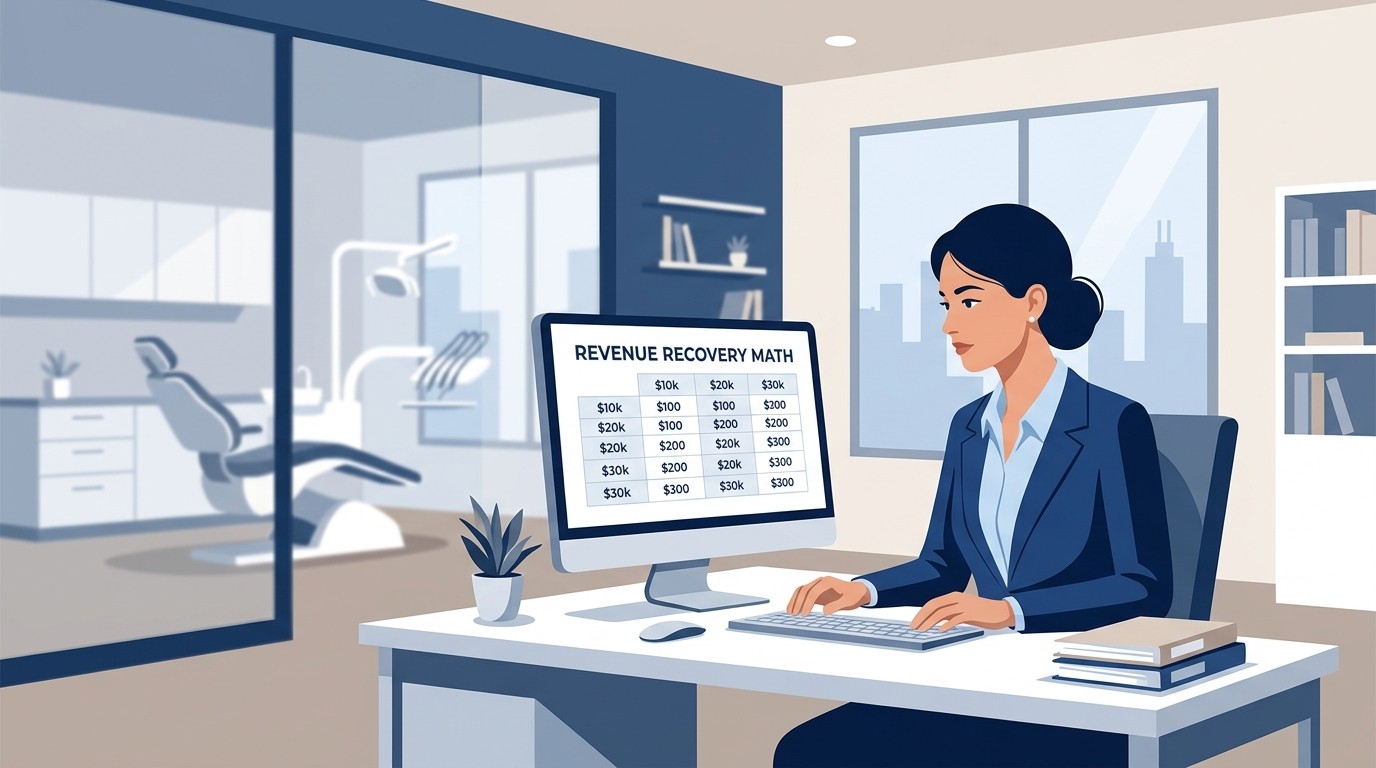
Industry observation suggests practices commonly leave a few percent of collections uncollected through underpayments, posting errors, missed claims, and reconciliation gaps. Set even a conservative recovery against the cost. At a million dollars of production, recovering a single percent is ten thousand dollars a year, against a tool that typically runs a few hundred dollars a month. The tool does not need to be cheaper than your imaging software. It needs to recover more than it costs, and at most production levels that bar is low. Our full breakdown of what one percent of collections is worth by practice size runs the numbers at every level.
The practice management system, by contrast, returns nothing directly. It is essential, but it is pure cost. Which means the tool you were about to reject for costing more than your practice management software is the only one of the two with a return attached.
Why the wrong frame is so sticky
This comparison persists for a reason worth naming, because naming it is how you get past it.
Software budgets are organized by cost. Everything in the software line is an expense, so a new tool naturally gets sorted there, and once it is sorted as an expense it gets judged as one. The mental filing happens before the evaluation does, and the filing is what is wrong.
There is also a quieter reason. Judging the tool as an expense lets you avoid the harder question underneath, which is how much you are actually losing right now. As long as the decision is about price, you never have to find out your gap. The moment the decision becomes about return, you do, and that number is uncomfortable precisely because most practices have never measured it. We cover why that gap stays invisible in the production versus collections gap.
What "worth it" actually depends on
Stripped of the framing problem, whether revenue recovery is worth it comes down to two honest variables: how much you are losing, and what recovery costs.
The cost side is knowable up front. The loss side is the one that matters and the one most practices are guessing at. If you know your gap, verified against your bank rather than estimated from your practice management reports, the math is simple arithmetic. If you do not know it, that uncertainty is not a reason to treat the tool as an expense. It is the strongest argument for finding the number, because you cannot be losing nothing and unsure at the same time. The practices most confident their gap is small usually have the least visibility into whether it is. Our guide to dental revenue cycle management covers where those losses tend to hide.
Worth it is not a matter of opinion or of how the price compares to your other tools. It is a matter of whether the recovery exceeds the cost, and at most production levels, with even conservative assumptions, it does.
Frequently Asked Questions
Is dental revenue recovery software worth the cost?
At most production levels, yes. Recovering even one percent of collections typically covers the cost several times over. At a million dollars in production, one percent is ten thousand dollars against a cost usually in the low thousands per year. The case holds at conservative recovery estimates.
Why does revenue recovery software cost more than my practice management system?
Because they are different kinds of purchase. A practice management system is a cost of operating that returns nothing directly. Revenue recovery is measured against uncollected revenue it recovers, so its price should be compared to what you are losing, not to your other software bills.
How do I know if it is worth it for my practice?
Compare the annual cost to what you are losing, verified against your bank rather than estimated from practice management reports. If you do not know your gap, that uncertainty is the reason to find it, not a reason to treat the tool as an expense.
Isn't it just another software subscription?
It sits in the software budget, which is why it gets judged as an expense, but functionally it is a return on revenue you already earned and have not collected. Filing it as a cost is what makes it look overpriced.
What is the right way to compare it to other tools?
Do not compare it to other tools at all. Compare its cost to your uncollected revenue. The relevant question is whether it recovers more than it costs, not whether it is cheaper than your imaging or practice management software.
Zeldent answers the "worth it" question directly by telling you your actual gap, reconciling your ledger against your real bank deposits every day so you see what you are losing instead of guessing. Book a demo to replace the estimate with a number.