DSO Revenue Integrity: Reconciling Collections Across Every Location

At a single practice, a reconciliation gap is a problem. Across a fleet, it is a problem multiplied by the number of locations, and nobody is watching all of them at once.
Why revenue integrity is different for a DSO
A single-location owner who loses track of a deposit loses their own money. A dental support organization operates on a different economic model, and that model changes what reconciliation is for.
Most DSOs and management groups earn a management fee calculated as a percentage of the collections they support. Every dollar that a location produces but fails to collect is not just a loss to that location. It is a reduction in the base the entire management fee draws from. Revenue integrity, at the group level, is not a cost-control exercise. It is protection of the yield on the group's own revenue engine.
That reframing matters because it changes who should care. At a practice, reconciliation is the owner's problem. At a group, it belongs to the CFO, the RCM team, and anyone whose numbers roll up to an auditor or an investor.
Why reconciliation breaks at scale
The mechanics that make reconciliation hard at one location get worse, not merely bigger, as locations multiply.
At one practice, one person can usually hold the whole picture in their head: what was produced, what was deposited, which claims are outstanding. Across dozens of locations, no one holds that picture, and the group instead relies on each location to report its own numbers. That reliance is the vulnerability, because a location reporting its own reconciliation is the financial equivalent of grading its own homework.
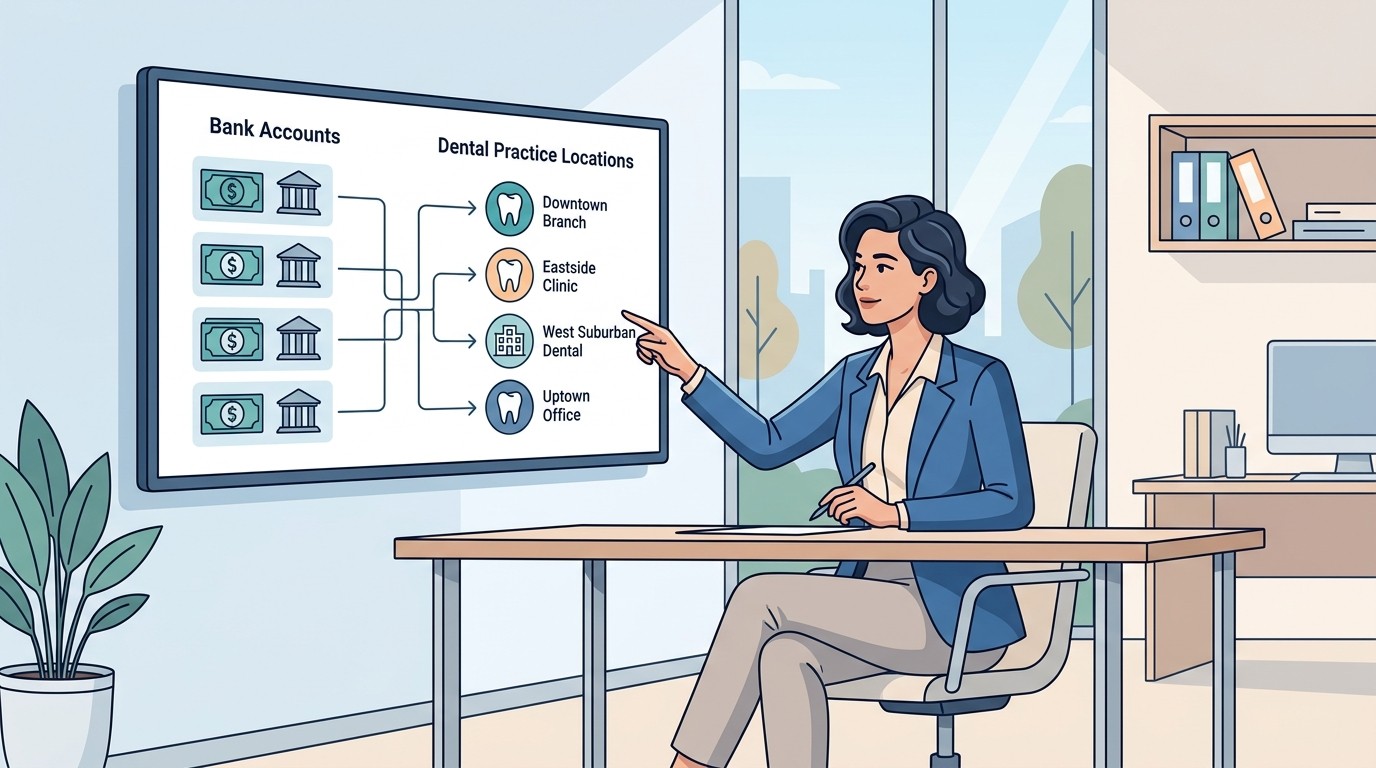
Banking multiplies the complexity. Groups frequently run multiple accounts per location, shared accounts across offices, and inter-account transfers that make it genuinely hard to tell which money belongs to which location. A deposit that does not match booked production at a single practice is obvious. The same gap across a fleet with commingled banking can be invisible for months.
And the practice management system, whether Denticon, Dentrix Ascend, or a mix inherited through acquisition, still only knows what staff entered. Multiply the "the ledger only reports what it was told" problem by every location, and the group's consolidated financials inherit every posting error, every skimmed deposit, and every miskeyed adjustment from every office at once. Our guide to dental revenue cycle management covers that single-location version of the problem this scales up.
Starting from the bank, not the ledger
The principle that makes group reconciliation tractable is the same one that makes it work at a single practice, applied with more discipline: start from the bank, not the ledger.
The ledger is the group's aggregated claim about what happened. The bank is what actually happened. A revenue integrity program compares the two at the location level every day, so that a gap surfaces against ground truth rather than against another internal report that may carry the same error. When the money that reached the bank does not match what the practice management system says was collected, that difference is the finding, and it is attributable to a specific location, a specific day, and ideally a specific claim.
Doing this by hand across a fleet is not realistic, which is why most groups do not do it and instead reconcile monthly at the summary level, if at all. Summary-level monthly reconciliation catches almost nothing, because it nets location-level gaps against each other and buries the signal.
The three buckets a group needs
A reconciliation finding at scale is only useful if it separates genuine risk from noise. Every unreconciled item should fall into one of three buckets.
At-risk is money the system believes is genuinely missing: collected and not deposited, or deposited into the wrong place and never traced. This is the bucket that matters, and it should be small.
Variance is timing. Payments in flight, deposits that will clear in a day or two, batch effects at period boundaries. These resolve on their own and should not trigger alarm, but they need to be visibly separated so they do not hide the at-risk bucket.
Input error is money that is fine but was posted wrong in the practice management system. It is not a loss, but it distorts every downstream number until corrected, and at the group level those distortions aggregate into financials that do not tie out.
This three-way split is what turns a wall of discrepancies into an actionable report, and it maps directly to the waterfall a group's auditors expect to see.
What auditors and investors want to see
For a group that is institutionally backed or preparing for a transaction, reconciliation is not only operational hygiene. It is diligence readiness.
An acquirer or an auditor examining a dental group will want to tie reported collections to actual bank deposits across the fleet, and they will want the variance between revenue and cash explained rather than asserted. A group that can produce that waterfall on demand, drillable by location and by payment type, is a group whose numbers can be trusted, and trusted numbers command better valuations and smoother diligence. Our guide to pre-acquisition financial due diligence covers what that examination looks like from the buyer's side.
The reverse is also true. A group whose location-level numbers do not reconcile to the bank will have that surface during diligence, at the worst possible time, and it will cost them in price or in delay.
Acquisitions and the integration gap
Groups that grow by acquisition face a specific version of this risk that is worth naming on its own.
Every acquired practice arrives with its own practice management system, its own banking, its own posting habits, and its own accumulated errors. During integration, the acquiring group is least able to see clearly: systems are changing, staff are shifting, and the new location's historical numbers are unsettled. That is exactly the window in which reconciliation gaps and, occasionally, embezzlement go undetected, because everything unusual gets attributed to the transition. We cover the practice-level version in our guide on what breaks when you move to a cloud PMS.
Establishing independent reconciliation on an acquired location from day one gives the group a clean baseline, catches integration-period errors while they are small, and means the group is not inheriting problems it cannot yet see.
Role-based oversight across a fleet
A group cannot act on findings that reach the wrong people. A revenue integrity program at scale has to route what it finds by role: the central RCM team sees insurance and claims findings, individual offices see their own discrepancies and the steps to fix them, and corporate finance sees everything consolidated. Each finding should carry a resolution path the group approves once and applies identically across every location, so that fixing a problem in one office does not require reinventing the fix in the next.
The audit trail underneath all of this has to be immutable. When a previously reconciled record is edited after the fact, the system should recompute and re-alert automatically, because retroactive changes to closed periods are both an operational risk and, sometimes, a signal of something worse. Our guide to separation of duties and internal controls covers why that independence matters.
Frequently Asked Questions
What is revenue integrity for a DSO?
Revenue integrity is the practice of confirming that every dollar a group's locations produce is actually collected and deposited, verified against the bank rather than the practice management ledger. For a DSO earning a percentage-of-collections management fee, it protects the base that fee is calculated on.
Why is reconciliation harder across multiple dental locations?
No single person holds the full picture, so the group relies on each location to report its own numbers, which removes independence. Multiple and shared bank accounts make it hard to attribute money to locations, and mixed practice management systems inherited through acquisition compound the posting errors that flow into consolidated financials.
How should a dental group reconcile collections?
By comparing each location's actual bank deposits against what its practice management system reports as collected, daily and at the location level, then sorting every gap into genuine risk, timing variance, and posting error. Summary-level monthly reconciliation nets location gaps against each other and misses most findings.
What do acquirers look for in a dental group's financials?
They tie reported collections to actual bank deposits across the fleet and expect the variance between revenue and cash to be explained, drillable by location and payment type. Groups that can produce that reconciliation on demand earn better valuations and smoother diligence.
How does reconciliation help during DSO acquisitions?
An acquired practice arrives with its own systems, banking, and accumulated errors, and the integration period is when problems hide most easily. Independent reconciliation from day one establishes a clean baseline and catches integration-period errors and losses while they are still small.
Zeldent provides revenue integrity across an entire group, reconciling every location's ledger against its actual bank deposits nightly, sorting findings into at-risk, variance, and input error, and routing them by role. It handles mixed banking and mixed practice management systems, which is what makes it work across a fleet and through acquisitions. Book a demo to see it across your locations.