Humana Dental Payment Reconciliation: Portal Navigation and ERA Matching
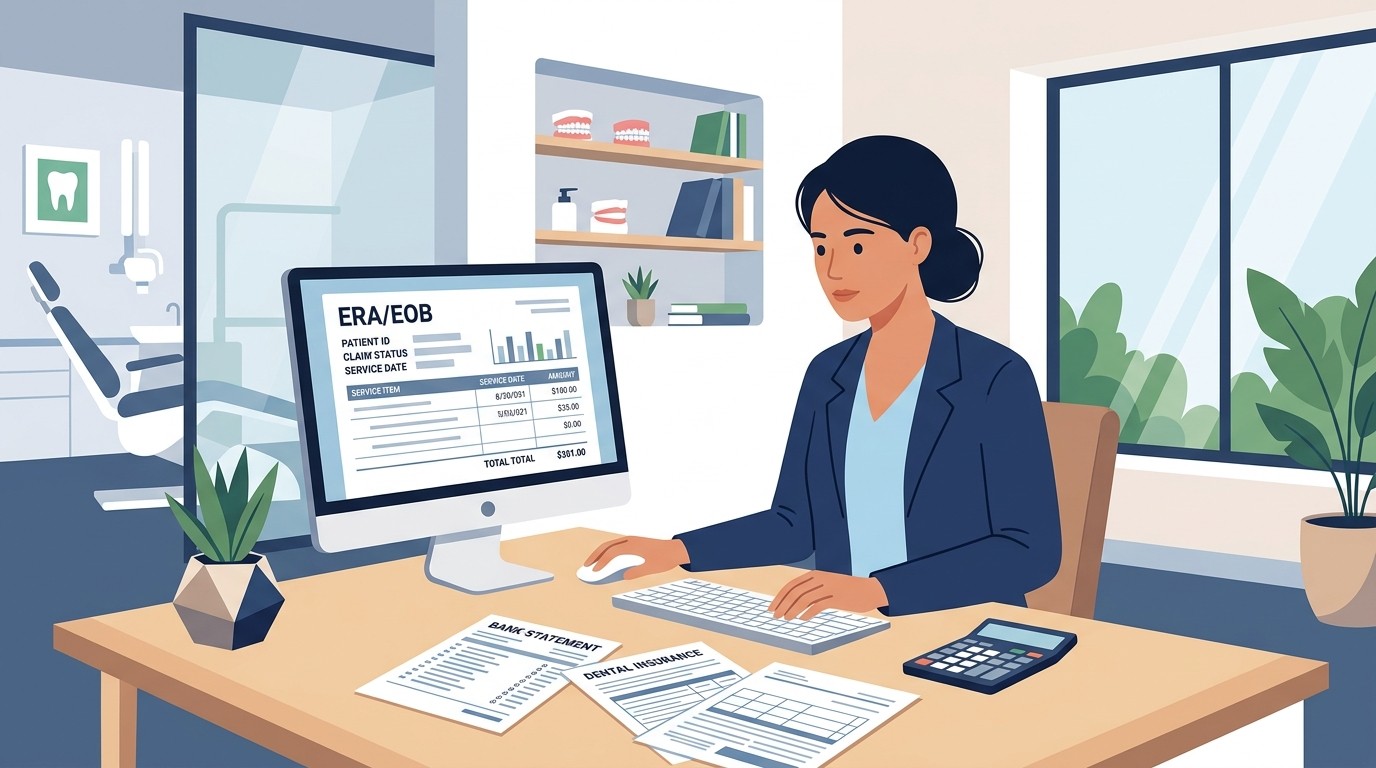
Insurance Payment Quick Reference
Download the quick reference guide with ERA codes, payer portals, and troubleshooting tips for insurance payment reconciliation.
Humana dental payments require attention to their specific portal workflows and ERA formats. Here is how to reconcile them accurately.
Humana is a major national health insurer with significant dental coverage, including standalone dental plans and dental benefits embedded in Medicare Advantage and employer-sponsored medical plans. For dental practices, Humana payments follow standard industry processes but have their own portal interface and operational specifics that make them distinct from other payers.
📚 Part of our insurance series: This article is part of The Complete Guide to Dental Insurance Payments, covering everything from EFT enrollment to ERA matching and payer-specific workflows.
This guide covers how Humana dental payments work, how to navigate their provider portal, and how to match deposits to ERAs accurately.
Understanding Humana Dental Products
Humana offers multiple dental product lines. Understanding which product a patient has helps set expectations for payment processing and amounts.
Humana Dental PPO plans allow patients to see any dentist with higher benefits for in-network providers. These traditional plans have deductibles, annual maximums, and coinsurance structures.
Humana Dental HMO or DHMO plans require patients to select a primary care dentist. Payments follow a copay schedule rather than traditional claims processing. Your payment arrives as a capitation or per-service amount depending on the specific plan design.
Humana Medicare Advantage plans often include dental benefits. These process through Humana's Medicare systems and may appear differently in your portal than commercial dental claims.
Humana Preventive Plus and similar discount programs are not insurance. No claims are filed and no Humana payments arrive for these members. Patients pay your full fee with a discount applied.
How Humana Dental Payments Arrive
Most Humana dental payments arrive via electronic funds transfer. Bank descriptions typically show Humana, Humana Dental, or similar variations with a trace number.
EFT enrollment is managed through the Humana provider portal or through Availity. If you are not enrolled in EFT, Humana sends paper checks with attached EOB documentation. EFT enrollment speeds payment receipt and creates cleaner audit trails.
Humana may offer virtual credit card payments for some claims. Many practices decline VCC payments due to processing fees that reduce net collections. You can specify EFT-only payment preference through your provider enrollment settings.
Payments typically arrive three to five business days after Humana finalizes the claim. Complex claims or those requiring additional review may take longer.
Navigating the Humana Provider Portal
Humana maintains a provider portal at humana.com/provider. This is your primary resource for claims status, eligibility verification, and remittance information.
Registration requires your Tax ID, NPI, and practice information. Once registered, you can add staff members with appropriate access levels for different functions.
Key portal functions for reconciliation include claims status tracking for submitted claims through adjudication, remittance search for finding payment details and downloading ERAs, eligibility and benefits verification for confirming patient coverage, and provider information management for updating your practice details.
Humana also works with Availity for provider transactions. If you already use Availity for other payers, you may be able to access Humana functions there depending on your enrollment.
To find ERAs for reconciliation, log into the Humana portal and navigate to the Claims section. Select Payment and Remittance or ERA lookup. Search by payment date range, amount, or check/EFT trace number.
ERAs from Humana arrive in standard 835 format. You can view them in the portal, download them for import into your PMS, or receive them through your clearinghouse if configured for automatic ERA delivery.
Matching Humana Deposits to ERAs
Start by identifying the Humana deposit in your bank account. Note the exact deposit amount, deposit date, bank description, and trace number.
In the Humana portal, search for matching ERAs. Navigate to the remittance section and search by the payment date range or trace number. If you have the exact trace number from your bank, search by that for a precise match.
Humana frequently combines multiple claims into a single deposit. If your deposit amount does not match any single ERA, look for multiple ERAs from the same date range that sum to the deposit total. This is common when multiple patients have Humana coverage and claims process on the same cycle.
Once you locate the ERA or ERAs, verify the match. Confirm the sum of ERA totals equals the deposit exactly. Check that trace numbers align. Review the timing to ensure it makes sense.
Before posting payments, review each claim line on the ERA. Verify patients are yours and service dates match your records. Review allowed amounts against your fee schedule. Check contractual adjustments. Note patient responsibility amounts for proper billing. Flag denied claims for follow-up.
Understanding Humana ERA Codes
Humana uses standard ANSI reason codes and remark codes. Some appear more frequently than others.
CO-45 indicates a contractual adjustment. This is the difference between your billed amount and Humana's allowed amount. Post this as a provider adjustment, not patient responsibility.
PR-1 indicates a deductible amount. This is patient responsibility and should transfer to the patient balance.
PR-2 indicates coinsurance. This is also patient responsibility.
PR-3 indicates copay amounts, common in DHMO plans.
CO-4 indicates the procedure code is inconsistent with the modifier or not covered. Review the claim for coding issues.
CO-18 indicates a duplicate claim or service. Humana believes they already paid for this service.
CO-29 indicates the time limit for filing has expired. Late claims are denied.
CO-97 indicates payment already made for this benefit period.
Remark codes provide additional context. N30 indicates patient ineligible. N115 provides information about maximum benefits. MA04 indicates secondary payer information is needed.
Common Humana Reconciliation Issues
Deposits that do not match any ERA require investigation. Expand your date range in the portal as Humana may release payment before the ERA posts. Check your clearinghouse if you receive ERAs there. Verify the deposit is actually from Humana and not a similarly named payer.
Medicare Advantage claims may process differently than commercial claims. If you treat Medicare Advantage patients with Humana coverage, their ERAs may appear in a different section of the portal or with different formatting than commercial dental ERAs.
Partial payments require review of the ERA remark codes. Common causes include patient deductible not yet met, annual maximum reached, waiting periods for certain procedures, frequency limitations on services, and downcoding to less expensive procedure codes.
Missing claims require status checks in the portal. Search by patient name, date of service, or claim number. The claim may be pending, may require additional information, or may have been denied without your knowledge.
Coordination of benefits issues arise when patients have multiple coverage. If Humana is secondary, ensure the primary EOB was submitted with the claim. If Humana is primary, payment should process normally.
Posting Humana Payments Correctly
Post the exact deposit amount as shown on the ERA. Do not round or estimate. Apply payment to the specific patients and procedures listed.
Post contractual adjustments using your standard adjustment code. These represent the difference between your fee and Humana's allowed amount for in-network providers. This is not patient responsibility.
Transfer patient responsibility to patient balances. The ERA specifies exactly what the patient owes including deductibles, coinsurance, and non-covered amounts.
For denied claims, post a zero payment with the denial reason documented. Create a follow-up task for claims that can be appealed or corrected. Do not leave denied claims unaddressed.
Document the ERA trace number and reference in your PMS when posting. This creates an audit trail linking the bank deposit to specific claim payments.
Daily Reconciliation Workflow
Establish a consistent workflow for Humana payments. Each morning, check your bank for Humana deposits. Log into the portal and search for ERAs matching those deposits. Download and review ERAs before posting. Post payments same-day when possible. Research and document any discrepancies immediately.
At end of day, verify your total posted Humana payments match the bank deposit. Every dollar deposited should be accounted for in your posted payments plus any amounts flagged for research.
Weekly, review unresolved Humana discrepancies. Claims older than seven days without resolution become harder to research as documentation ages and memory fades.
Monthly, analyze your Humana collection rate compared to billed amounts. If you are consistently collecting less than expected, review your fee schedule against Humana's allowed amounts. You may need to update your schedule or evaluate your network participation.
Tips for Efficient Humana Reconciliation
Set up automatic ERA delivery through your clearinghouse. This ensures ERAs arrive without manual portal downloads and integrates with your existing workflow.
Use the trace number as your primary matching tool. The trace number is the most reliable way to connect a bank deposit to its corresponding ERA.
Create a Humana-specific posting batch in your PMS. This makes it easier to balance and audit Humana payments separately from other payers.
Train billing staff on Humana's common codes and processes. Consistency in how your team handles Humana claims prevents errors that create reconciliation problems.
Consider automation tools that match insurance deposits to ERAs automatically. Manual matching works but consumes time that could be spent on higher-value activities like following up on denials or pursuing aged receivables.
Tired of manually matching Humana payments? See how Zeldent automates insurance reconciliation and catches discrepancies before they become lost revenue.
Insurance Payment Quick Reference
Download the quick reference guide with ERA codes, payer portals, and troubleshooting tips for insurance payment reconciliation.