Reconciling Acquired Practices: The Financial Blind Spot in DSO Integration

The most dangerous time in a dental group's financial life is the ninety days after it acquires a practice, because that is when nobody can tell a real problem from the noise of the transition.
Why integration is a blind spot
A dental group that grows by acquisition is repeatedly doing the one thing that reconciliation depends on least: changing everything at once.
When a practice is acquired, its banking changes or gets absorbed, its staff roles shift, its practice management system may migrate, and its historical numbers get folded into a new group's reporting. Every one of those changes disturbs the financial picture, and they all happen together. In that environment, the normal signals that something is wrong, a deposit that does not match collections, an adjustment that should not be there, a payment that never posted, get lost, because everything looks slightly off and all of it is attributed to the transition.
That attribution is the danger. "It is just the integration settling down" is true often enough to be believable, which is exactly why it is such effective cover for the times it is not true.
What actually hides in the transition
Several distinct problems find shelter in the integration window, and they are worth separating.
Accumulated posting errors come with the practice. The acquired location has its own history of miskeyed payments, misapplied adjustments, and small reconciliation gaps that nobody ever caught, and those are now the group's problem. Without a baseline, the group cannot tell which discrepancies are inherited and which are new.
Migration artifacts appear when the practice management system changes. Balances shift, adjustments land in the wrong period, and some history comes over incomplete. Our guide to what breaks when you move to a cloud PMS covers this failure mode in detail, and it is amplified when it happens during an ownership change.
And then there is the uncomfortable possibility. Given that industry estimates put embezzlement exposure at 60 to 70 percent of practices, a meaningful share of acquired locations arrive with an active or dormant scheme that the previous owner never detected. The integration period, when oversight is thinnest and every anomaly is being written off as transition noise, is precisely when such a scheme continues undetected under new ownership. Our embezzlement prevention guide covers how these persist.
The baseline you should establish on day one
The fix is not complicated in concept, though it requires discipline to execute during a busy transition: establish an independent financial baseline on the acquired location before, or immediately as, it comes into the fold.
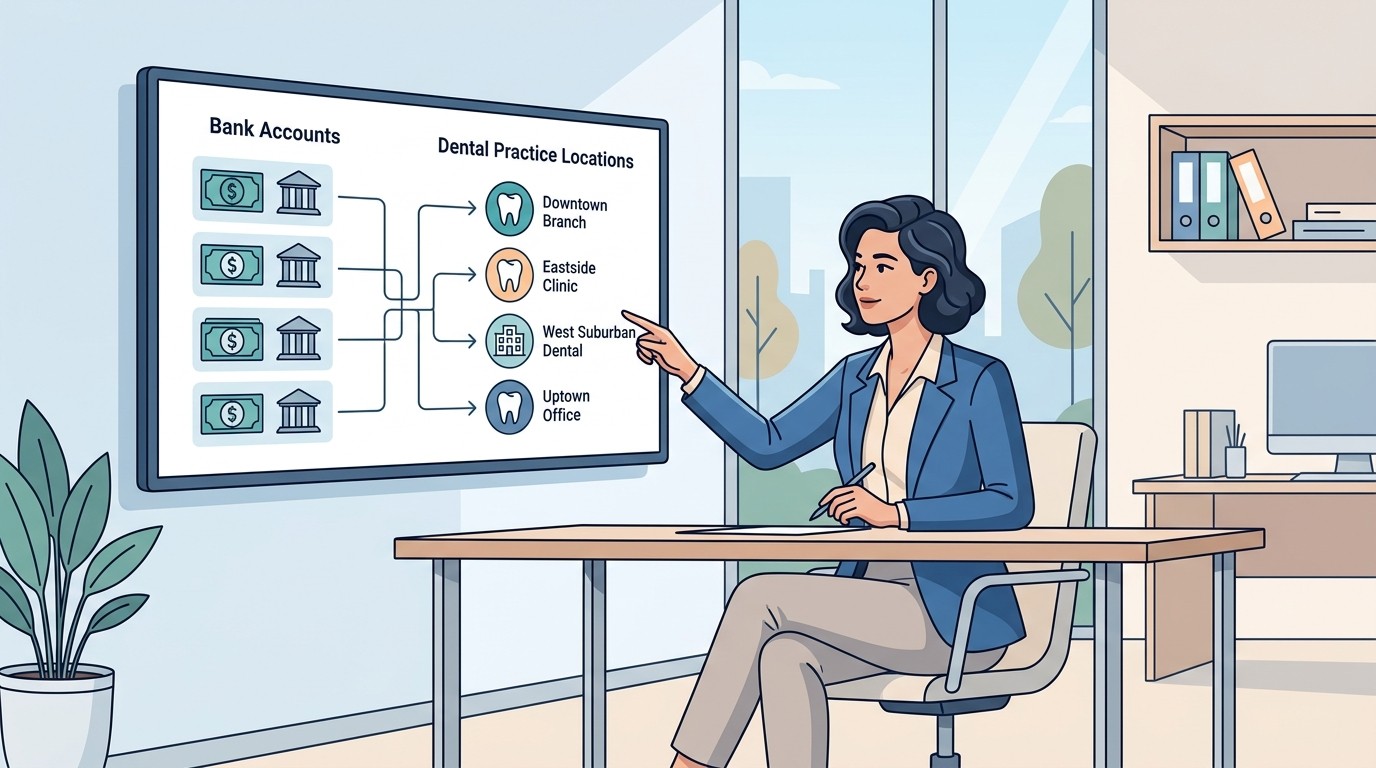
That baseline is a clean reconciliation of the location's actual bank deposits against what its practice management system reports as collected, run from day one under the new ownership. It does two things at once. It gives the group a known-good starting line, so that any discrepancy appearing afterward can be identified as new rather than inherited. And it surfaces whatever the location was already carrying, so the group learns what it actually bought rather than discovering it a year later.
Running this at acquisition is far cheaper than running it in diligence would have been, and far, far cheaper than discovering the problem at the next audit. Our guide to pre-acquisition financial due diligence covers the version of this done before the deal closes, and the baseline described here is its natural continuation after close.
Why per-location independence matters here
A group cannot establish this baseline by folding the acquired location into consolidated reporting and watching the group number. Consolidation is exactly what hides a single location's problems, because one location's gap nets against another's noise.
The baseline has to be location-specific and anchored to that location's own bank, independent of the group's aggregated view and independent of whatever the acquired staff report. This is the same principle that governs revenue integrity across the whole fleet, covered in our DSO revenue integrity guide: start from the bank, keep it location-level, and never let a location grade its own homework, least of all in the window when the group knows it least.
Building acquisition reconciliation into the playbook
Groups that acquire repeatedly benefit from making this a standard step in the integration checklist rather than a special project each time.
The pattern looks like this. Before close, verify collections against deposits as part of diligence. At close, stand up independent reconciliation on the location immediately, using its existing banking and practice management system, before any migration. Through the migration, keep that reconciliation running so migration artifacts are caught as they happen rather than discovered afterward. And once stable, the location simply becomes another node in the group's ongoing revenue integrity program. Making it routine means the group's tenth acquisition is protected as well as its first, which is rarely true when each integration is handled ad hoc.
Frequently Asked Questions
Why is the integration period after a dental acquisition financially risky?
Because banking, staffing, systems, and reporting all change at once, every anomaly gets attributed to the transition. That makes it the easiest time for inherited errors, migration artifacts, and even active embezzlement to go undetected.
What is an acquisition reconciliation baseline?
It is a clean reconciliation of an acquired location's actual bank deposits against what its practice management system reports as collected, established immediately at close. It gives the group a known-good starting point and surfaces whatever the location was already carrying.
Should reconciliation happen before or after a dental acquisition?
Both. Before close it is part of diligence, verifying the collections you are paying a multiple for. After close it continues as a baseline, catching integration-period errors and confirming the location's numbers under new ownership.
Why not just watch the consolidated group number after an acquisition?
Consolidation hides a single location's problems, because one location's gap nets against another location's noise. The baseline has to be location-specific and anchored to that location's own bank to be meaningful.
How do groups that acquire frequently manage this?
By making acquisition reconciliation a standard step in the integration checklist: verify at diligence, stand up independent reconciliation at close, keep it running through migration, then fold the location into the ongoing revenue integrity program.
Zeldent stands up independent reconciliation on an acquired location from day one, across mixed banking and mixed practice management systems, so a group knows what it bought and catches integration-period problems while they are small. Book a demo to see how it fits your acquisition playbook.