Standardizing End-of-Day Procedures Across Multiple Locations
Location A closes out in 15 minutes with zero errors. Location B takes an hour and still has variances. Same organization, completely different results. The difference is standardization.
📚 Part of our DSO series: This article is part of The DSO Financial Operations Playbook, our comprehensive guide to building scalable financial operations across multiple dental practice locations.
Why Standardization Matters for Multi-Location Practices
When you operate multiple dental practice locations, inconsistent end-of-day procedures create compounding problems that ripple through your entire organization.
Different processes mean different results. One location catches errors daily while another lets them accumulate for weeks. One location's reports are reliable enough to act on while another's require manual verification before anyone trusts them. One location's staff knows exactly what to do while another's improvises based on whoever happens to be working that day.
These inconsistencies make meaningful oversight nearly impossible. You cannot compare locations fairly if they are not measuring the same things in the same way. You cannot identify problems quickly if you do not have a baseline for what normal looks like. You cannot scale efficiently if every new location requires custom procedures and individualized management attention.
Standardized EOD procedures solve these problems systematically. Every location follows the same process, produces the same outputs, and meets the same standards. Management becomes systematic rather than reactive, and leadership can focus on exceptions rather than trying to interpret inconsistent data from different locations.
The Core Components of Standardized EOD
Every location's end-of-day process needs to accomplish the same fundamental objectives, even if the specific keystrokes differ based on which practice management system they use.
Payment verification ensures that all payments collected during the day are properly accounted for in the system. This means confirming that payment types match actual collection methods, that the cash drawer balances to what the PMS shows, and that credit card batches reconcile to posted credit card payments. Without proper payment verification, discrepancies slip through undetected.
Deposit preparation ensures that all funds are ready for the bank with proper documentation. The deposit slip must be completed accurately with appropriate itemization, and the deposit total must match what the PMS shows was collected. Documentation must be organized in a way that allows for later verification if questions arise.
PMS closeout generates the day-end reports that serve as the official record of daily activity. Production and collection totals need verification, and schedules should be reviewed for the following day to identify any preparation needed.
Reconciliation ties everything together by comparing the deposit total to PMS collections and documenting any variances with clear explanations. Unresolved variances must be flagged for follow-up rather than ignored.
Reporting completes the cycle by submitting standard reports to corporate or regional management, communicating any exceptions that need attention, and filing documentation according to retention policies.
Timing Standards That Enable Oversight
Standardizing when EOD happens matters as much as standardizing what it includes. If one location closes out at 5:00 PM and another waits until 9:00 PM, consistent oversight becomes impossible.
The last patient checkout should occur by the scheduled close time, with payment collection complete within fifteen minutes after that. Cash drawer counts should happen immediately after the last payment is processed, while the day's activity is still fresh. Credit card batch settlement should occur at the same time every day so that timing-related variances are consistent and predictable.
The PMS day-end process should run only after all payments have been posted, ensuring reports reflect complete data. Deposit preparation must be complete before staff leaves for the day. Report submission should occur within thirty minutes of close.
When every location adheres to consistent timing, regional and corporate oversight becomes manageable. If every location submits reports by 6:30 PM, leadership can review them by 7:00 PM rather than checking throughout the evening to see which locations have finally reported.
Documentation That Enables Verification
Standardize not just what gets documented but how it gets documented.
Required documentation for every location should include the deposit slip whether physical or digital, a day-end summary report from the PMS, cash count verification signed by the person who counted, the credit card batch report from the terminal or processor, and an exception log documenting any variances and their explanations.
Format requirements should specify standard report templates that all locations use, consistent naming conventions for files and documents, a central storage location accessible to management, and clear retention requirements so documentation is available when needed for audits or investigations.
Building the Universal Checklist
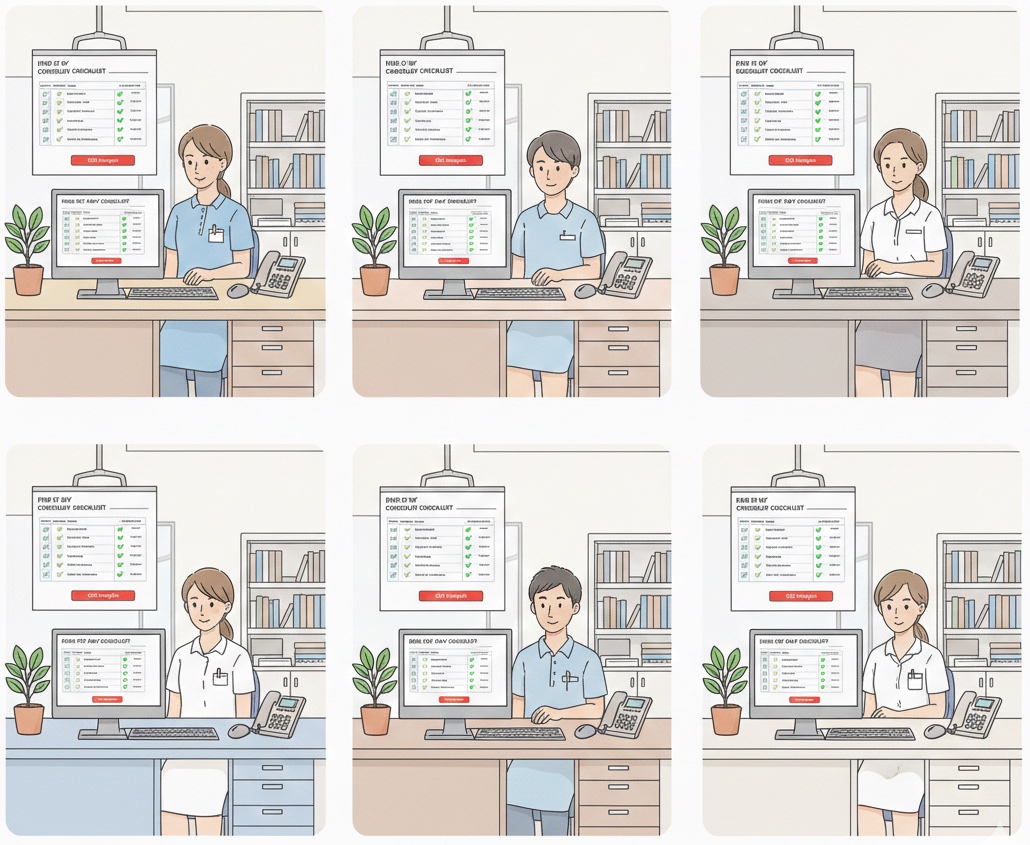
The goal is one checklist that works for all locations, with minor supplements for location-specific variations rather than entirely different checklists for each site.
Payment closeout starts with confirming all patients have been checked out and payments collected, then verifying no pending checkouts remain in the PMS. Count the cash drawer and record the count on a standard verification form, then compare the count to the PMS cash total and investigate any variance over five dollars. Settle the credit card batch, record the batch total, compare it to the PMS credit card total, and investigate any credit card variance.
Deposit preparation involves preparing cash according to cash handling policy, preparing checks for deposit, completing the deposit slip with itemization, verifying the deposit total matches the PMS total, and securing the deposit according to policy.
PMS closeout requires running the day-end process, generating the daily summary report, verifying production and collection totals, reviewing adjustment totals for reasonableness, and printing or saving all required reports.
Reconciliation means comparing the deposit total to the PMS collection total, documenting any variances with explanations, flagging unresolved variances for follow-up, and noting any unusual transactions that management should be aware of.
Reporting and handoff completes the process by submitting the daily report to corporate or regional management, filing documentation according to retention policy, noting any issues for the next day, confirming the schedule for the following day, and securing the office.
Adapting for Necessary Location Differences
While the core checklist should be universal, some adaptation is unavoidable when locations operate differently in ways that cannot be immediately changed.
PMS variations require location-specific supplements that translate the universal checklist into the specific button names, menu paths, and report names for each platform. These supplements should reference the universal checklist rather than replacing it entirely.
Banking variations may require different deposit procedures if locations use different banks, or different workflows for remote deposit capture versus physical deposits. Bank cutoff times may differ, affecting when the deposit portion of closeout must be complete.
Staffing variations affect who performs which tasks and what backup procedures apply when key staff are absent. Some locations may require supervision for certain tasks while others have more experienced staff who can work independently.
The key principle is creating location-specific supplements that reference the universal standard rather than creating entirely separate procedures for each location.
Implementing Standardization Successfully
Implementation works best in phases rather than attempting to change everything overnight.
The first phase documents current state by observing what each location actually does during EOD, interviewing staff about their procedures and why they do things certain ways, reviewing current documentation, and identifying what works well versus what creates problems. This assessment reveals common elements that already exist across locations, best practices that should be adopted universally, problem areas that standardization should address, and variations that need resolution.
The second phase designs the standard based on best practices identified in phase one. Include corporate finance leadership, regional managers, top-performing office managers, and staff who actually perform EOD in the design process. The standard should be simple enough to follow consistently, complete enough to catch issues, efficient enough to avoid burdening staff, and measurable for accountability. Draft the checklist and procedures, review with stakeholders, pilot at select locations, and refine based on feedback before rolling out universally.
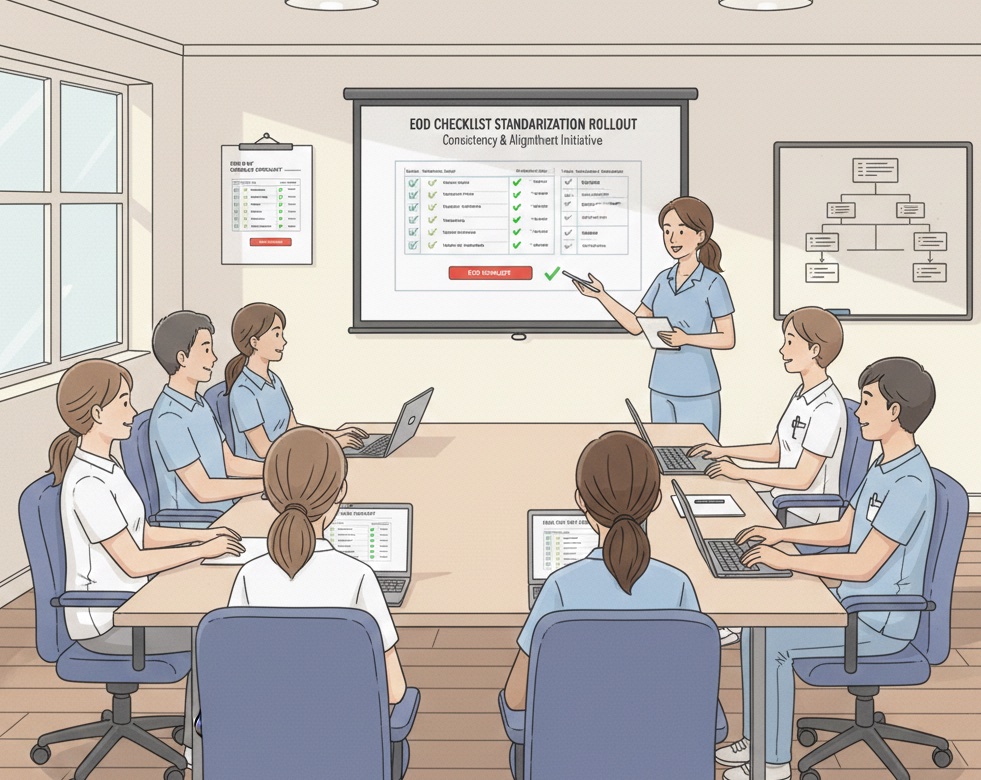
The third phase rolls out the standard across all locations. Communication should explain why standardization matters, share the new procedures clearly, set realistic implementation timelines, and identify support resources available during transition. Training should cover all staff who perform EOD, include hands-on practice with the new checklist, allow time for questions and concerns, and certify that training is complete before expecting compliance. Support during transition should include dedicated resources for questions, quick reference guides, clear escalation paths, and patience with the learning curve.
The fourth phase monitors and enforces the standard because standardization only works if it is maintained over time. Monitoring should include daily review of submitted reports, weekly compliance checks, monthly audits of documentation, and quarterly on-site verification. Enforcement should address non-compliance promptly, seek to understand reasons for deviation, provide additional training when needed, and escalate to performance management when warranted. Continuous improvement should gather feedback from locations, identify process improvements, update standards as needed, and communicate changes clearly.
Common Challenges and How to Address Them
Every multi-location standardization effort encounters predictable resistance and obstacles.
Resistance to change manifests as variations of "we have always done it this way" from locations with established routines. Address this by explaining the concrete benefits of standardization, acknowledging what the location already does well, incorporating their best practices into the universal standard where appropriate, and setting clear expectations with deadlines rather than leaving adoption optional.
Different PMS platforms mean locations cannot follow identical steps even if they achieve identical outcomes. Address this by standardizing outcomes rather than just steps, creating PMS-specific supplements, focusing on what gets submitted rather than the specific workflow, and considering PMS consolidation over time as a longer-term solution.
Staffing differences mean some locations have dedicated billing staff while others divide responsibilities differently. Address this by defining roles clearly for each staffing model, ensuring coverage regardless of how staff are organized, adjusting timing expectations if warranted by staffing constraints, and providing additional support to understaffed locations.
Varying close times complicate oversight when locations finish at different hours. Address this by setting relative deadlines such as within thirty minutes of close rather than absolute times, grouping locations by close time for monitoring purposes, adjusting corporate review schedules to accommodate variation, and considering standardized close times if operationally feasible.
Technology gaps exist when some locations lack capabilities others have. Address this by identifying minimum technology requirements for the standardized process, investing in upgrades where needed, creating manual workarounds as temporary solutions, and prioritizing technology parity across locations.
Measuring Whether Standardization Works
Compliance metrics track whether locations actually follow the standard. Measure the percentage of locations submitting reports on time, checklist completion rate, documentation completeness, and deviation frequency. Target ninety-five percent or better on-time submission, one hundred percent checklist completion, one hundred percent required documentation, and less than five percent deviation rate.
Quality metrics track whether the standard produces the intended results. Measure average variance between deposit and PMS totals, percentage of days with zero variance, time to resolve identified variances, and error rate in posted payments. Target average variance under fifty dollars, ninety percent or more days with zero variance, variances resolved within forty-eight hours, and error rate under one percent.
Efficiency metrics track whether the standard is actually workable for location staff. Measure average time to complete EOD, staff overtime related to EOD, support requests about EOD procedures, and staff satisfaction with the process. Target EOD complete in thirty minutes or less, no regular overtime for EOD tasks, declining support requests over time as familiarity increases, and positive staff feedback about the process.
Technology That Supports Standardization
Digital checklists ensure consistency by preventing steps from being skipped, creating automatic timestamps, making completion visible to management, and creating historical records. Options include built-in PMS checklists, standalone checklist apps, custom forms in practice management tools, or even simple shared documents that are better than paper.
Automated reporting reduces the manual effort required from location staff by automatically generating reports at day-end, automatically submitting to a central repository, automatically alerting management when reports are missing, and providing dashboards showing status across all locations.
Reconciliation automation verifies that the standard is actually working by automatically comparing PMS data to bank data, automatically calculating variances, automatically flagging exceptions that need attention, and maintaining automatic audit trails. Automation ensures the standard is followed consistently while reducing the burden on location staff.
The Organizational Payoff
Corporate and DSO leadership benefits from consistent, reliable data from all locations that enables meaningful comparison, early warning of issues before they become crises, reduced management overhead, and a scalable foundation for growth.
Regional managers benefit from clear expectations they can communicate and enforce, easier oversight of multiple locations, faster identification of problems, and a fair basis for performance evaluation.
Location staff benefit from clear guidance on exactly what to do, reduced ambiguity and stress, pride in following a professional process, and recognition for compliance rather than confusion about expectations.
The organization as a whole benefits from reduced revenue leakage, lower fraud risk through consistent controls, better financial accuracy, and a foundation that supports continued growth without proportional increases in management complexity.
Implementing standardized EOD procedures across your locations? Zeldent provides automated reconciliation that verifies every location's closeout against bank data, ensuring your standards are actually being met. See all locations in one dashboard, flag exceptions automatically, and know that standardization is working. Schedule a demo to see consistent oversight across your portfolio.