Why Your Dental Billing Software Needs an Audit Layer
"We trusted our billing software completely. Then we realized no one was actually verifying that the payments it posted matched what hit our bank."
Modern dental practices run on software. Your practice management system handles scheduling and charting. Your billing platform submits claims and posts payments. Your patient communication tool sends reminders and collects reviews. These tools have transformed how dental practices operate.
But here's a question most practice owners never ask: Who audits your billing software?
When Zentist posts an insurance payment, who verifies it actually deposited? When Pearly collects a patient payment, who confirms it hit your bank account? When your RCM provider says they recovered $50,000 last month, who checks that the money is actually there?
The answer, for most practices, is no one. And that's a problem.
The Billing Software Ecosystem
The dental billing software landscape has evolved rapidly. Where practices once handled everything in their PMS, they now use specialized tools for different parts of the revenue cycle.
Zentist focuses on claims submission, ERA processing, and payment posting for DSOs and larger groups. Their automation handles the complex workflow of getting claims paid and posting the results.
Pearly specializes in patient billing, A/R automation, and payment plans. They help practices collect more from patients through automated outreach and convenient payment options.
Teero, which evolved from eAssist, provides outsourced billing services including claims submission, denial management, and payment posting. They function as a virtual billing team for practices that don't want to handle billing in-house.
Dental Intel offers analytics and insights into practice performance, helping owners understand their numbers and identify improvement opportunities.
These tools are valuable. They save time, reduce errors, and often improve collection rates. But they all share a common limitation: they operate inside your revenue cycle. None of them provide independent verification that the money they report actually landed in your bank account.
The Verification Gap
Consider how your billing software works. It connects to your PMS and insurance portals. It processes claims and posts payments. It generates reports showing how much was collected. You look at those reports and assume the numbers reflect reality.
But software makes mistakes. Integrations fail. Payments get posted to wrong accounts. Insurance deposits get partially applied. Human operators, whether in-house or outsourced, introduce errors.
Without independent verification, these issues go undetected. Your billing report says you collected $80,000 last month. Your bank says $76,000 deposited. Where did $4,000 go? If no one is checking, you might never know.
This isn't about your billing software being bad. It's about the fundamental principle that any financial system needs verification. Banks reconcile their own records against external sources. Public companies have auditors. The IRS doesn't take your word for what you earned.
Your billing software handles transactions. Zeldent verifies that those transactions actually resulted in money hitting your bank account.
What Goes Wrong Without Auditing
The issues that slip through without verification fall into several categories.
Insurance payments represent the largest transaction volume for most practices. Your billing software posts ERAs as they arrive, but ERAs don't always match actual deposits. Payments get batched differently than expected. Carrier systems have errors. ACH deposits fail and retry days later. Without matching ERA postings to actual bank deposits, these discrepancies accumulate.
Patient payments have their own challenges. Credit card batches don't always match payment postings due to chargebacks, processing fees, or timing differences. Cash and check deposits depend on human processes that can break down. Patient financing through CareCredit, Sunbit, or Proceed might show as collected in your system before the funding actually arrives.
Third-party collections create additional complexity. If you use a billing service like Teero or an RCM provider, they're reporting numbers to you. But their reporting comes from inside the system they operate. It's not independently verified against your bank.
Write-offs and adjustments are particularly concerning without auditing. Your billing software might automatically post adjustments for contractual allowances, but are those adjustments correct? Is someone writing off balances that should have been collected? Without visibility into adjustment patterns, you can't know.
The Audit Layer Concept
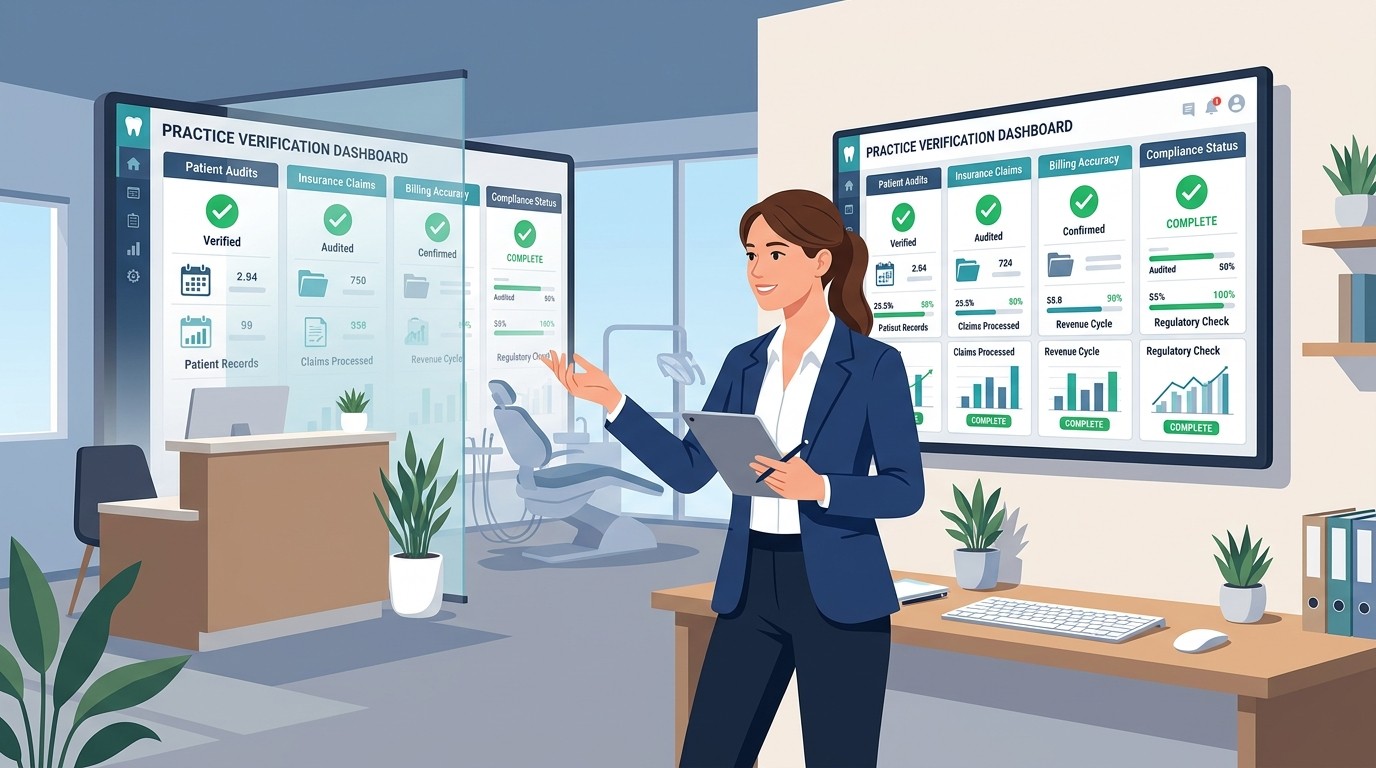
An audit layer sits outside your billing workflow and verifies its output. It doesn't replace your billing software. It doesn't compete with it. It checks its work.
Zeldent functions as this audit layer. It connects to your PMS to see what was billed, collected, and adjusted. It connects to your bank to see what actually deposited. It compares these data sources independently of your billing software to verify that the transactions your billing system reports match the reality in your bank account.
When they match, you have confirmation. When they don't, you have visibility into exactly what's off and why.
This is the same principle that drives financial controls in every well-run business. The person who handles cash shouldn't be the same person who reconciles the books. The system that posts transactions shouldn't be the only system that verifies them. Independent verification catches errors that internal controls miss.
How Auditing Works with Different Billing Tools
The audit layer integrates with whatever billing stack you're using.
If you use Zentist for claims and ERA posting, Zeldent verifies that the payments Zentist posts match your actual bank deposits. When Zentist shows an insurance payment of $4,200 from Delta Dental, Zeldent confirms that $4,200 actually hit your account. If there's a discrepancy, it surfaces immediately with details about what's off.
If you use Pearly for patient billing, Zeldent verifies that patient payments Pearly reports are actually depositing. Credit card batch totals match. ACH payments clear. Payment plan collections arrive as expected. The beautiful dashboard Pearly shows you gets validated against banking reality.
If you use an outsourced billing service like Teero, Zeldent provides independent verification of their work. You're paying them to collect money. Zeldent confirms the money is actually being collected. This isn't about distrust. It's about verification that every business relationship should have.
If you use Dental Intel for analytics, Zeldent provides the underlying data verification that makes those analytics meaningful. Insights built on unverified data can lead to wrong conclusions. Insights built on verified data drive real improvement.
The Value of Independence
Why does independence matter? Because systems designed to do work aren't designed to check that work.
Your billing software optimizes for efficiency. It wants to process claims quickly, post payments automatically, and minimize manual intervention. These are good goals, but they're different from verification.
An audit layer optimizes for accuracy. It asks whether the work that was done produced the expected results. It compares internal records to external reality. It surfaces discrepancies that the working system might never detect.
This independence is also important for trust. If your billing provider reports that they collected $100,000 for you last month, you want to believe them. An independent verification layer lets you verify rather than trust. When the numbers match, trust is confirmed. When they don't, you have visibility into the gap.
What the Audit Layer Catches
The types of issues an audit layer surfaces fall into distinct categories.
Posting errors are common and often invisible without verification. A payment posted to the wrong patient. An insurance check applied to only some of the claims it covered. A credit card refund processed incorrectly. These errors exist in any billing workflow, and without external verification, they become permanent.
Timing differences cause confusion without proper tracking. Your billing software might show a payment as collected today, but processing delays mean it won't deposit until tomorrow or next week. The audit layer tracks these timing differences so you know what to expect and can identify when expected deposits don't arrive.
Process failures get exposed quickly. If your front desk stops making deposits daily, the audit layer notices. If your billing provider has a posting backlog, it shows up. If an insurance payer changes their EFT process, you see the impact before it becomes a mystery at month-end.
Systematic underpayments become visible. When you compare expected payments to actual deposits across hundreds of transactions, patterns emerge. Maybe one carrier consistently underpays by small amounts. Maybe certain procedure codes get adjusted down more than they should. These patterns are invisible when you're operating inside the billing system but obvious when you're auditing it from outside.
Embezzlement and Fraud Prevention
The audit layer also serves as a critical embezzlement control. Billing software can be manipulated by insiders who understand how it works. Payments can be diverted before posting. Adjustments can cover theft. Reports can be altered.
An audit layer that connects directly to your bank is much harder to fool. The bank doesn't know or care about your PMS or billing software. It just records deposits. When your audit layer compares what your billing system says happened to what your bank shows actually happened, manipulation becomes visible.
This doesn't mean your staff is stealing. Most aren't. But the same controls that catch fraud also catch errors, process failures, and systematic issues. Implementing an audit layer improves your financial visibility whether or not you have an embezzlement problem.
Choosing Your Stack
The modern dental practice revenue cycle involves multiple software tools working together. The question isn't whether to use billing software. The question is whether to verify it.
Your PMS handles scheduling, charting, and treatment planning. Your billing software handles claims and payment posting. Your patient engagement tools handle communication and collections. Your analytics platform helps you understand performance. And your audit layer verifies that all of this translates into actual money in your bank account.
Zeldent fits into this stack as the verification layer. It doesn't replace any of your existing tools. It makes all of them more trustworthy by providing independent confirmation that they're working correctly.
The practices that maintain the highest collection rates and catch problems the fastest aren't the ones with the best billing software. They're the ones who verify their billing software is working as expected.
Using Zentist, Pearly, Teero, or another billing platform? Schedule a demo of Zeldent to see how the audit layer completes your revenue cycle stack.